
[论文解读] Feature Completion Transformer for Occluded Person Re-identification
本文提出特征补全Transformer(FCFormer),一种新颖的自监督框架,用于遮挡行人重识别,通过可学习的Transformer解码器隐式补全遮挡区域的缺失特征。通过引入遮挡实例增强(OIA)以生成多样化的遮挡样本对,并采用双流共享编码器架构,FCFormer训练特征补全解码器(FCD)从遮挡输入中重建整体特征,在五个基准数据集上实现最先进性能,在Market-1501-Occluded数据集上达到71.3%的R-1准确率。
Occluded person re-identification (Re-ID) is a challenging problem due to the destruction of occluders. Most existing methods focus on visible human body parts through some prior information. However, when complementary occlusions occur, features in occluded regions can interfere with matching, which affects performance severely. In this paper, different from most previous works that discard the occluded region, we propose a Feature Completion Transformer (FCFormer) to implicitly complement the semantic information of occluded parts in the feature space. Specifically, Occlusion Instance Augmentation (OIA) is proposed to simulates real and diverse occlusion situations on the holistic image. These augmented images not only enrich the amount of occlusion samples in the training set, but also form pairs with the holistic images. Subsequently, a dual-stream architecture with a shared encoder is proposed to learn paired discriminative features from pairs of inputs. Without additional semantic information, an occluded-holistic feature sample-label pair can be automatically created. Then, Feature Completion Decoder (FCD) is designed to complement the features of occluded regions by using learnable tokens to aggregate possible information from self-generated occluded features. Finally, we propose the Cross Hard Triplet (CHT) loss to further bridge the gap between complementing features and extracting features under the same ID. In addition, Feature Completion Consistency (FC$^2$) loss is introduced to help the generated completion feature distribution to be closer to the real holistic feature distribution. Extensive experiments over five challenging datasets demonstrate that the proposed FCFormer achieves superior performance and outperforms the state-of-the-art methods by significant margins on occluded datasets.
研究动机与目标
- 为解决遮挡行人重识别的挑战,即由于复杂遮挡导致可见部分通常不足的问题。
- 克服现有方法依赖姿态或分割等外部线索的局限性,这些线索在严重遮挡下易出错。
- 通过仅依赖遮挡特征本身实现自监督特征补全,减少对标注语义信息的依赖。
- 通过在训练中模拟真实且多样的遮挡场景,提升模型泛化能力和鲁棒性。
- 通过新颖的损失函数和补全机制,弥合整体特征与遮挡特征表示之间的性能差距。
提出的方法
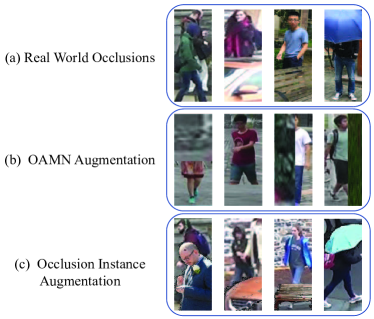
- 遮挡实例增强(OIA)通过将来自17种遮挡类型的精选图块粘贴到行人图像上,生成多样化的遮挡样本,创建出逼真的整体-遮挡图像对。
- 采用权重共享的双流编码器处理整体和遮挡图像,学习对齐的判别性特征,无需额外的语义监督。
- 特征补全解码器(FCD)利用可学习的标记,通过自注意力机制聚合未遮挡区域的上下文信息,并在遮挡区域重建特征。
- 引入交叉困难三元组(CHT)损失,以最小化正样本对与负样本对之间的边际距离,增强特征的判别能力。
- 特征补全一致性(FC²)损失确保生成的补全特征分布与真实整体特征分布一致,提升特征的真实性。
- 该框架通过成对的整体-遮挡图像端到端训练,实现在无需真实遮挡掩码或关键点标注的情况下进行自监督补全。

实验结果
研究问题
- RQ1自监督特征补全机制是否能在不依赖外部语义线索的情况下提升遮挡行人重识别的性能?
- RQ2可学习的、基于注意力的解码器在仅利用可见部分的情况下,重建遮挡区域缺失特征的效率如何?
- RQ3通过OIA引入多样化且逼真的遮挡增强是否能提升遮挡Re-ID中的泛化能力和鲁棒性?
- RQ4CHT与FC²损失的结合在多大程度上能缩小真实整体特征与补全特征之间的域差距?
- RQ5在多个遮挡Re-ID基准上,所提方法在准确率和鲁棒性方面与最先进方法相比表现如何?
主要发现
- FCFormer在Market-1501-Occluded数据集上达到71.3%的Rank-1准确率,显著优于先前最先进方法。
- 在DukeMTMC-reID-Occluded数据集上,FCFormer达到68.8%的Rank-1准确率,表明其在不同遮挡模式下具有强大的泛化能力。
- 使用ViT-B主干网络时,FCFormer在Market-1501-Occluded数据集上实现60.9%的mAP,证明了基于Transformer的编码器在遮挡场景下的有效性。
- 消融实验表明,CHT与FC²损失均对性能有显著贡献,其中FC²提升了特征分布的一致性。
- 即使没有额外的语义监督,FCFormer在Rank-1准确率上比ResNet-50基线模型高出5.0%,mAP高出1.9%。
- 可视化结果表明,FCD聚焦于遮挡物边缘和身体部位,表明其能有效关注与特征补全相关的上下文信息。
阅读本论文
在 Nubint 阅读器中打开原文,边读边就任意段落提问。
在 Nubint 中阅读本论文本解读由 AI 根据论文原文生成,引用前请核对原文。