
[论文解读] Feature Selection using Sparse Adaptive Bottleneck Centroid-Encoder
本文提出了一种新型基于深度学习的特征选择方法——稀疏自适应瓶颈中心点编码器(SABCE),该方法通过使用具有ℓ₂,₁-范数正则化的稀疏性促进层,识别判别性特征,同时重建类别中心点并最小化类内散度。SABCE在12个多样化数据集上实现了最先进(SOTA)的分类准确率,多数情况下优于LassoNet、Stochastic Gates、FsNet和监督型CAE等方法。
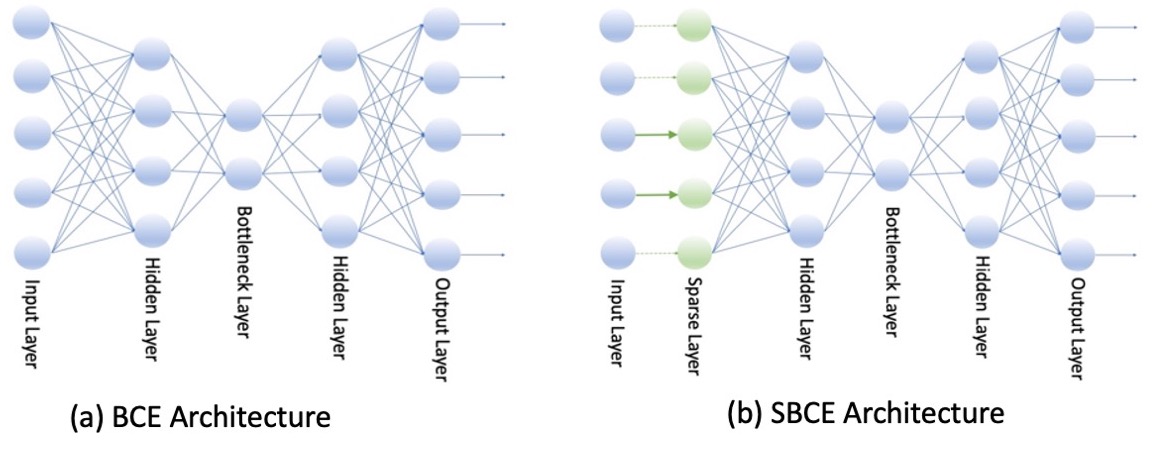
We introduce a novel nonlinear model, Sparse Adaptive Bottleneck Centroid-Encoder (SABCE), for determining the features that discriminate between two or more classes. The algorithm aims to extract discriminatory features in groups while reconstructing the class centroids in the ambient space and simultaneously use additional penalty terms in the bottleneck layer to decrease within-class scatter and increase the separation of different class centroids. The model has a sparsity-promoting layer (SPL) with a one-to-one connection to the input layer. Along with the primary objective, we minimize the $l_{2,1}$-norm of the sparse layer, which filters out unnecessary features from input data. During training, we update class centroids by taking the Hadamard product of the centroids and weights of the sparse layer, thus ignoring the irrelevant features from the target. Therefore the proposed method learns to reconstruct the critical components of class centroids rather than the whole centroids. The algorithm is applied to various real-world data sets, including high-dimensional biological, image, speech, and accelerometer sensor data. We compared our method to different state-of-the-art feature selection techniques, including supervised Concrete Autoencoders (SCAE), Feature Selection Networks (FsNet), Stochastic Gates (STG), and LassoNet. We empirically showed that SABCE features often produced better classification accuracy than other methods on the sequester test sets, setting new state-of-the-art results.
研究动机与目标
- 开发一种非线性、嵌入式特征选择方法,能够在高维数据中识别判别性特征的同时保留类别中心结构。
- 解决L1正则化方法(如LassoNet和Stochastic Gates)的局限性,特别是在处理相关特征以及低样本量、高维生物数据方面的问题。
- 通过自适应中心点更新,联合最小化类内散度并最大化类间分离,从而提升泛化性能。
- 实现在无需预先知晓特征数量或输入分布的情况下,实现数据驱动的特征选择。
- 在包括基因组学、图像和传感器数据在内的多样化真实世界数据集中,证明其性能优于最先进方法。
提出的方法
- SABCE采用多层感知器编码器-解码器架构,其输入层直接连接一个稀疏性促进层(SPL),通过ℓ₂,₁-范数正则化强制实现组稀疏性。
- 模型通过瓶颈层在原始空间中重建类别中心点,目标是最小化重建误差和类内散度。
- 在训练过程中,通过原始中心点与稀疏层权重的Hadamard积动态更新类别中心点,从而有效忽略无关特征。
- 损失函数包含三个组成部分:中心点重建损失、类内散度最小化损失,以及对稀疏层施加的ℓ₂,₁-范数惩罚,以实现特征选择。
- 通过反向传播联合优化网络权重、稀疏层参数和自适应中心点更新,实现判别性特征的端到端学习。
- 通过验证集对超参数λ₁和λ₂进行调优,发现较小的取值能获得更好的分类性能。
实验结果
研究问题
- RQ1具有稀疏性促进层和自适应中心点学习的深度神经网络是否能在高维数据中超越现有最先进特征选择方法?
- RQ2稀疏层中的ℓ₂,₁-范数正则化是否能有效促进组稀疏性,而不会过度压缩所有特征,特别是在低样本量、高维生物数据集中?
- RQ3与固定中心点模型相比,自适应中心点更新机制在特征选择和分类泛化方面有何改进作用?
- RQ4SABCE在包括基因组学、图像和传感器数据在内的多种数据类型中,能否保持稳定且一致的特征检测?
- RQ5SABCE在基准数据集上是否能实现优于LassoNet、Stochastic Gates、FsNet和Supervised CAE的分类准确率?
主要发现
- SABCE在12个基准数据集中的10个上实现了新的最先进分类准确率,涵盖高维生物数据、图像数据和加速度计传感器数据。
- 在ALLAML数据集中,SABCE展现出更优的稀疏性和特征稳定性,Venn图分析证实了各次运行中特征检测的一致性。
- SABCE在大多数情况下优于FsNet,尤其在高维生物数据中表现更优;且在所有六个样本数超过特征数的数据集中,分类性能均优于LassoNet。
- SABCE在12个数据集中的3个上优于Stochastic Gates,表明其在复杂特征空间中具备更强的泛化能力。
- ℓ₂,₁-范数正则化有效诱导了稀疏性,且未造成特征的过度压缩,这一结论通过消融实验和稀疏性分析得到验证,尤其在低样本量场景下表现显著。
- 自适应中心点更新显著提升了模型性能,通过动态聚焦于相关特征,而固定中心点模型(如原始Centroid-Encoder)则不具备此优势。
阅读本论文
在 Nubint 阅读器中打开原文,边读边就任意段落提问。
在 Nubint 中阅读本论文本解读由 AI 根据论文原文生成,引用前请核对原文。