
[论文解读] Feature Splatting: Language-Driven Physics-Based Scene Synthesis and Editing
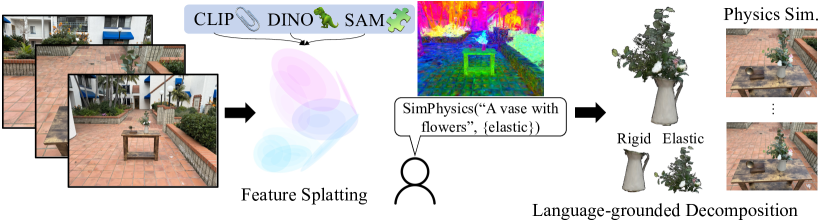
特征点云(Feature Splatting)提出了一套统一框架,通过引入语言对齐语义与基于物理的动力学,增强了3D高斯点云。通过将视觉-语言特征蒸馏至高斯点云,并集成基于粒子的物理模拟器,实现了半自动场景分解与通过自然语言提示实现的逼真物理交互,从而在提升效率的同时减少伪影,生成高保真度且可编辑的3D场景。
Scene representations using 3D Gaussian primitives have produced excellent results in modeling the appearance of static and dynamic 3D scenes. Many graphics applications, however, demand the ability to manipulate both the appearance and the physical properties of objects. We introduce Feature Splatting, an approach that unifies physics-based dynamic scene synthesis with rich semantics from vision language foundation models that are grounded by natural language. Our first contribution is a way to distill high-quality, object-centric vision-language features into 3D Gaussians, that enables semi-automatic scene decomposition using text queries. Our second contribution is a way to synthesize physics-based dynamics from an otherwise static scene using a particle-based simulator, in which material properties are assigned automatically via text queries. We ablate key techniques used in this pipeline, to illustrate the challenge and opportunities in using feature-carrying 3D Gaussians as a unified format for appearance, geometry, material properties and semantics grounded on natural language. Project website: https://feature-splatting.github.io/
研究动机与目标
- 统一3D场景表示,整合外观、几何、语义与基于物理的动力学特性于单一格式中。
- 通过将对象语义与材质属性与自然语言查询对齐,实现基于语言的场景编辑。
- 解决在基于高斯点云的表示中特征蒸馏与物理模拟所面临的挑战。
- 减少伪影并提升特征承载型3D高斯点云在动态场景生成中的效率。
提出的方法
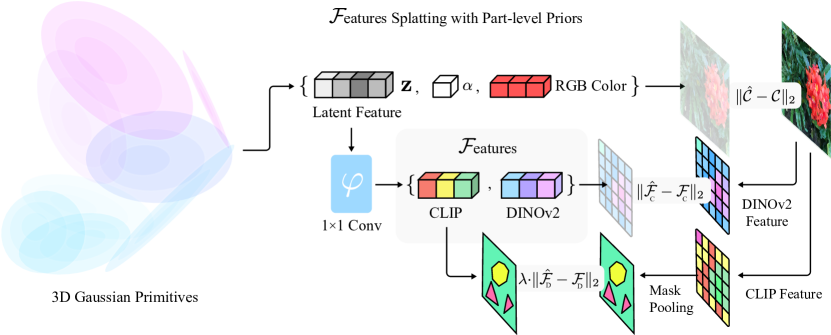
- 通过一种新颖的蒸馏管道,将来自2D基础模型(如CLIP、DINOv2、SAM)的高质量、以对象为中心的视觉-语言特征蒸馏至3D高斯点云,以减少高频噪声。
- 引入DINOv2正则化,防止对粗粒度参考特征的过拟合,提升边界对齐能力与泛化性能。
- 通过改进的MPM(物质点法)引擎,将基于粒子的物理模拟器增强至静态3D高斯点云场景,适配高斯基元。
- 通过隐式体积保持机制,填充内部支持粒子,防止在形变过程中发生塌陷,尤其在重力作用下表现更优。
- 基于形变梯度旋转高斯点云,以维持表面连续性,并在大形变下减少视觉伪影。
- 融合来自多个视觉基础模型(CLIP、DINOv2、SAM)的特征,提升开放词汇场景分解中2D定位的准确率与鲁棒性。
实验结果
研究问题
- RQ13D高斯点云能否有效结合来自视觉-语言基础模型的丰富、语言对齐的语义信息,以支持场景编辑?
- RQ2在将2D特征投影至3D高斯点云时,如何在不损失细节的前提下有效缓解高频频噪声?
- RQ3基于粒子的物理模拟器能否被有效集成至3D高斯点云表示中,以实现逼真的动态行为?
- RQ4在基于高斯点云的模拟中,如何在大形变过程中维持体积保持与结构完整性?
- RQ5融合多个视觉模型的特征在多大程度上提升了开放词汇定位与分解的准确率?
主要发现
- Feature Splatting 在颜色渲染上达到26.47的PSNR,验证视图上的CLIP特征损失为0.046,特征保真度优于基线方法。
- 引入DINOv2正则化后,对参考特征中高频噪声的过拟合现象减少,泛化能力与边界对齐性能得到提升。
- 训练时间平均缩短至一小时以内,优于Feature3DGS(最高达六小时)。
- 通过内部粒子填充实现的体积保持机制,防止了弹性物体在碰撞中发生塌陷,实现了逼真的弹跳行为。
- 基于形变梯度的高斯点云旋转方法相比先前基于梯度的旋转方法,显著减少了表面伪影。
- 在LERF数据集上,融合CLIP、DINOv2与SAM的特征可提升2D定位准确率;若任一组件被移除,性能均出现下降。
阅读本论文
在 Nubint 阅读器中打开原文,边读边就任意段落提问。
在 Nubint 中阅读本论文本解读由 AI 根据论文原文生成,引用前请核对原文。