
[论文解读] Fed and Trump -- The Dirty Game
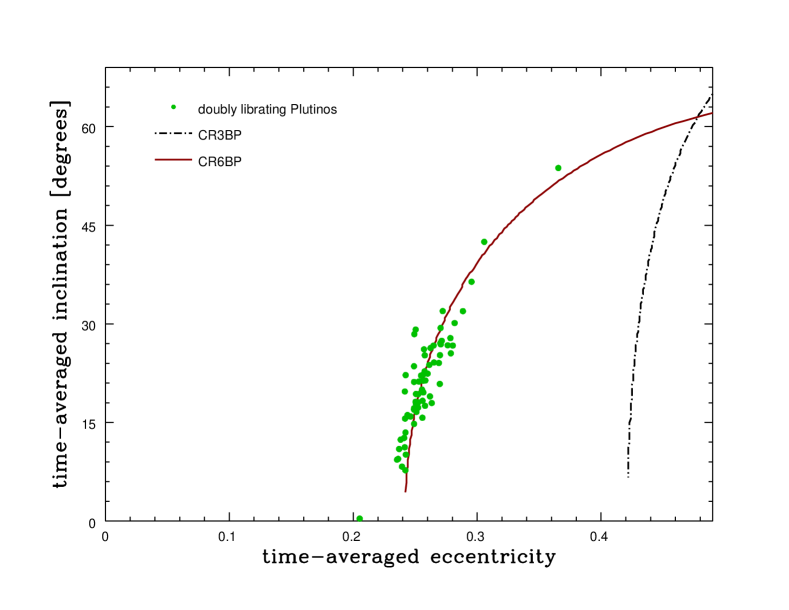
论文分析了双重锁定的Plutino,识别出在偏心率–倾角空间中 g 锁定的聚集,并将其与第三类周期轨道联系起来;估计约 16% 的 Plutino 为 g 锁定者。
Named for orbital kinship with Pluto, the Plutinos are a prominent group of Kuiper Belt objects whose orbital periods are in libration about the 3/2 ratio with Neptune's. We investigate the long term orbital dynamics of known Plutinos, with attention to the additional libration (or lack thereof) of their argument of perihelion, $g$, a well-known characteristic of Pluto's orbit. We show that the $g$ librators amongst the Plutinos cluster around an arc in the eccentricity--inclination parameter plane. This previously unreported dynamical structure is owed to a family of periodic orbits of the third kind in the restricted problem of three bodies, identified by Poincaré at the end of the 19th century. Approximately sixteen percent of the currently known Plutinos exhibit $g$ librations, a far greater fraction than the ratios of the associated libration frequencies. These results may offer new constraints for theoretical models of the dynamical history of the Plutinos and of the orbital migration history of the giant planets.
研究动机与目标
- 评估已知 Plutino 的长期动力学,重点关注 g 锁定。
- 识别哪些 Plutino 表现出持久的 g 锁定并描述它们的分布。
- 将 g 锁定聚集与经典三体问题中第三类周期轨道家族联系起来。
- 提供关于 Plutino 中 g 锁定分数的更新估计,并讨论对海王星-行星迁移模型的影响。
提出的方法
- 从 Volk & Van Laerhoven (2024) 汇总 Plutino 列表并从 JPL Horizons 获取轨道数据。
- 使用 SWIFT_RMVS3 将轨道传播 1 亿年,将 Plutino 视为测试粒子。
- 通过在 100 Myr 内 max(sigma) - min(sigma) < 358 度的标准筛选长期稳定的 Plutino。
- 搜索 g 锁定中心(0°, 90°, 180°, 270°),且 g 的变动范围小于 179°。
- 计算时间平均偏心率和倾角;分析时间平均 e–i 平面中的聚集。
- 计算 Plutino 的轨道平均扰动函数极小值,并与 CR6BP 与 CR3BP 中第三类周期轨道进行比较,以解释观察到的结构。

实验结果
研究问题
- RQ1在海王星外部的 3:2 共振中,有多少比例的 Plutino 展示持久的 g 锁定(g 锁定者)?
- RQ2g 锁定者在时间平均的偏心率–倾角平面中的分布如何,哪些动力学结构解释了这一分布?
- RQ3观察到的 g 锁定位与化简三体问题中第三类周期轨道家族有何关系?
- RQ4在比较 CR3BP 与 CR6BP 模型时,内部巨行星对 g 锁定轨迹的影响是什么?
主要发现
- 在 441 个长期稳定的 Plutino 中,69 个显示出 g 锁定,约占 16%。
- g 锁定者在时间平均的偏心率–倾角平面上沿着大致双曲弧线聚集。
- 轨道平均扰动函数的局部极小值与 g = ±90° 极小值对齐,与第三类周期轨道家族一致;与纯 CR3BP 情况相比,内侧巨行星将该轨迹移向较低的偏心率。
- 在 0° 或 180° 的 g 锁定中心上未观察到聚集;g 锁定者在 90° 与 270° 两个中心之间大致均分。
- 一个特殊对象 (2015 VR164) 位于主聚簇之外,具有非常低的 e 与 i,可能是由运动学效应而非共振动力学造成。
- 观测到的 g 锁定分数超出简单相空间体积估计,表明存在由于动力学稳定性和在行星迁移过程中的捕获历史导致的过密现象。
阅读本论文
在 Nubint 阅读器中打开原文,边读边就任意段落提问。
在 Nubint 中阅读本论文本解读由 AI 根据论文原文生成,引用前请核对原文。