
[论文解读] Federated Learning and Blockchain-enabled Fog-IoT Platform for Wearables in Predictive Healthcare
该论文提出一个雾-IoT 平台,结合联邦学习和私有区块链来在可穿戴物联网预测医疗中保护数据隐私、完整性和适应性;在 Raspberry Pi 测试平台上使用 1D CNN 通过 HAR 数据集验证其可行性。
Over the years, the popularity and usage of wearable Internet of Things (IoT) devices in several healthcare services are increased. Among the services that benefit from the usage of such devices is predictive analysis, which can improve early diagnosis in e-health. However, due to the limitations of wearable IoT devices, challenges in data privacy, service integrity, and network structure adaptability arose. To address these concerns, we propose a platform using federated learning and private blockchain technology within a fog-IoT network. These technologies have privacy-preserving features securing data within the network. We utilized the fog-IoT network's distributive structure to create an adaptive network for wearable IoT devices. We designed a testbed to examine the proposed platform's ability to preserve the integrity of a classifier. According to experimental results, the introduced implementation can effectively preserve a patient's privacy and a predictive service's integrity. We further investigated the contributions of other technologies to the security and adaptability of the IoT network. Overall, we proved the feasibility of our platform in addressing significant security and privacy challenges of wearable IoT devices in predictive healthcare through analysis, simulation, and experimentation.
研究动机与目标
- 解决可穿戴 IoT 在预测性医疗中的数据隐私与服务完整性挑战。
- 开发一个可扩展、可自适应的雾-IoT 架构,利用联邦学习与私有区块链。
- 评估低成本测试平台,以评估分布式健康分析中的模型准确性与安全性影响。
提出的方法
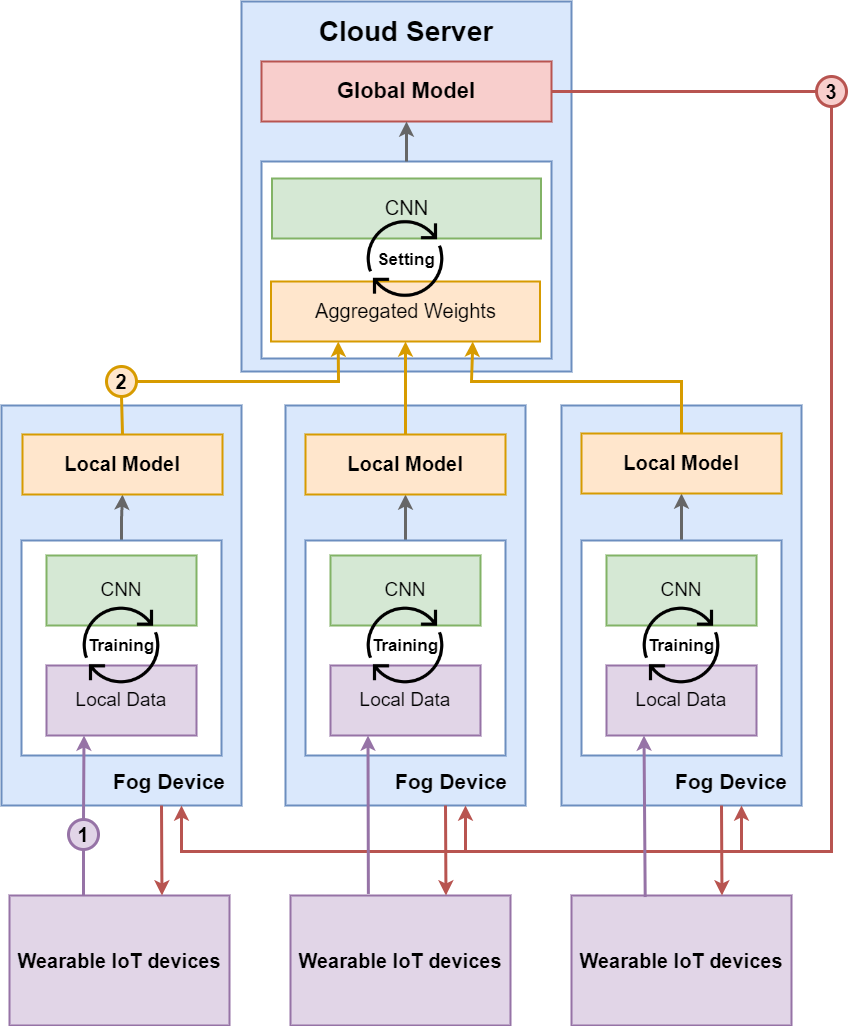
- 利用雾-IoT 架构将训练迁移到雾设备,而可穿戴设备作为客户端。
- 实现联邦学习,将本地训练的 CNN 模型汇聚为全局 HAR 模型。
- 将私有区块链(在防篡改的 Hyperledger 中)用于管理训练数据与模型版本控制。
- 使用在 HAR 数据上训练的一维卷积神经网络(1D CNN)来模拟预测性医疗监测。
- 部署基于 Raspberry Pi 的测试平台,包含 10 个雾节点,以模拟分布式学习与评估。
- 将全局模型准确性与本地模型平均准确性进行比较,以评估 FL 的有效性。

实验结果
研究问题
- RQ1在可穿戴 IoT 场景中,具有边到雾训练的联邦学习是否能够在保持预测模型完整性的同时保护患者数据隐私?
- RQ2将私有区块链整合是否提升雾-IoT 医疗平台中本地训练模型与全局聚合的安全性与可追溯性?
- RQ3所提出的扩展方案对全局模型性能相对于对本地模型取平均的影响如何?
主要发现
- 本地模型在 HAR 数据上达到 90.43% 的测试准确率。
- 全局模型的准确率在 91.75% 达到峰值,随着客户端数量增加,超过平均本地模型准确率。
- 扩展方案赋予最佳本地模型最高权重,提升全局模型性能。
- 联邦学习设置在减少原始数据暴露给中央服务器的同时,保持分类器的完整性。
- 私有区块链为训练模型与联邦更新提供防篡改的日志记录与访问控制。
阅读本论文
在 Nubint 阅读器中打开原文,边读边就任意段落提问。
在 Nubint 中阅读本论文本解读由 AI 根据论文原文生成,引用前请核对原文。