
[论文解读] Federated Learning for 6G: Paradigms, Taxonomy, Recent Advances and Insights
一个关于联邦学习如何在6G协议栈中集成的全面综述,详细讨论PHY、MAC、网络、传输和应用层的范式、分类、算法和应用。
Artificial Intelligence (AI) is expected to play an instrumental role in the next generation of wireless systems, such as sixth-generation (6G) mobile network. However, massive data, energy consumption, training complexity, and sensitive data protection in wireless systems are all crucial challenges that must be addressed for training AI models and gathering intelligence and knowledge from distributed devices. Federated Learning (FL) is a recent framework that has emerged as a promising approach for multiple learning agents to build an accurate and robust machine learning models without sharing raw data. By allowing mobile handsets and devices to collaboratively learn a global model without explicit sharing of training data, FL exhibits high privacy and efficient spectrum utilization. While there are a lot of survey papers exploring FL paradigms and usability in 6G privacy, none of them has clearly addressed how FL can be used to improve the protocol stack and wireless operations. The main goal of this survey is to provide a comprehensive overview on FL usability to enhance mobile services and enable smart ecosystems to support novel use-cases. This paper examines the added-value of implementing FL throughout all levels of the protocol stack. Furthermore, it presents important FL applications, addresses hot topics, provides valuable insights and explicits guidance for future research and developments. Our concluding remarks aim to leverage the synergy between FL and future 6G, while highlighting FL's potential to revolutionize wireless industry and sustain the development of cutting-edge mobile services.
研究动机与目标
- 解释AI原生6G的动力以及FL在实现无线系统隐私保护分布式学习中的作用。
- 提供与6G相关的FL范式(水平、垂直、联邦迁移)及相关架构的分类。
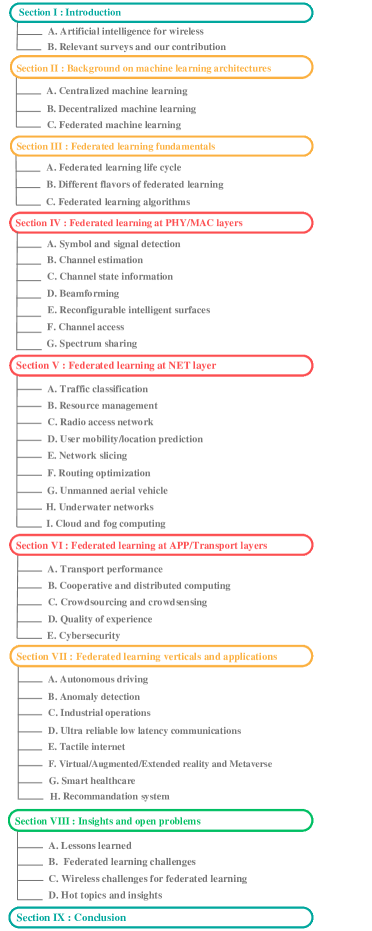
- 评估在物理层、MAC、NET、传输和应用层中的FL应用与技术。
- 指出挑战、见解与未解决的问题,以指导未来在6G及更高阶段对FL的整合。
提出的方法
- 对FL基础知识进行调查与综合,包括生命周期、风格和算法。
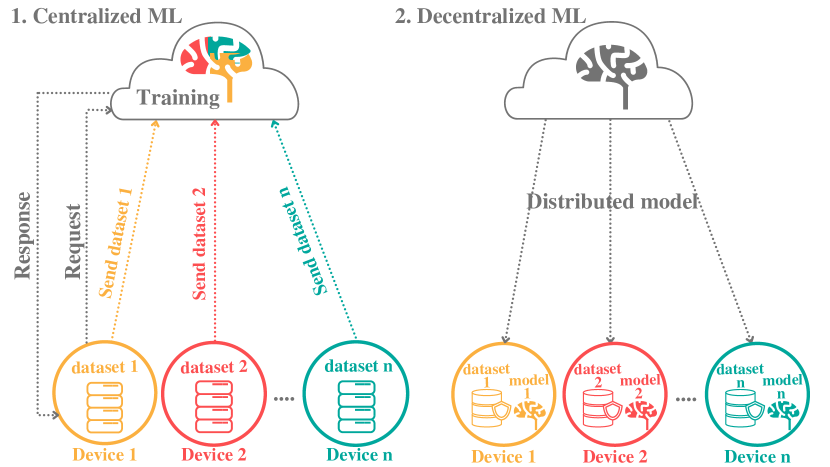
- 在隐私、可扩展性和异构性背景下比较集中式ML、分布式ML和FL。
- 分析在PHY、MAC、NET和APP层中的FL应用,给出具有代表性的架构与框架。
- 汇编现有FL算法(FedAvg、FedSGD、FedProx、FedATT、SimFL)及其优点/缺点。
实验结果
研究问题
- RQ1哪些FL范式与分类最适合6G无线生态系统的需求?
- RQ2如何在PHY、MAC、NET、传输和应用层部署FL以提升性能并保护隐私?
- RQ3在将FL应用于6G无线网络时,主要挑战与未解决的问题是什么?哪些见解可指导未来工作?
- RQ4哪些FL算法和框架最适合不同的无线场景和数据分布(IID与非IID)?
主要发现
- 相比集中式和纯去中心化ML,FL在无线网络中提供隐私保护、可扩展性和通信效率。
- FL可以在协议栈中全面整合,解决从PHY到APP层的挑战,并在效率与鲁棒性方面带来显著收益。
- 多种FL风格(水平、垂直、 federated transfer)覆盖6G情境中的多样数据分布场景。
- 存在多种FL算法,在收敛速度、数据异质性处理和通信开销方面各有权衡。
- 现有用于FL的ML框架(TFF、PySyft、LEAF、PaddleFL、FATE、IBM FL、FedML)支持实际开发与试验。
- 在数据非IID性、同步、通信开销和设备能力异质性方面仍存在挑战,需要算法和架构层面的解决方案。
阅读本论文
在 Nubint 阅读器中打开原文,边读边就任意段落提问。
在 Nubint 中阅读本论文本解读由 AI 根据论文原文生成,引用前请核对原文。