
[论文解读] FedLoGe: Joint Local and Generic Federated Learning under Long-tailed Data
FedLoGe 提出了一种统一的联邦学习框架,在长尾数据分布下通过利用稀疏等角紧框架分类器(SSE-C)进行表征学习,并通过全局与局部自适应特征重对齐(GLA-FR)实现自适应特征重对齐,联合优化全局模型与个性化模型。该方法在 CIFAR-10/100-LT、ImageNet 和 iNaturalist 上实现了最先进性能,通过受神经坍缩启发的设计,同时提升了全局模型准确率与客户端特定的个性化性能。
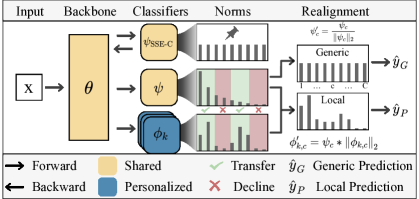
Federated Long-Tailed Learning (Fed-LT), a paradigm wherein data collected from decentralized local clients manifests a globally prevalent long-tailed distribution, has garnered considerable attention in recent times. In the context of Fed-LT, existing works have predominantly centered on addressing the data imbalance issue to enhance the efficacy of the generic global model while neglecting the performance at the local level. In contrast, conventional Personalized Federated Learning (pFL) techniques are primarily devised to optimize personalized local models under the presumption of a balanced global data distribution. This paper introduces an approach termed Federated Local and Generic Model Training in Fed-LT (FedLoGe), which enhances both local and generic model performance through the integration of representation learning and classifier alignment within a neural collapse framework. Our investigation reveals the feasibility of employing a shared backbone as a foundational framework for capturing overarching global trends, while concurrently employing individualized classifiers to encapsulate distinct refinements stemming from each client's local features. Building upon this discovery, we establish the Static Sparse Equiangular Tight Frame Classifier (SSE-C), inspired by neural collapse principles that naturally prune extraneous noisy features and foster the acquisition of potent data representations. Furthermore, leveraging insights from imbalance neural collapse's classifier norm patterns, we develop Global and Local Adaptive Feature Realignment (GLA-FR) via an auxiliary global classifier and personalized Euclidean norm transfer to align global features with client preferences. Extensive experimental results on CIFAR-10/100-LT, ImageNet, and iNaturalist demonstrate the advantage of our method over state-of-the-art pFL and Fed-LT approaches.
研究动机与目标
- 为解决现有方法在长尾数据下的联邦学习中仅优化全局模型或假设数据平衡,而忽略个性化客户端性能的问题。
- 在长尾且异构客户端数据的联邦学习中,联合提升全局模型与个性化模型的性能。
- 设计一种表征学习机制,利用稀疏、等角紧框架分类器,剪枝噪声特征并增强主导特征。
- 通过基于范数的重对齐实现快速、自适应的全局与局部特征对齐,同时保留客户端特定偏好。
- 在真实长尾设置下,于包括 CIFAR-100-LT、ImageNet 和 iNaturalist 在内的多样化基准上验证该框架。
提出的方法
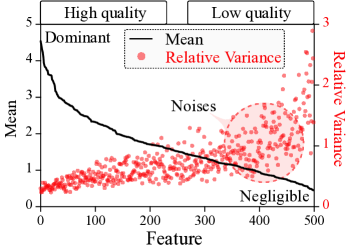
- 引入静态稀疏等角紧框架分类器(SSE-C),一种稀疏、结构化的分类器,通过强制实现等角性与稀疏性,抑制噪声特征并增强表征学习。
- 采用共享主干网络进行全局表征学习,同时允许客户端特定的分类器根据本地数据分布自适应调整。
- 应用神经坍缩原理,强制类均值与特征原型收敛,提升泛化能力与训练稳定性。
- 设计基于辅助全局分类器与个性化欧氏距离范数迁移的全局与局部自适应特征重对齐(GLA-FR),实现与客户端偏好的特征对齐。
- 使用带可学习缩放因子 γ 的范数相等损失,控制分类器向量的范数,稳定训练并提升收敛性。
- 基于特征幅值对分类器权重实施稀疏剪枝,选择性地移除低影响、高方差的特征,提升模型鲁棒性。
实验结果
研究问题
- RQ1在长尾数据下的联邦学习中,共享主干搭配稀疏、结构化分类器是否能提升表征学习?
- RQ2当数据既为长尾又异构时,如何在联邦学习中联合优化全局与个性化模型性能?
- RQ3在数据不平衡的联邦学习环境中,分类器的稀疏性与等角性在多大程度上可减少噪声并提升特征质量?
- RQ4通过范数迁移实现的自适应特征重对齐,是否能有效对齐全局特征与客户端特定偏好,同时不损害全局性能?
- RQ5SSE-C 与 GLA-FR 的集成是否能在多样化长尾基准上带来一致的性能提升?
主要发现
- FedLoGe 在 CIFAR-100-LT 上实现了最先进性能,在所有类别组中均优于所有基线模型,无论在全局模型还是个性化模型准确率方面。
- 在 ImageNet-LT 和 iNaturalist-160k 上,FedLoGe 实现了显著的准确率提升,尤其在中等与尾部类别中表现突出,展现出对长尾分布的强鲁棒性。
- 消融实验表明,与密集 ETF 相比,SSE-C 显著提升了全局与个性化模型性能,且在与 GLA-FR 结合时达到最优性能。
- 剪枝 SSE-C 中的微弱特征(低均值幅值)对性能影响极小,而剪枝主导特征则导致性能急剧下降,证实了特征优先级分配的有效性。
- 敏感性分析显示,CIFAR-10/100-LT 的最佳 γ 值为 1.0,而 ImageNet 与 iNaturalist 的最佳值为 1.6,且 SSE-C 的性能在约 60% 稀疏度时达到峰值。
- 即使在高达 90% 的稀疏度下,模型仍保持强劲性能,表明稀疏性增强了鲁棒性而非损害其性能。
阅读本论文
在 Nubint 阅读器中打开原文,边读边就任意段落提问。
在 Nubint 中阅读本论文本解读由 AI 根据论文原文生成,引用前请核对原文。