
[论文解读] FedSpeed: Larger Local Interval, Less Communication Round, and Higher Generalization Accuracy
FedSpeed 引入一个 prox-corrected prox-term 和梯度扰动,以降低联邦学习中的局部偏差和过拟合,从而实现更大的本地区间和更快的收敛,并提升泛化。
Federated learning is an emerging distributed machine learning framework which jointly trains a global model via a large number of local devices with data privacy protections. Its performance suffers from the non-vanishing biases introduced by the local inconsistent optimal and the rugged client-drifts by the local over-fitting. In this paper, we propose a novel and practical method, FedSpeed, to alleviate the negative impacts posed by these problems. Concretely, FedSpeed applies the prox-correction term on the current local updates to efficiently reduce the biases introduced by the prox-term, a necessary regularizer to maintain the strong local consistency. Furthermore, FedSpeed merges the vanilla stochastic gradient with a perturbation computed from an extra gradient ascent step in the neighborhood, thereby alleviating the issue of local over-fitting. Our theoretical analysis indicates that the convergence rate is related to both the communication rounds $T$ and local intervals $K$ with a upper bound $\small \mathcal{O}(1/T)$ if setting a proper local interval. Moreover, we conduct extensive experiments on the real-world dataset to demonstrate the efficiency of our proposed FedSpeed, which performs significantly faster and achieves the state-of-the-art (SOTA) performance on the general FL experimental settings than several baselines. Our code is available at \url{https://github.com/woodenchild95/FL-Simulator.git}.
研究动机与目标
- 解决联邦学习中由异构数据引起的局部不一致性和客户端漂移。
- 提出包含 prox-correction 与梯度扰动的 FedSpeed,以降低局部偏差和过拟合。
- 在非凸平滑设置且本地区间较大时,建立收敛性保证,给出 O(1/T) 速率。
- 在 CIFAR-10/100 和 TinyImagenet 上,在 IID 和非 IID 分布下展示经验上的 SOTA 性能。
提出的方法
- 在局部更新期间应用 prox-correction 项,以抵消来自 prox-term 的偏差。
- 将原始随机梯度与来自额外梯度上升步的扰动合并,以减轻局部过拟合。
- 使用三阶段局部更新:计算梯度,执行一个上升步,计算第二个梯度,合并成准梯度以进行下降。
- 更新由 prox 驱动的修正变量 hat{g}^t 以捕捉局部偏移动量并降低轮次间的偏差。
- 在每轮 K 次局部更新后,通过对修正后的本地模型进行平均来执行全局聚合。
- 给出收敛性分析,在合适的本地区间 K、扰动和学习率的选择下,显示 O(1/T) 速率。
实验结果
研究问题
- RQ1 prox-correction 与梯度扰动在 FL 中如何影响局部不一致性和客户端漂移?
- RQ2与现有基线相比,FedSpeed 能否在更大本地区间下实现更快的收敛和更好的泛化?
- RQ3在具有异质数据的非凸平滑目标下,FedSpeed 的理论收敛性保证是什么?
- RQ4FedSpeed 在标准数据集上的 IID 与非 IID 设置以及不同参与度下的经验表现如何?
主要发现
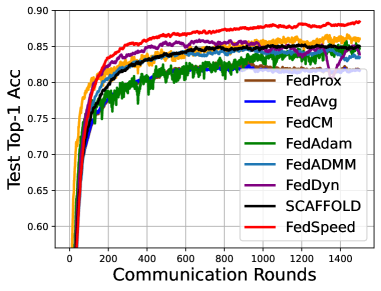
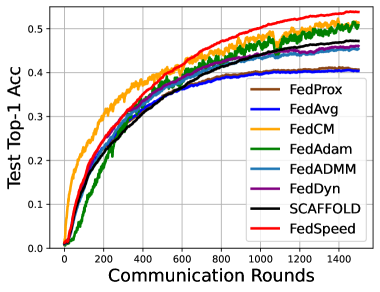
- 在实验中,FedSpeed 相较于 FedAvg、FedProx、FedCM、FedPD、SCAFFOLD、FedDyn 和 FedADMM 实现更快的收敛和更优的泛化。
- 在更大的本地区间下,FedSpeed 保持稳定性并提升 CIFAR-10/100 与 TinyImagenet 的测试准确率。
- 在 2% 参与率、500 个客户端的设置下,FedSpeed 在 CIFAR-10/100 和 TinyImagenet 的 IID 与 Dirichlet(0.6) 非 IID 设置中达到最高测试准确率(相对增益对比强基线高达约 3 个百分点)。
- 理论结果表明,当本地区间 K 适当较大且学习率调优时,收敛速度为 O(1/T)。
阅读本论文
在 Nubint 阅读器中打开原文,边读边就任意段落提问。
在 Nubint 中阅读本论文本解读由 AI 根据论文原文生成,引用前请核对原文。