
[论文解读] Feedback-Free Starbursts at Cosmic Dawn: Observable Predictions for JWST
该论文在标准宇宙学框架内扩展了无反馈的星burst(FFB)分析模型,以预测 JWST 针对高红移星系的可观测属性,包括提高的恒星形成效率、恒星质量与 UV 光度函数,以及爆发性星形成 histories。
We extend the analysis of a physical model within the standard cosmology that robustly predicts a high star-formation efficiency (SFE) in massive galaxies at cosmic dawn due to feedback-free starbursts (FFBs). It implies an excess of bright galaxies at z>~10 compared to the standard models based on the low SFE at later epochs, an excess indicated by JWST observations. Here we provide observable predictions based on the analytic FFB scenario. These can be compared with simulations and JWST observations. We approximate the SFE as a function of redshift and mass, assuming a maximum SFE of 0.2~1 in the FFB regime. From this, we derive the evolution of the galaxy mass and luminosity functions as well as the evolution of stellar and star-formation densities. We then predict the star-formation history (SFH), galaxy sizes, outflows, gas fractions, metallicities, and dust attenuation, all as functions of mass and redshift in the FFB regime. The major distinguishing feature is the occurrence of FFBs above a mass threshold that declines with redshift. The luminosities and star formation rates in bright galaxies are predicted to be in excess of extrapolations of standard empirical models and cosmological simulations, an excess that grows from z~9 to higher redshifts. The FFB phase of ~100 Myr is predicted to show a characteristic SFH that fluctuates on a timescale of ~10 Myr. The stellar systems are compact (Re~0.3 kpc at z~10 and declining with z). The galactic gas consists of a steady wind driven by supernovae from earlier generations, with high outflow velocities (FWHM~1400-6700km/s), low gas fractions (<0.1), low metallicities (<~0.1 solar), and low dust attenuation ($A_{UV}$~0.5 at z~10 and declining with z). We make tentative comparisons with current JWST observations for initial insights, anticipating more complete and reliable datasets for detailed quantitative comparisons in the future.
研究动机与目标
- 由于无反馈星爆(FFB),在宇宙黎明时的大质量星系中预计会有高星形成效率的动机。
- 在 FFB 框架内推导与 redshift 与晗质量相关的解析 SFE。
- 在 FFB 体系下预测可观测的星系性质(质量与光度函数、密度、尺寸、气体分数、金属丰度、尘埃)。
- 将 FFB 预测与外推至高 redshift 的 UM 模型和标准 SAM 进行比较,并讨论初步的 JWST 印象。
- 提供数字表和代码以便社区复现 FFB 预测。
提出的方法
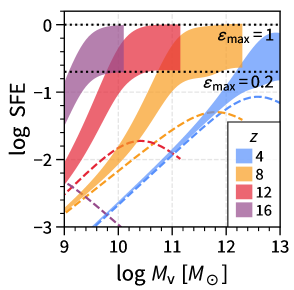
- 用跨越从低 UM 类值到 FFB 策略中最大 SFE epsilon_max 的 SFE 表示 FFB 情景(epsilon_max 在 0.2–1 区间内)。
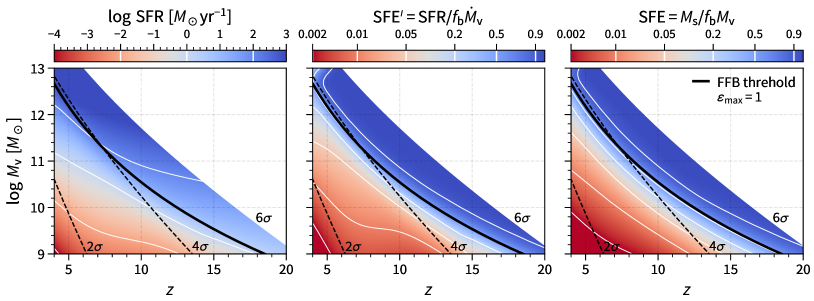
- 将 SFR 模型为 <SFR_ffb> = epsilon_max f_b dot{M}_v,在 FFB 门槛 M_v,ffb(z) 之上并通过 sigmoid 函数实现跨阈值的平滑过渡。
- 通过将 SFR_um+ffb 与 SFR_um 的时间积分差值加到 UM 基线之上,得到中位恒星质量 M_s(M_v,z)(式 7)。
- 通过将条件的 M_s|M_v 与晗质量函数 n(M_v) 做卷积,得到恒星质量函数 Phi(log M_s)(式 10)。
- 通过在固定 M_v 下对 M_UV 服从高斯分布并与中位关系到 M_s 的关系推导 UV 光度函数 Phi(M_UV)(式 11、式 12)。
- 从预测的质量与光度函数中估计宇宙密度 rho_s(z)、rho_UV(z) 与 rho_SFR(z)(式 13–15)。
实验结果
研究问题
- RQ1哪些 redshift 与晗质量区间使得 FFB 主导星形成?
- RQ2FFB 如何在 z ≳ 6–15 相较于标准模型改变恒星质量函数和 UV 光度函数?
- RQ3在 FFB 范畴中预测的宇宙密度(恒星、UV、SFR)及其演化?
- RQ4FFB 星系的特征性星形成历史和可观测爆发信号?
- RQ5FFB 预测如何与 UniverseMachine/投射 UM 外推以及 JWST 数据比较?
主要发现
- FFB 建立了一个晗质量与 redshift 的阈值线 M_v,ffb(z);超过该阈值的星系进入 FFB 作用区,epsilon_max 最大可达 1(探讨区间为 0.2–1)。
- FFB 在 z ≥ 6 时预测比标准 UM/SAM 模型更明亮的 UV 光度函数和更高的恒星质量,且超额在更高 redshift 增大。
- 对于 epsilon_max = 0.2–1,恒星质量函数在 z ∼ 10 及以后显示出更多的高质量星系(M_s ≳ 10^9–10^10 M_sun)。
- FFB 情景下的 UVLF 相对于 UM/SAM 有显著提升,特别是在 z ∼ 9–12,即使在尘埃校正后也如此,且在 z ∼ 12 的 epsilon_max ∼ 0.2–0.5 时可能与早期 JWST 数据对齐。
- FFB 阶段持续约 ~100 Myr,具有 ~10 Myr 波动的爆发性 SFH;在 z ∼ 10 时星系尺度紧凑(R_e ≈ 0.3 kpc), Winds:FWHM ≈ 1400–6700 km/s,气体分数 < 0.1,金属丰度 ≤ 0.1 Z_sun,UV 衰减 A_UV ≈ 0.5 在 z ∼ 10,随 redshift 降低。
- 与 JWST 数据的保守性比较表明,epsilon_max ∼ 0.2–0.5 的粗略一致性,尽管结果仍属初步且依赖于完整数据。
- 作者提供用于复现预测的数字表和代码。
阅读本论文
在 Nubint 阅读器中打开原文,边读边就任意段落提问。
在 Nubint 中阅读本论文本解读由 AI 根据论文原文生成,引用前请核对原文。