
[论文解读] Fermionic quantum criticality through the lens of topological holography
本文提出了一种拓扑全息框架,用于研究 (1+1)d 系统中的费米子量子临界点和无能隙相,利用高一维的对称性拓扑场理论(SymTFT)来编码费米子全局对称性和自旋结构。通过费米子化 SymTFT 边界并分类在 $Χ_2^F$、$Χ_2\timesΧ_2^F$、$Χ_4^F$ 和非可逆 $\text{Rep}(S_3)$ 对称性下的无能隙相和相变,识别出多种奇异的量子临界行为,包括费米子对称性增强的无能隙 SPT/SSB 相。
We utilize the topological holographic framework to characterize and gain insights into the nature of quantum critical points and gapless phases in fermionic quantum systems. Topological holography is a general framework that describes the generalized global symmetry and the symmetry charges of a local quantum system in terms of a slab of a topological order, termed as the symmetry topological field theory (SymTFT), in one higher dimension. In this work, we consider a generalization of the topological holographic picture for $(1+1)d$ fermionic quantum phases of matter. We discuss how spin structures are encoded in the SymTFT and establish the connection between the formal fermionization formula in quantum field theory and the choice of fermionic gapped boundary conditions of the SymTFT. We demonstrate the identification and the characterization of the fermionic gapped phases and phase transitions through detailed analysis of various examples, including the fermionic systems with $\mathbb{Z}_{2}^{F}$, $\mathbb{Z}_{2} imes \mathbb{Z}_{2}^{F}$, $\mathbb{Z}_{4}^{F}$, and the fermionic version of the non-invertible $ ext{Rep}(S_{3})$ symmetry. Our work uncovers many exotic fermionic quantum critical points and gapless phases, including two kinds of fermionic symmetry enriched quantum critical points, a fermionic gapless symmetry protected topological (SPT) phase, and a fermionic gapless spontaneous symmetry breaking (SSB) phase that breaks the fermionic non-invertible symmetry.
研究动机与目标
- 将拓扑全息框架扩展至费米子量子系统,特别是在 (1+1)d 中,以描述广义全局对称性及其异常。
- 建立 SymTFT 费米子无能隙边界条件与量子场论中费米子化程序之间的精确对应关系。
- 在多种费米子全局对称性(包括 $Χ_2^F$、$Χ_2\timesΧ_2^F$、$Χ_4^F$ 和非可逆 $\text{Rep}(S_3)$)下,对费米子无能隙相和量子临界点进行分类与表征。
- 通过具体例子识别并分析新型费米子量子临界点,包括对称性增强、无能隙 SPT 和无能隙 SSB 相。
- 展示自旋结构和费米子统计如何从拓扑体相(SymTFT)中涌现,并通过边界条件和任意子凝聚模式编码。
提出的方法
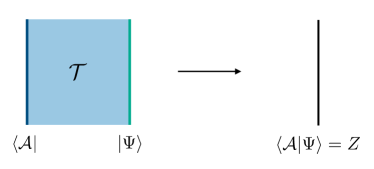
- 采用拓扑全息的“夹心”构造,其中 (1+1)d 费米子系统被实现为具有特定任意子体相和无能隙边界条件的 (2+1)d SymTFT 的边界。
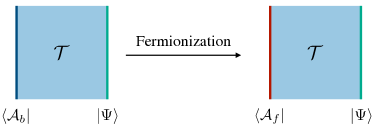
- 在 SymTFT 中利用超拉格朗日代数结构实现费米子化,将费米子边界条件的选择与边界理论的自旋结构和统计性质联系起来。
- 在量子场论中应用形式费米子化公式,通过边界处的任意子凝聚,将具有 $Χ_2$ 对称性的玻色子 SymTFT 映射为费米子版本。
- 通过分类 SymTFT 体相中可能的任意子凝聚来分析无能隙相和相变,特别关注 $e$、$m$、$f$ 及其组合的凝聚。
- 利用环面码中不同自旋结构(A/P)与任意子基底划分函数之间的对应关系,推导出费米子最小模型的划分函数。
- 应用超拉格朗日代数概念,对费米子无能隙边界进行分类,并识别边界 CFT 中费米子对称荷和统计性质的涌现。
实验结果
研究问题
- RQ1如何将拓扑全息框架推广以描述 (1+1)d 量子系统中费米子全局对称性及其异常?
- RQ2自旋结构在 SymTFT 构造中扮演何种精确角色?它们如何通过边界条件和任意子凝聚模式编码?
- RQ3在具有非可逆或高阶对称性(如 $Χ_4^F$ 或 $\text{Rep}(S_3)$)的费米子系统中,会涌现出何种类型的奇异量子临界点?
- RQ4SymTFT 体相中的费米子化与任意子凝聚如何导致边界理论中无能隙 SPT 和 SSB 相的涌现?
- RQ5如何利用 SymTFT 框架对具有 $Χ_2^F$、$Χ_2\timesΧ_2^F$、$Χ_4^F$ 和 $\text{Rep}(S_3)$ 对称性的费米子链中的无能隙相和相变进行分类?
主要发现
- 通过 SymTFT 构造,本文识别出两类不同的费米子对称性增强量子临界点(SPT-SSB 和 SPT-Kitaev),其源于非平凡的任意子凝聚模式。
- 在 $Χ_4^F$-对称链中发现一种新型费米子无能隙 SPT 相,其特征为非平凡的任意子凝聚模式,该模式保持费米子对称性但破坏了体相拓扑序。
- 对于 $Χ_2\timesΧ_2^F$ 对称性,证明了从平凡相到 Kitaev 相的相变由模 $Χ_2^D$ 的伊辛模型描述,临界点被识别为具有中心电荷 $c=1/2$ 的非平凡固定点。
- 在 $Χ_2\timesΧ_2^F$ 系统中,GW 相与 SSB 相之间的相变被映射为由伊辛模型与 Majorana 费米子耦合描述的临界理论,中心电荷为 $c=1$。
- 在 $Χ_4^F$-对称系统中,证明了平凡相与 SSB 相之间的临界点由 3-态 Potts 模型与自由 Majorana 费米子耦合描述,中心电荷为 $c=1.75$。
- 对于非可逆 $\text{Rep}(S_3)$ 对称性,平凡相与 SSB 相之间的临界点被识别为 $m=5$ 的费米子最小模型,中心电荷为 $c=1.75$;同时,Kitaev 相与 SSB 相之间的相变也被证明由同一 $m=5$ 费米子最小模型描述。
阅读本论文
在 Nubint 阅读器中打开原文,边读边就任意段落提问。
在 Nubint 中阅读本论文本解读由 AI 根据论文原文生成,引用前请核对原文。