
[论文解读] Ferrari: Federated Feature Unlearning via Optimizing Feature Sensitivity
Ferrari 是一种新颖的联邦特征遗忘框架,通过最小化特征敏感度(基于Lipschitz连续性)实现高效、仅客户端的敏感特征、后门特征和偏差特征的遗忘,且无需重新训练。该方法在极低的效用损失和次周期运行时间下实现高效率,相较于现有方法在准确性、公平性和效率方面均表现出色,适用于多种遗忘场景。
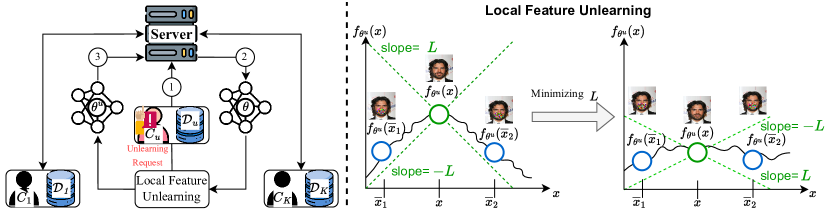
The advent of Federated Learning (FL) highlights the practical necessity for the right to be forgotten for all clients, allowing them to request data deletion from the machine learning models service provider. This necessity has spurred a growing demand for Federated Unlearning (FU). Feature unlearning has gained considerable attention due to its applications in unlearning sensitive, backdoor, and biased features. Existing methods employ the influence function to achieve feature unlearning, which is impractical for FL as it necessitates the participation of other clients, if not all, in the unlearning process. Furthermore, current research lacks an evaluation of the effectiveness of feature unlearning. To address these limitations, we define feature sensitivity in evaluating feature unlearning according to Lipschitz continuity. This metric characterizes the model outputs rate of change or sensitivity to perturbations in the input feature. We then propose an effective federated feature unlearning framework called Ferrari, which minimizes feature sensitivity. Extensive experimental results and theoretical analysis demonstrate the effectiveness of Ferrari across various feature unlearning scenarios, including sensitive, backdoor, and biased features. The code is publicly available at https://github.com/OngWinKent/Federated-Feature-Unlearning
研究动机与目标
- 解决联邦学习中缺乏实用且保护隐私的特征遗忘方法的问题,且无需其他客户端参与。
- 基于Lipschitz连续性,定义一种新的评估指标——特征敏感度,用于衡量遗忘效果。
- 开发一种可扩展、高效且有效的联邦特征遗忘框架,支持对敏感特征、后门特征和偏差特征的遗忘。
- 从理论和实证两方面证明,最小化特征敏感度可带来比精确遗忘更优的模型效用。
- 在满足“被遗忘权”监管要求的同时,保持模型的准确性和公平性。
提出的方法
- 提出一种新的评估指标——特征敏感度,基于Lipschitz连续性定义,用于衡量模型输出随输入特征扰动的变化速率。
- 提出Ferrari,一种联邦遗忘框架,仅使用遗忘客户端的本地数据集来最小化特征敏感度,避免访问全局数据。
- 采用损失函数,约束模型相对于特定特征的Lipschitz常数,确保对输入扰动的鲁棒性。
- 在遗忘客户端的数据上执行单周期优化过程,以降低敏感度,实现快速高效的遗忘。
- 使用基于梯度的优化方法微调全局模型,系统性地降低目标特征的影响。
- 理论分析证明,由于敏感度有界且优化稳定,Ferrari相比精确遗忘可实现更优的模型效用。
实验结果
研究问题
- RQ1基于Lipschitz连续性定义的特征敏感度,能否作为评估联邦特征遗忘的可靠且实用的指标?
- RQ2能否在不依赖其他客户端参与的情况下,实现联邦遗忘方法对特定特征的遗忘?
- RQ3与精确遗忘相比,最小化特征敏感度是否能带来更优的模型效用和公平性?
- RQ4Ferrari在不同数据领域中,对敏感特征、后门特征和偏差特征的遗忘效果如何?
- RQ5超参数(如噪声水平和数据完整性)对Ferrari遗忘性能的影响是什么?
主要发现
- Ferrari在无偏和有偏数据集上实现了相当或更优的准确率(Acc_r ≈ Acc_u),表明其成功遗忘了偏差特征,而Fine-tune和FedRecovery则表现出显著的性能差距。
- 在后门遗忘任务中,Ferrari在干净数据上保持了高准确率(Acc_r),同时有效抑制了触发效应(Acc_u较低),且在噪声水平σ ∈ [0.05, 1.0]范围内性能稳定。
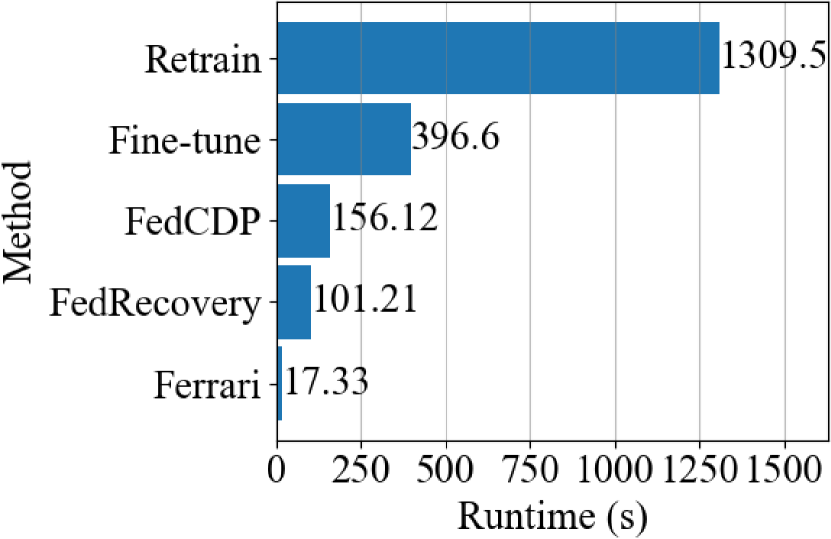
- Ferrari展现出卓越的时间效率,仅用一个训练周期完成遗忘,运行时间最短,优于Retrain、Fine-tune以及需要全局数据访问的方法。
- 消融实验表明,若移除Lipschitz约束(非Lipschitz方法),将导致灾难性遗忘,Acc_r降至10%以下,证明有界敏感度的必要性。
- 即使仅使用遗忘客户端70%的数据,仍能实现有效的遗忘,表明其对数据丢失具有鲁棒性,且具备高度实用性。
- 理论分析确认,Ferrari相比精确遗忘可实现更优的模型效用,因为有界敏感度可防止过拟合与优化不稳定性。
阅读本论文
在 Nubint 阅读器中打开原文,边读边就任意段落提问。
在 Nubint 中阅读本论文本解读由 AI 根据论文原文生成,引用前请核对原文。