
[论文解读] Few-shot Classification via Ensemble Learning with Multi-Order Statistics
该论文提出 ELMOS,一种新颖的少样本分类方法,通过使用集成学习与多阶统计量来提升在新类别上的泛化能力。通过将一阶、二阶和三阶统计量池化应用于共享主干网络的特征,ELMOS 构建了多样化且无参数的基学习器,并进行联合训练,在 miniImageNet、CIFAR-FS 和 CUB 上实现了最先进性能,且相比以往的集成方法,存储和计算成本更低。
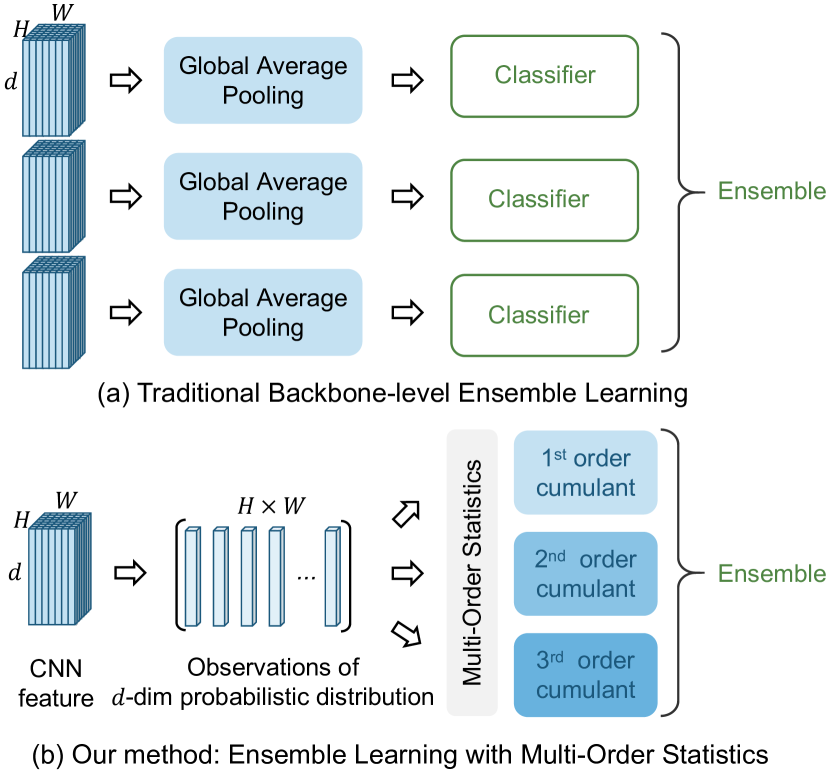
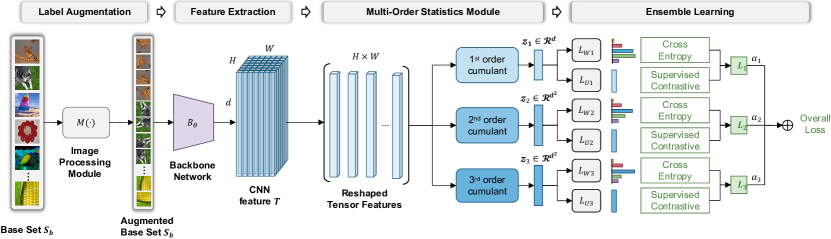
Transfer learning has been widely adopted for few-shot classification. Recent studies reveal that obtaining good generalization representation of images on novel classes is the key to improving the few-shot classification accuracy. To address this need, we prove theoretically that leveraging ensemble learning on the base classes can correspondingly reduce the true error in the novel classes. Following this principle, a novel method named Ensemble Learning with Multi-Order Statistics (ELMOS) is proposed in this paper. In this method, after the backbone network, we use multiple branches to create the individual learners in the ensemble learning, with the goal to reduce the storage cost. We then introduce different order statistics pooling in each branch to increase the diversity of the individual learners. The learners are optimized with supervised losses during the pre-training phase. After pre-training, features from different branches are concatenated for classifier evaluation. Extensive experiments demonstrate that each branch can complement the others and our method can produce a state-of-the-art performance on multiple few-shot classification benchmark datasets.
研究动机与目标
- 从理论上证明在基础类别上进行集成学习如何减少在新类别上的泛化误差。
- 解决传统集成方法在少样本分类中计算与存储成本过高的问题。
- 设计一种无参数的集成机制,利用深度特征的多阶统计量提升多样性与性能。
- 验证多阶统计量在生成互补学习器以提升少样本分类性能方面的有效性。
提出的方法
- 该方法采用共享主干网络,并在后续并行连接多个分支,每个分支对特征图应用不同阶数的统计池化(一阶、二阶、三阶)。
- 每个分支作为集成中一个独立的学习器,不引入额外参数,从而实现高效的联合训练。
- 通过结合基于分类的(CB)损失和基于相似度的(SB)损失来训练集成模型,以提升特征判别力与泛化能力。
- 预训练完成后,将所有分支的特征拼接并输入分类器,用于在新类别上的评估。
- 多阶统计量的使用通过捕捉特征分布的不同方面,确保学习器之间的多样性。
- 该方法专为迁移学习设计,利用完整的基础数据集而无需元学习中的采样episode,从而避免元学习固有的信息损失。
实验结果
研究问题
- RQ1在少样本分类中,能否从理论上证明在基础类别上进行集成学习可减少在新类别上的真实误差?
- RQ2不同阶数的统计池化如何促进特征多样性与分类性能?
- RQ3采用共享主干的无参数集成方法能否在计算成本更低的前提下,优于现有集成方法?
- RQ4在所提框架中,基于分类的损失与基于相似度的损失各自贡献如何?
主要发现
- 在 1-shot 5-way miniImageNet 上,ELMOS 达到 78.18% ± 0.41 的准确率,优于以往最先进方法。
- 在 5-shot 5-way CIFAR-FS 上,ELMOS 达到 89.87% ± 0.31,较第二好的方法高出 0.31%。
- 在 CUB 上,ELMOS 在 5-shot 设置下达到 95.02% ± 0.16,超过第二好的模型 1.0%。
- 消融实验表明,结合一阶、二阶与三阶统计量的性能优于任一单一阶数,证明其互补性。
- CB 与 SB 损失联合使用优于单独使用任一损失,验证了两种监督信号的重要性。
- ELMOS 显著优于最相关的方法 EASY,在所有基准测试中均表现出更低的预训练时间与更高的准确率。
阅读本论文
在 Nubint 阅读器中打开原文,边读边就任意段落提问。
在 Nubint 中阅读本论文本解读由 AI 根据论文原文生成,引用前请核对原文。