
[论文解读] Finding origins of CMB anomalies in the inflationary quantum fluctuations
本文提出了一种新的早期宇宙宇宙学中的量子涨落机制——直接和膨胀(DSI),该机制通过在宇称共轭点处的正向与反向时间演化分量,生成具有尺度依赖性的宇称不对称功率谱。DSI对关键的CMB异常现象——低四极矩功率、半球不对称性以及温度反相关性——的解释优于标准暴胀模型,其四极矩的p值为3.5%(比标准暴胀高39倍),且在结合宇称与低ℓ统计时,DSI比标准暴胀更可能50至650倍。
In this paper, we present compelling evidence for the parity asymmetry (a discrete symmetry that is separate from isotropy) in the Cosmic Microwave Background (CMB) map, measured through two-point temperature correlations. This parity asymmetric CMB challenges our understanding of the quantum physics of the early Universe rather than LCDM ($Λ$ Cold-Dark-Matter). We commence by conducting a comprehensive analysis of the Planck CMB, focusing on the distribution of power in low-multipoles and temperature anticorrelations at parity conjugate points in position space. We find tension with the near scale-invariant power-law power spectrum of Standard Inflation (SI), with p-values of the order $\mathcal{O}\left( 10^{-4}-10^{-3} ight)$. Alternatively, we explore the framework of direct-sum inflation (DSI), where a quantum fluctuation arises as a direct-sum of two components evolving forward and backward in time at parity conjugate points in physical space. We found that DSI is consistent with data on parity asymmetry, the absence of power at $θ>60^{\circ}$, and power suppression at low-even-multipoles, which are major data anomalies in the SI. Furthermore, we discover that the parameters characterizing the hemispherical power asymmetry anomaly become statistically insignificant when the large SI quadrupole amplitude is reduced to align with the data. DSI explains this low quadrupole with a p-value of $3.5\%$, 39 times higher than SI. Combining statistics from parameters measuring parity and low-$\ell$ angular power spectrum, we find that DSI is 50-650 times more probable than SI. In summary, our investigation suggests that CMB temperature fluctuations exhibit homogeneity and isotropy but parity-asymmetric consistent with predictions of DSI. This observation provides tantalizing evidence for the quantum mechanical nature of gravity.
研究动机与目标
- 在量子引力与暴胀物理的框架下,探究长期存在的CMB异常现象的起源,包括低多极矩功率抑制与半球功率不对称性。
- 检验CMB温度图中观测到的宇称破坏特征(特别是宇称共轭点处的温度反相关性)是否可由超越标准暴胀的新量子力学机制解释。
- 重新评估半球功率不对称性(HPA)异常的统计显著性,挑战此前关于宇宙学原理被破坏的主张。
- 提出并验证一种新的暴胀模型——直接和膨胀(DSI),该模型自然产生宇称不对称的功率谱,且无需引入额外自由参数。
- 评估DSI与关键观测约束的相容性:θ > 60°时的功率抑制、低偶数多极矩的抑制,以及观测到的低四极矩振幅。
提出的方法
- 利用位置空间中的两点温度相关函数分析普朗克CMB数据,以检测宇称不对称特征,特别是通过构建宇称共轭图T(−n̂)。
- 定义奇宇称与偶宇称分量T⁻ = (T − T̄)/2与T⁺ = (T + T̄)/2,以分离CMB天图中的宇称破坏结构。
- 引入乘积图Z = T × T̄与G = T⁺ × T⁻,以量化宇称不对称性,并验证偶数与奇数多极矩之间的统计独立性。
- 实施4-sigma裁剪,以减轻罕见极端事件(如冷/热点)对宇称统计造成的污染。
- 通过四极矩振幅的p值与全局各向同性度量等统计指标,将DSI模型实现与普朗克数据及标准暴胀(SI)进行比较。
- 利用偶数与奇数功率谱之比w⁺/w⁻及分布P(Z)量化宇称不对称性,并将模型预测与观测结果进行对比。
实验结果
研究问题
- RQ1观测到的CMB温度图是否表现出显著的宇称破坏,其显著性超出标准暴胀所预测的范围?
- RQ2低四极矩振幅与ℓ < 4时的功率抑制能否由一种新的暴胀中量子力学机制解释,而非宇宙学原理的破坏?
- RQ3半球功率不对称性异常是否具有统计稳健性,还是标准暴胀模型中观测到的大四极矩所致的伪影?
- RQ4能否通过一种直接和膨胀(DSI)机制——即量子涨落作为正向与反向时间演化分量之和——再现CMB中观测到的宇称不对称特征?
- RQ5在结合多个异常现象(宇称不对称性、低ℓ功率抑制与四极矩振幅)时,DSI的统计证据相较于标准暴胀如何?
主要发现
- CMB表现出显著的宇称不对称特征,包括在宇称共轭点处的温度反相关性,当与标准暴胀的标度不变功率谱对比时,其p值为10⁻⁴至10⁻³量级。
- 直接和膨胀(DSI)模型对低四极矩振幅的解释具有3.5%的p值,比标准暴胀的p值高39倍,表明与数据具有更强的一致性。
- 当在标准暴胀模型中将大四极矩振幅校正为与观测一致时,半球功率不对称性异常变得统计不显著,从而挑战了此前关于宇宙学原理被破坏的主张。
- 结合宇称不对称性与低ℓ角功率谱的统计,DSI被发现比标准暴胀更可能50至650倍。
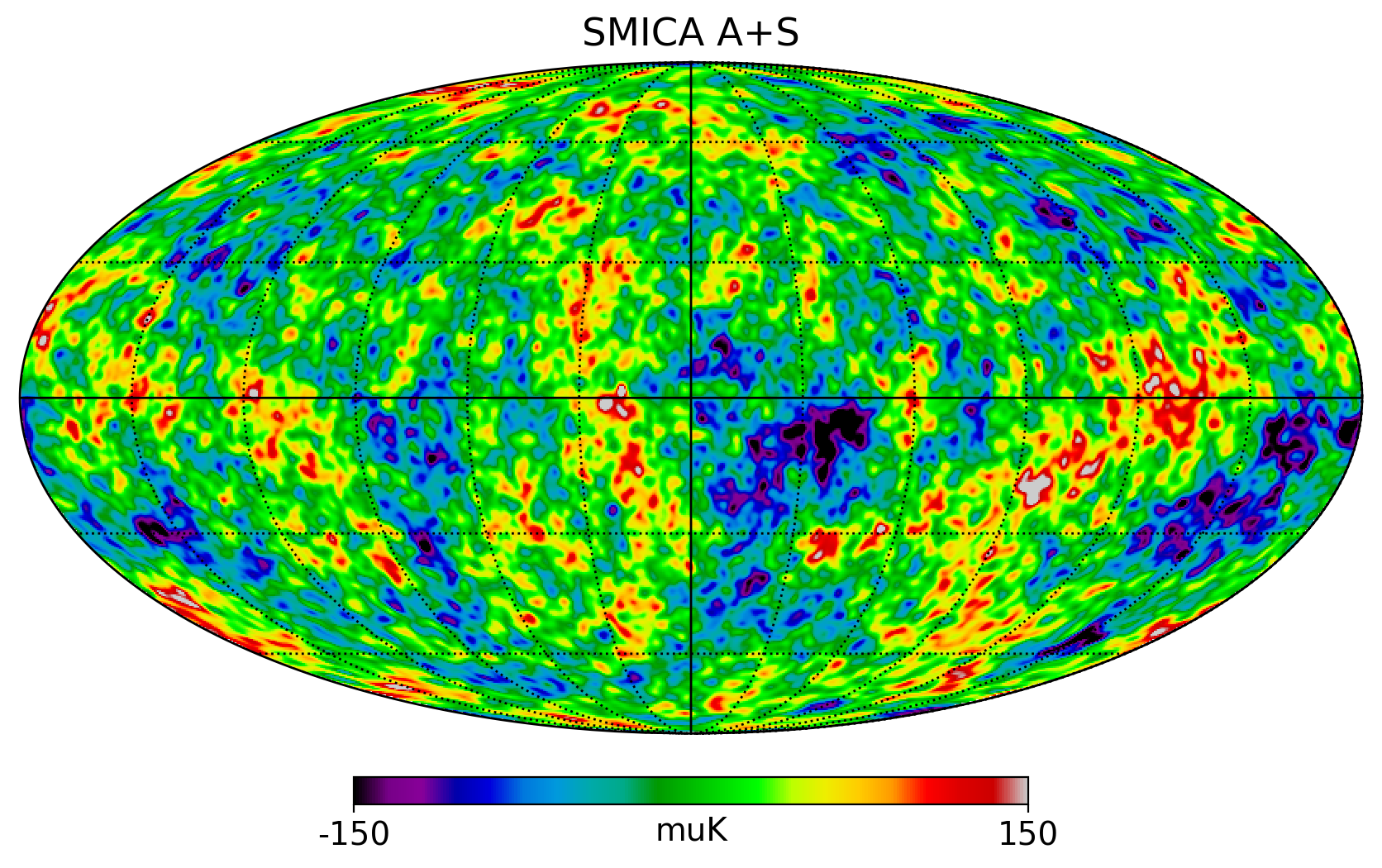
- 对CMB图的视觉检查显示,观测到的普朗克数据与奇宇称分量T⁻及负Z图高度相似,而标准暴胀的实现则无此偏好。
- DSI模型在不引入额外自由参数的情况下,重现了关键异常现象——θ > 60°时的低功率、低偶数多极矩的抑制以及宇称不对称性,表明观测到的CMB特征可能具有更深层的量子起源。
阅读本论文
在 Nubint 阅读器中打开原文,边读边就任意段落提问。
在 Nubint 中阅读本论文本解读由 AI 根据论文原文生成,引用前请核对原文。