
[论文解读] Fine-Tuned 'Small' LLMs (Still) Significantly Outperform Zero-Shot Generative AI Models in Text Classification
这项研究表明,规模更小、经过微调的LLMs在文本分类任务中始终优于零-shot提示的生成式AI模型(ChatGPT、Claude Opus),适用于多样化任务和文本,并提供一个易于获取的微调工具包。
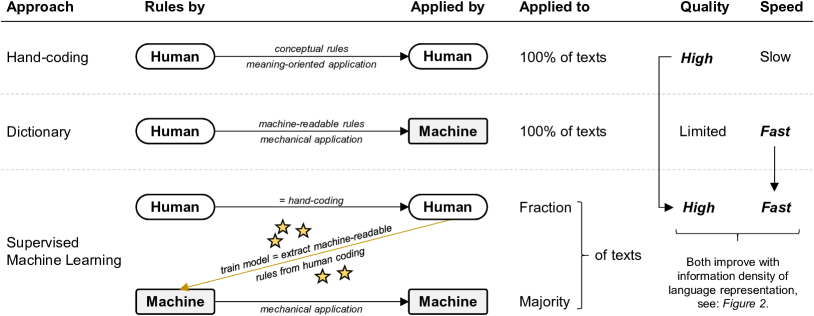
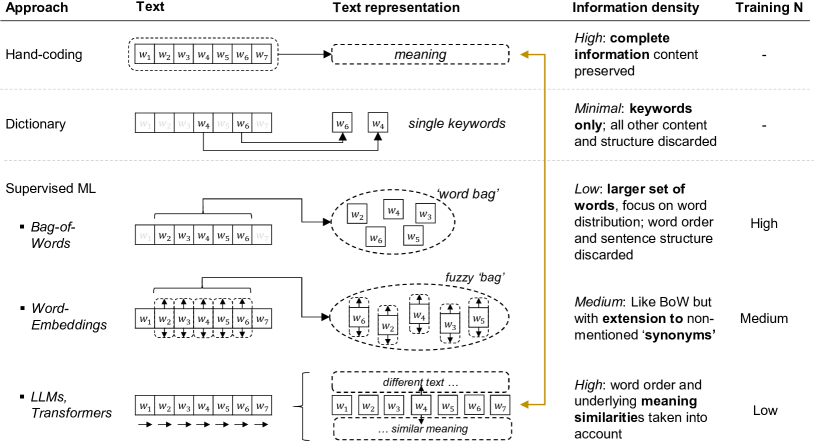
Generative AI offers a simple, prompt-based alternative to fine-tuning smaller BERT-style LLMs for text classification tasks. This promises to eliminate the need for manually labeled training data and task-specific model training. However, it remains an open question whether tools like ChatGPT can deliver on this promise. In this paper, we show that smaller, fine-tuned LLMs (still) consistently and significantly outperform larger, zero-shot prompted models in text classification. We compare three major generative AI models (ChatGPT with GPT-3.5/GPT-4 and Claude Opus) with several fine-tuned LLMs across a diverse set of classification tasks (sentiment, approval/disapproval, emotions, party positions) and text categories (news, tweets, speeches). We find that fine-tuning with application-specific training data achieves superior performance in all cases. To make this approach more accessible to a broader audience, we provide an easy-to-use toolkit alongside this paper. Our toolkit, accompanied by non-technical step-by-step guidance, enables users to select and fine-tune BERT-like LLMs for any classification task with minimal technical and computational effort.
研究动机与目标
- Motivate the comparison between fine-tuned small LLMs and zero-shot generative AI models for text classification.
- Systematically evaluate performance across diverse tasks, languages, and text genres.
- Provide an accessible toolkit to facilitate fine-tuning of small LLMs for classification tasks.
- Offer insights into data requirements and model choice for practitioners.
提出的方法
- Compare five fine-tuned LLMs (RoBERTa Base/Large, DeBERTa V3, ELECTRA Large, XLNet Large, BART Large) with zero-shot prompts from GPT-3.5, GPT-4, Claude Opus, and BART.
- Evaluate on four case studies: sentiment (NYT economy articles), stance (Kavanaugh tweets), emotion (German political texts), and multi-class nationalist party positions.
- Train each model three times with different seeds and report mean and stddev for Accuracy, Precision, Recall, and F1 (macro and weighted).
- Use a consistent dataset split for fine-tuned models and full-dataset labeling for zero-shot models, with prompts detailed in the appendix.
- Provide an easy-to-use Hugging Face-based Jupyter Notebook toolkit with default hyperparameters for out-of-the-box strong performance.
- Discuss ablation results on training data size for RoBERTa Large.]
- research_questions/1-4
- {
- key_findings: [
- table_headers: [
- table_rows: [[
- MAJ-VOT
- 0.73 (± 0.00)
- 0.53 (± 0.00)
- 0.73 (± 0.00)
- 0.42 (± 0.00)
- 0.61 (± 0.00)
实验结果
研究问题
- RQ1Do fine-tuned smaller LLMs outperform zero-shot prompted generative AI models in text classification across tasks and text types?
- RQ2How does performance vary across task difficulty, language, and data size for fine-tuning?
- RQ3What are the practical data and compute requirements to achieve state-of-the-art results with fine-tuned small LLMs?
- RQ4Can an accessible toolkit democratize fine-tuning for broad user audiences?
主要发现
- Fine-tuned RoBERTa Large and DeBERTa V3 achieve top performance across tasks, often surpassing zero-shot GPT-3.5/4 and Claude Opus.
- Across sentiment, stance, and emotion tasks, fine-tuned models generally outperform zero-shot prompts, with stronger gains on specialized tasks.
- Zero-shot prompt-based models show competitive performance but remain behind tuned small LLMs in most cases.
- The paper provides an easy-to-use toolkit enabling non-experts to fine-tune small LLMs for classification with strong out-of-the-box results.
- Ablation studies indicate training data size impacts RoBERTa Large performance, informing data requirements for achieving optimal results.
- Results indicate that model size and complexity do not substitute for application-specific training data.
阅读本论文
在 Nubint 阅读器中打开原文,边读边就任意段落提问。
在 Nubint 中阅读本论文本解读由 AI 根据论文原文生成,引用前请核对原文。