
[论文解读] Fine-tuning multilingual language models in Twitter/X sentiment analysis: a study on Eastern-European V4 languages
本研究针对东欧V4语言(捷克语、斯洛伐克语、波兰语、匈牙利语)在俄乌战争背景下的Twitter/X数据,对多语言大语言模型——BERT、BERTweet、Llama2、Llama3和Mistral进行了细调,以实现基于方面的情感分析。尽管训练数据有限(最少仅6,000条推文),使用DeepL翻译进行数据增强的微调Llama2和Mistral模型在性能上超越了少样本提示的GPT-4及其他模型,达到SOTA水平,凸显了模型特异性和语言特异性微调的重要影响。
The aspect-based sentiment analysis (ABSA) is a standard NLP task with numerous approaches and benchmarks, where large language models (LLM) represent the current state-of-the-art. We focus on ABSA subtasks based on Twitter/X data in underrepresented languages. On such narrow tasks, small tuned language models can often outperform universal large ones, providing available and cheap solutions. We fine-tune several LLMs (BERT, BERTweet, Llama2, Llama3, Mistral) for classification of sentiment towards Russia and Ukraine in the context of the ongoing military conflict. The training/testing dataset was obtained from the academic API from Twitter/X during 2023, narrowed to the languages of the V4 countries (Czech Republic, Slovakia, Poland, Hungary). Then we measure their performance under a variety of settings including translations, sentiment targets, in-context learning and more, using GPT4 as a reference model. We document several interesting phenomena demonstrating, among others, that some models are much better fine-tunable on multilingual Twitter tasks than others, and that they can reach the SOTA level with a very small training set. Finally we identify combinations of settings providing the best results.
研究动机与目标
- 解决在俄乌战争背景下,东欧V4语言(捷克语、斯洛伐克语、波兰语、匈牙利语)缺乏多语言、低资源情感分析模型的问题。
- 探究小型微调大语言模型是否能在低资源、多语言的Twitter情感分析任务中超越大型通用模型(如GPT-4)。
- 评估翻译(Helsinki和DeepL)以及少样本提示对跨多种语言和情感目标下模型性能的影响。
- 识别在代表性不足且具有政治敏感性的语言中,基于方面的情感分类任务下最优的模型与超参数组合。
提出的方法
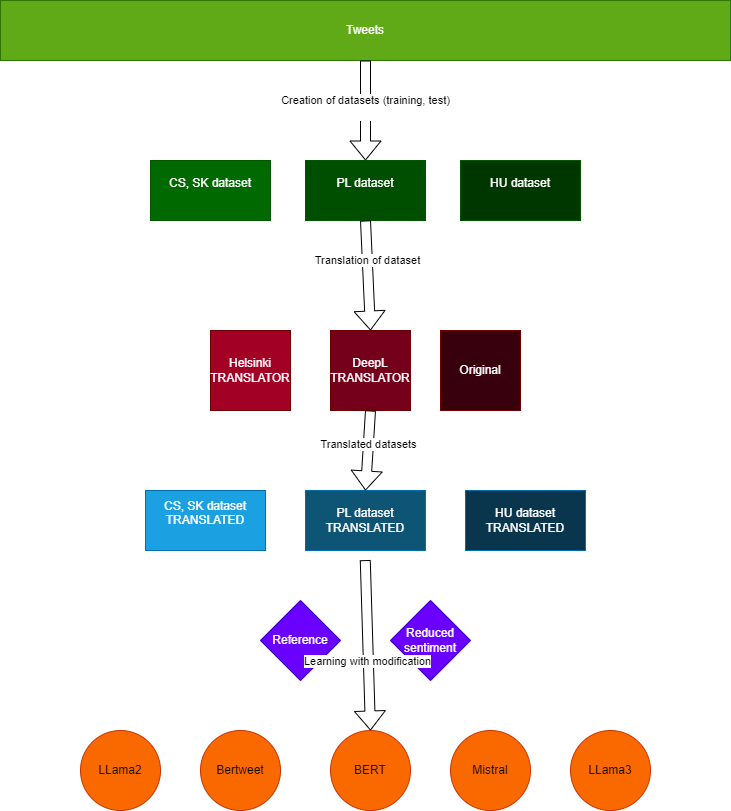
- 通过学术版API在2023年收集Twitter/X数据,筛选出与俄乌冲突相关的V4语言推文及关键词。
- 人工标注了针对俄罗斯和乌克兰的语种特定数据集,用于情感极性(负面/中性/正面)分类。
- 通过Helsinki和DeepL翻译器将原始推文翻译成英文,创建了九个实验数据集。
- 在每种语言及翻译变体上,对五种大语言模型(BERT、BERTweet、Llama2、Llama3、Mistral)使用二元和三元分类任务进行微调。
- 使用宏平均精确率、召回率和F1分数评估模型性能,GPT-4作为零样本参考模型。
- 测试了包括少样本提示和参考推文使用在内的多种变体,以评估上下文敏感性与微调效率。
实验结果
研究问题
- RQ1微调后的中小型多语言模型是否能在低资源、多语言的Twitter数据上实现V4语言基于方面的情感分析SOTA性能?
- RQ2将推文翻译成英文后,与使用原始语言相比,是否对多语言大语言模型的性能产生影响?
- RQ3在该特定任务和语言集合中,使用GPT-4的少样本提示在多大程度上优于微调模型?
- RQ4在文化与政治敏感背景下,是否存在显著的模型或语言特异性性能差异?
- RQ5微调模型在该任务上实现具有竞争力性能的最小有效训练规模是多少?
主要发现
- 仅使用6,000条多语言推文进行微调即可达到SOTA水平,显著优于使用GPT-4的少样本提示方法。
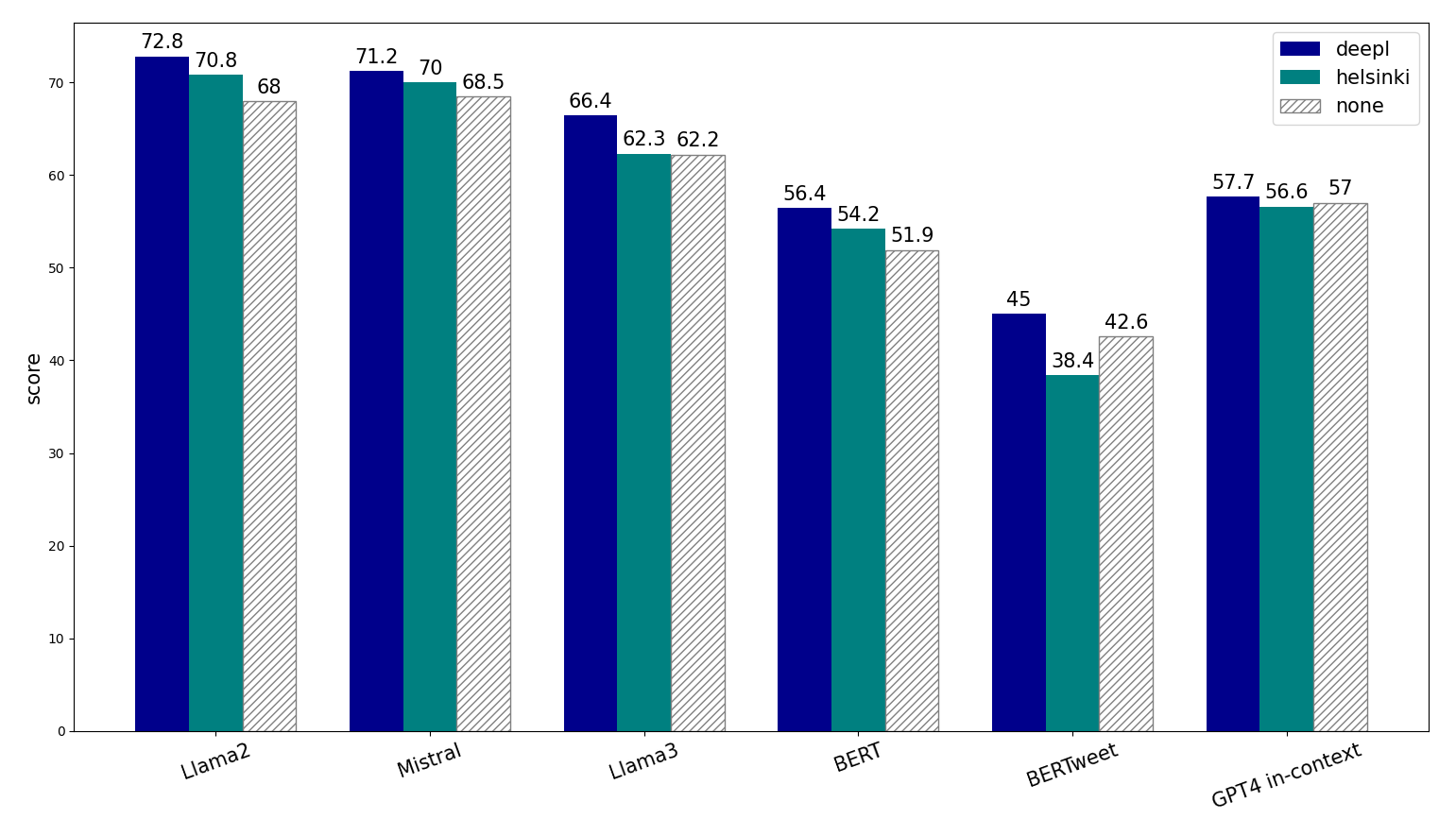
- 当结合DeepL翻译时,Llama2和Mistral表现最佳,在多个语种特定评估中甚至超越了GPT-4。
- Llama3、BERTweet和GPT-4的表现显著逊于Llama2和Mistral,表明性能高度依赖于模型架构,即使在相似架构之间亦如此。
- 将推文翻译为英文在性能上提供了稳定优势,即使对多语言预训练模型也是如此,表明英语对齐的表征能提升零样本泛化能力。
- 模型表现出语言特异性偏差——尤其在匈牙利语中,正面类别的召回率比负面类别低约10%,表明模型倾向于过度分类为负面。
- 微调有效使模型行为与目标方面(如对乌克兰或战争的情感)对齐,即使在短文本、上下文贫乏的推文中也能减少误分类。
阅读本论文
在 Nubint 阅读器中打开原文,边读边就任意段落提问。
在 Nubint 中阅读本论文本解读由 AI 根据论文原文生成,引用前请核对原文。