
[论文解读] Finetuning Foundation Models for Joint Analysis Optimization
本文提出了一种用于高能物理(HEP)端到端优化的基石模型微调框架,用联合的、基于梯度的训练替代了传统的顺序重建与分析流水线。该方法在重共振态衰变为四b夸克喷注的双希格斯衰变搜索任务中,使用基于ParT的喷注表征进行微调,实现了数据效率最高提升100倍,且信号拒参考性能相比冻结主干模型提升两倍。
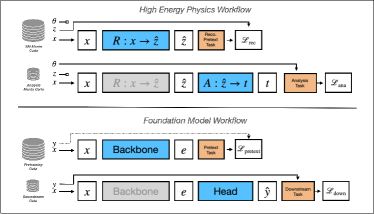
In this work we demonstrate that significant gains in performance and data efficiency can be achieved in High Energy Physics (HEP) by moving beyond the standard paradigm of sequential optimization or reconstruction and analysis components. We conceptually connect HEP reconstruction and analysis to modern machine learning workflows such as pretraining, finetuning, domain adaptation and high-dimensional embedding spaces and quantify the gains in the example usecase of searches of heavy resonances decaying via an intermediate di-Higgs system to four $b$-jets.
研究动机与目标
- 为克服高能物理数据分析流水线中顺序的、贪心的优化方法的局限性。
- 在机器学习中的基石模型训练与粒子物理分析工作流的分层结构之间,建立概念与实践上的桥梁。
- 量化通过微调与预训练实现的端到端、基于梯度的优化在性能与数据效率方面的提升。
- 通过在无关但物理相似的数据集(如JetClass)上初始化模型,探索高能物理中的领域自适应。
- 评估微调重建级表征是否能带来优于仅优化分析头的下游分析性能。
提出的方法
- 采用基石模型范式:在大规模公开数据集(JetClass)上,使用预训练任务(Xbb标记)对喷注表征模型(ParT)进行预训练。
- 使用来自CMS开放数据的小型、任务特定数据集,对预训练主干模型在目标HEP分析任务(重共振态衰变为双希格斯→四b夸克喷注)上进行微调。
- 比较三种训练策略:(1) 从零开始训练,(2) 冻结主干并在下游任务上微调,(3) 全端到端微调。
- 使用ParT模型生成的高维嵌入作为重建与分析的联合表征,实现整个流水线的梯度传播。
- 通过使用在JetClass上预训练的权重初始化模型,实现领域自适应,尽管其模拟器与目标数据集的分布不同。
- 在不同数据集规模下训练并评估模型,以衡量数据效率与性能增益。
实验结果
研究问题
- RQ1与冻结模型或从零开始训练相比,基石模型主干的端到端微调是否能在HEP分析中提升性能与数据效率?
- RQ2在大规模、无关数据集(JetClass)上进行预训练,能在不同模拟领域中多大程度上提升下游性能?
- RQ3微调重建级表征(喷注嵌入)是否能带来优于仅优化分析头的事件级分析性能?
- RQ4随着训练数据量的增加,冻结模型与微调模型之间的性能差距如何演变?
- RQ5在主干模型于不同分布上预训练的前提下,是否能在分层HEP流水线中实现成功的领域自适应?
主要发现
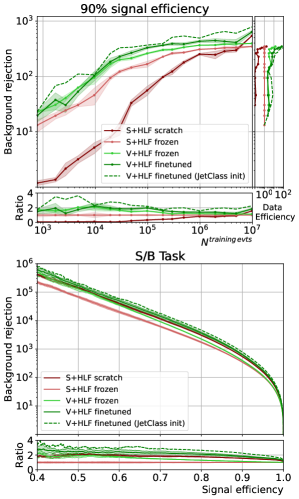
- 微调完整模型相比使用冻结主干,信号拒参考性能最高可提升两倍。
- 微调模型的数据效率相比冻结主干基线最高提升100倍,意味着达到特定性能水平所需的训练样本更少。
- 使用JetClass预训练权重初始化的模型优于所有其他配置,包括从随机初始化微调的模型,证明了在不同模拟领域间成功实现领域自适应。
- 随着训练数据量的增加,冻结模型与微调模型之间的性能差距逐渐缩小,当数据足够多时,从零开始训练的模型最终超越冻结模型。
- 表现最佳的配置是JetClass初始化的微调设置,该配置在所有数据集规模下均持续优于其他配置,如图4中所示的顶部虚线曲线。
- 本研究首次展示了在涉及对象级表征与事件级推理的分层HEP场景中,可行的微调工作流。
阅读本论文
在 Nubint 阅读器中打开原文,边读边就任意段落提问。
在 Nubint 中阅读本论文本解读由 AI 根据论文原文生成,引用前请核对原文。