
[论文解读] First stars signatures in high-z absorbers
该论文在 z ≈ 3–4 的红移处识别出三个极低金属量、碳增强的吸收体,认为它们是第一代恒星的气态化石,表现出与银河系晕中 CEMP-no 恒星类似的化学特征。通过丰度建模,研究证明这些系统由第一代恒星的低能超新星所富集,其中至少 50% 的金属源自这些原初爆炸。
The first stars were likely more massive than those forming today and thus rapidly evolved, exploding as supernovae and enriching the surrounding gas with their chemical products. In the Local Group, the chemical signature of the first stars has been identified in the so-called Carbon-Enhanced Metal-Poor stars (CEMP-no). On the contrary, a similar C-excess was not found in dense neutral gas traced by high-redshift absorption systems. Here we discuss the recent discovery of three C-enhanced very metal-poor ([Fe/H]< -2) optically thick absorbers at redshift z ~ 3-4, reported by (Saccardi et al. 2023). We show that these absorbers are extra-galactic tracers of the chemical signatures of the first stars, analogous to the CEMP-no stars observed in the Galactic halo and ultra-faint dwarf galaxies. Furthermore, by comparing observations with model predictions we demonstrate that these systems have most likely been imprinted by first stars exploding as low-energy supernovae, which provided > 50% of the metals in these absorbers
研究动机与目标
- 识别并表征具有原初恒星富集化学丰度特征的高红移气态吸收体。
- 确定第一代恒星的化学特征——特别是碳增强但无中子俘获元素增强——是否可在高红移的致密中性气体中被探测到。
- 将这些吸收体的丰度模式与本星系群中 CEMP-no 恒星的丰度模式进行比较,以建立气态与恒星化石之间与第一代恒星的直接联系。
- 利用观测到的丰度比值,约束第一代超新星对早期星际介质金属富集的贡献。
- 评估弥散、低金属量吸收体作为早期宇宙化学演化原始示踪物的可行性,且不受后续正常恒星污染的影响。
提出的方法
- 分析 XQ-100 遗产巡天的高分辨率类星体吸收光谱,测量 z ≈ 3–4 处亚 DLAs 和莱曼极限系统中铁、碳及其他元素的丰度。
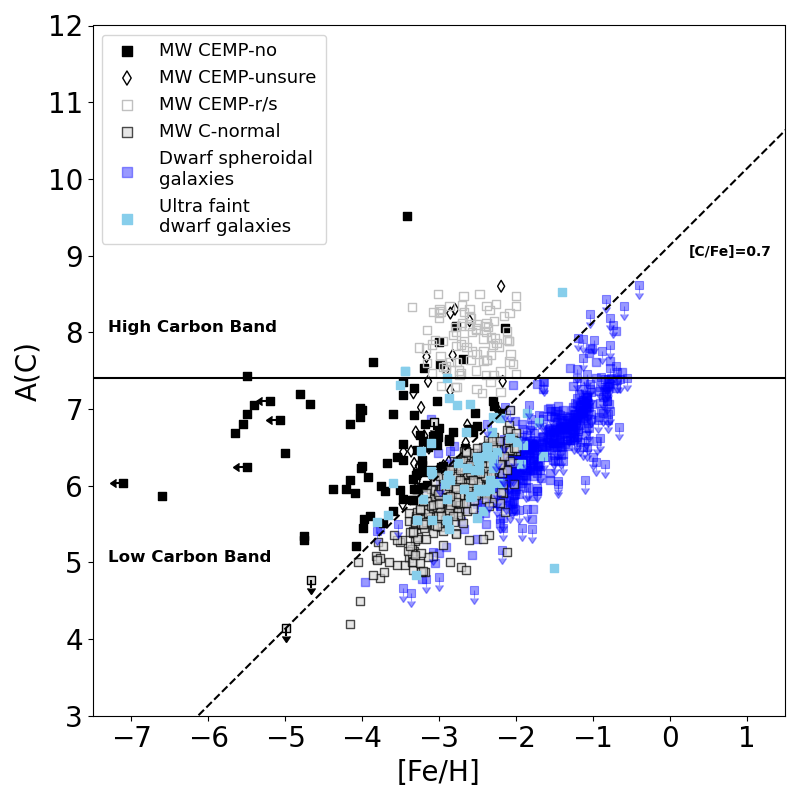
- 使用绝对碳丰度(A(C) = log(N_C/N_H) + 12)和 [C/Fe] 比值,基于低碳(A(C) < 7.4)与高碳(A(C) ≥ 7.4)带之间的区分,将吸收体分类为类似 CEMP-no 的类型。
- 将这三个碳增强吸收体的观测丰度模式与第一代恒星富集的理论模型进行比较,特别关注低能超新星(E ≤ 10^51 erg)的影响。
- 采用一种参数化早期星际介质富集模型,通过调节来自第一代恒星的金属比例(f_PopIII)、恒星形成效率和稀释因子,模拟观测到的丰度趋势。
- 评估观测到的 [Fe/H] 和 [C/Fe] 值与 f_PopIII ≥ 50% 的模型预测的一致性,表明主导富集来自原初超新星。
- 评估尘埃消耗和信噪比限制对丰度测量的影响,特别是在较高金属度下。
实验结果
研究问题
- RQ1第一代恒星的化学特征——特别是碳增强但无中子俘获元素增强——是否可在高红移气态吸收体中被探测到?
- RQ2在 z ≈ 3–4 处观测到的低金属量、碳增强吸收体的丰度模式是否与本星系群中 CEMP-no 恒星的丰度模式一致?
- RQ3这些吸收体中可归因于第一代超新星的金属比例是多少?这对第一代恒星爆炸能量特性有何启示?
- RQ4这些吸收体是否足够弥散且化学上孤立,以在不被后续恒星污染的情况下保留第一代恒星富集的原始特征?
- RQ5观测到的丰度比值与大质量第一代恒星低能超新星的理论模型相比如何?
主要发现
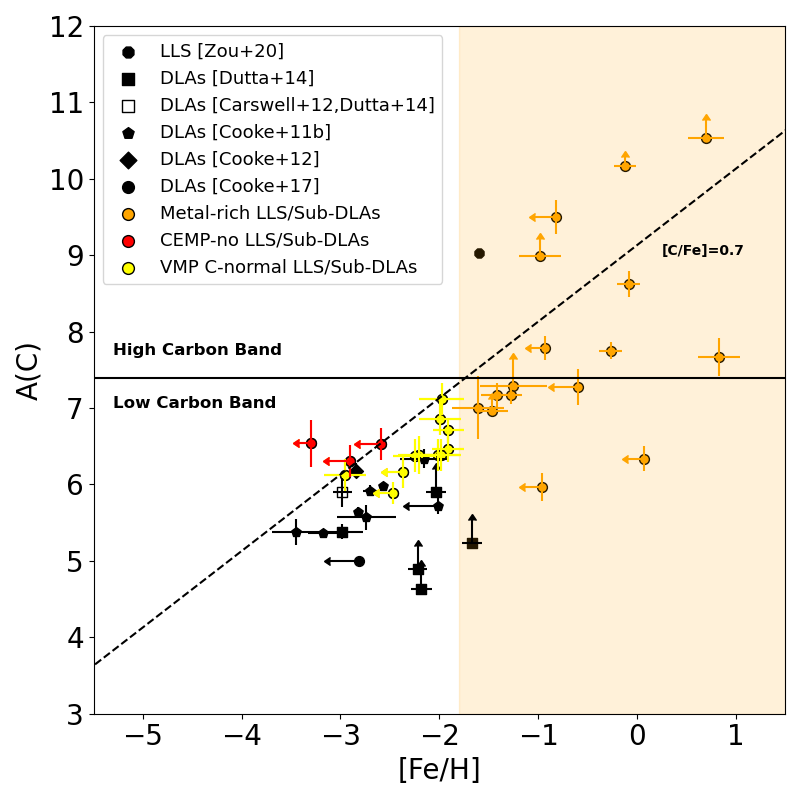
- 在 z ≈ 3–4 处识别出三个碳增强、极低金属量的吸收体,其 [Fe/H] < -2 且 [C/Fe] > +0.7,位于 A(C) 与 [Fe/H] 图中的 CEMP-no 类似区域。
- 这些吸收体表现出 A(C) < 7.4,确认其为低碳带系统,与 CEMP-no 恒星的化学特征一致,且与 CEMP-s 恒星明显不同。
- 观测到的丰度模式最符合至少 50% 的金属源自第一代恒星低能超新星(E ≤ 10^51 erg)的模型。
- 这些系统与化学孤立性一致,无后续污染的证据,支持其作为早期恒星形成气态化石的角色。
- 结果表明,即使在无恒星形成的情况下,光学厚、相对弥散的高红移吸收体仍可保留第一代恒星的化学印记。
- 未来利用 ELT 上的 ANDES 等仪器进行高分辨率光谱观测,将有望探测锌等关键元素,进一步验证这些丰度的原初起源。
阅读本论文
在 Nubint 阅读器中打开原文,边读边就任意段落提问。
在 Nubint 中阅读本论文本解读由 AI 根据论文原文生成,引用前请核对原文。