
[论文解读] FITS: Modeling Time Series with $10k$ Parameters
FITS 通过在频域中进行插值并映射回时域,使用约5k–10k参数的轻量级复频域模型,在频域插值方面实现了与最先进方法相竞争的结果。
In this paper, we introduce FITS, a lightweight yet powerful model for time series analysis. Unlike existing models that directly process raw time-domain data, FITS operates on the principle that time series can be manipulated through interpolation in the complex frequency domain. By discarding high-frequency components with negligible impact on time series data, FITS achieves performance comparable to state-of-the-art models for time series forecasting and anomaly detection tasks, while having a remarkably compact size of only approximately $10k$ parameters. Such a lightweight model can be easily trained and deployed in edge devices, creating opportunities for various applications. The code is available in: \url{https://github.com/VEWOXIC/FITS}
研究动机与目标
- 在资源受限的边缘设备上推动时间序列分析,因为传统模型过大。
- 引入一种在频域中使用复值参数来捕捉幅度与相位的插值方法。
- 证明一个小型、5k–10k 参数的模型也能达到与最先进或接近最先进的性能。
- 展示 FITS 在预测和异常检测任务中的适用性,提供一个简单、可训练的管道。
提出的方法
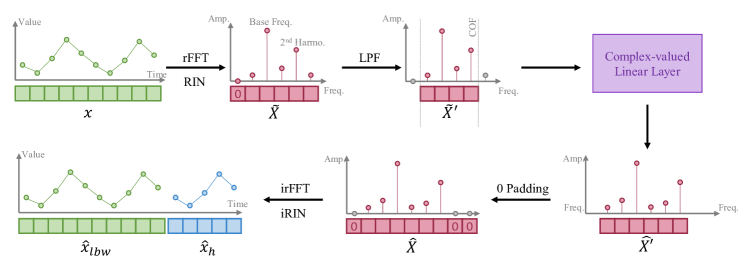
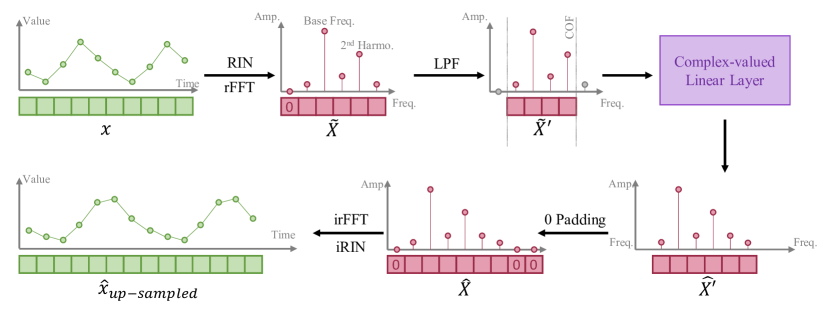
- 通过 rFFT 将时间序列片段转换为复杂频域。
- 通过单个复值线性层学习振幅缩放和相位偏移,在频域中进行插值。
- 对频率表示应用低通滤波以压缩表示,同时保留关键信息。
- 在时域进行逆变换以使用标准损失(如均方误差)进行监督。
- 使用可逆的逐实例归一化来处理直流分量并稳定训练。
- 以将回看窗口、预测期和回推的监督结合起来进行预测任务的训练;对于重构任务使用重构性监督。
实验结果
研究问题
- RQ1复合复值层的频域插值在预测精度上是否能与更大规模的时间序列模型竞争?
- RQ2应用低通滤波和可逆归一化是否在保持信息的同时实现边缘设备部署?
- RQ3FITS 在标准基准上的预测和异常检测性能在参数显著更少的情况下如何?
- RQ4回看窗口长度和截止频率对性能和效率有何影响?
- RQ5联合预测和回推监督是否能在实际预测任务中提升表现?
主要发现
- FITS 在長期预测数据集上实现了与最先进结果相竞争的性能,参数量仅约 5k–10k。
- 在 ETTh1/ETTh2 和 Electricity 数据集上,FITS 的 MSE 表现优于若干更大的基线模型,同时使用的参数量和 MACs 更少。
- 在表3中,FITS 使用 4.5K–16K 参数,1.6M–8.9M MACs,回看=96、预测 horizon=720 时在 Electricity 数据集的 CPU 推理时间为 0.6ms。
- FITS 显示出比 TimesNet、Pyraformer 等模型更低数量级的参数却保持着强劲的性能。
- 更长的回看窗口通常会提升性能;提高截止频率对性能有一定提升但计算成本更高。
- 在异常检测中,FITS 在若干数据集上以低参数量和亚毫秒推理时间获得最高 F1 分数,凸显其作为快速一线响应工具的适用性。
阅读本论文
在 Nubint 阅读器中打开原文,边读边就任意段落提问。
在 Nubint 中阅读本论文本解读由 AI 根据论文原文生成,引用前请核对原文。