
[论文解读] Flatten: Video Action Recognition is an Image Classification task
本文提出Flatten,一种即插即用模块,通过行主序展平将3D视频片段转换为2D空间表征,使标准图像分类模型能够有效识别视频动作。通过将时间序列转换为空间布局,Flatten在Kinetics-400、Something-Something v2和HMDB-51数据集上采用ResNet、SwinV2和Uniformer主干网络时均达到最先进性能,显著优于其原始3D对应模型。
In recent years, video action recognition, as a fundamental task in the field of video understanding, has been deeply explored by numerous researchers.Most traditional video action recognition methods typically involve converting videos into three-dimensional data that encapsulates both spatial and temporal information, subsequently leveraging prevalent image understanding models to model and analyze these data. However,these methods have significant drawbacks. Firstly, when delving into video action recognition tasks, image understanding models often need to be adapted accordingly in terms of model architecture and preprocessing for these spatiotemporal tasks; Secondly, dealing with high-dimensional data often poses greater challenges and incurs higher time costs compared to its lower-dimensional counterparts.To bridge the gap between image-understanding and video-understanding tasks while simplifying the complexity of video comprehension, we introduce a novel video representation architecture, Flatten, which serves as a plug-and-play module that can be seamlessly integrated into any image-understanding network for efficient and effective 3D temporal data modeling.Specifically, by applying specific flattening operations (e.g., row-major transform), 3D spatiotemporal data is transformed into 2D spatial information, and then ordinary image understanding models are used to capture temporal dynamic and spatial semantic information, which in turn accomplishes effective and efficient video action recognition. Extensive experiments on commonly used datasets (Kinetics-400, Something-Something v2, and HMDB-51) and three classical image classification models (Uniformer, SwinV2, and ResNet), have demonstrated that embedding Flatten provides a significant performance improvements over original model.
研究动机与目标
- 通过消除对专用3D架构的需求,简化视频动作识别。
- 通过使2D图像模型能够建模时间动态,弥合图像与视频理解之间的差距。
- 降低与3D时空建模相关的计算复杂度和训练开销。
- 证明仅通过最小修改即可使用标准图像分类框架有效解决视频动作识别问题。
- 验证将3D视频数据展平为2D形式以保留并利用时间关系的有效性。
提出的方法
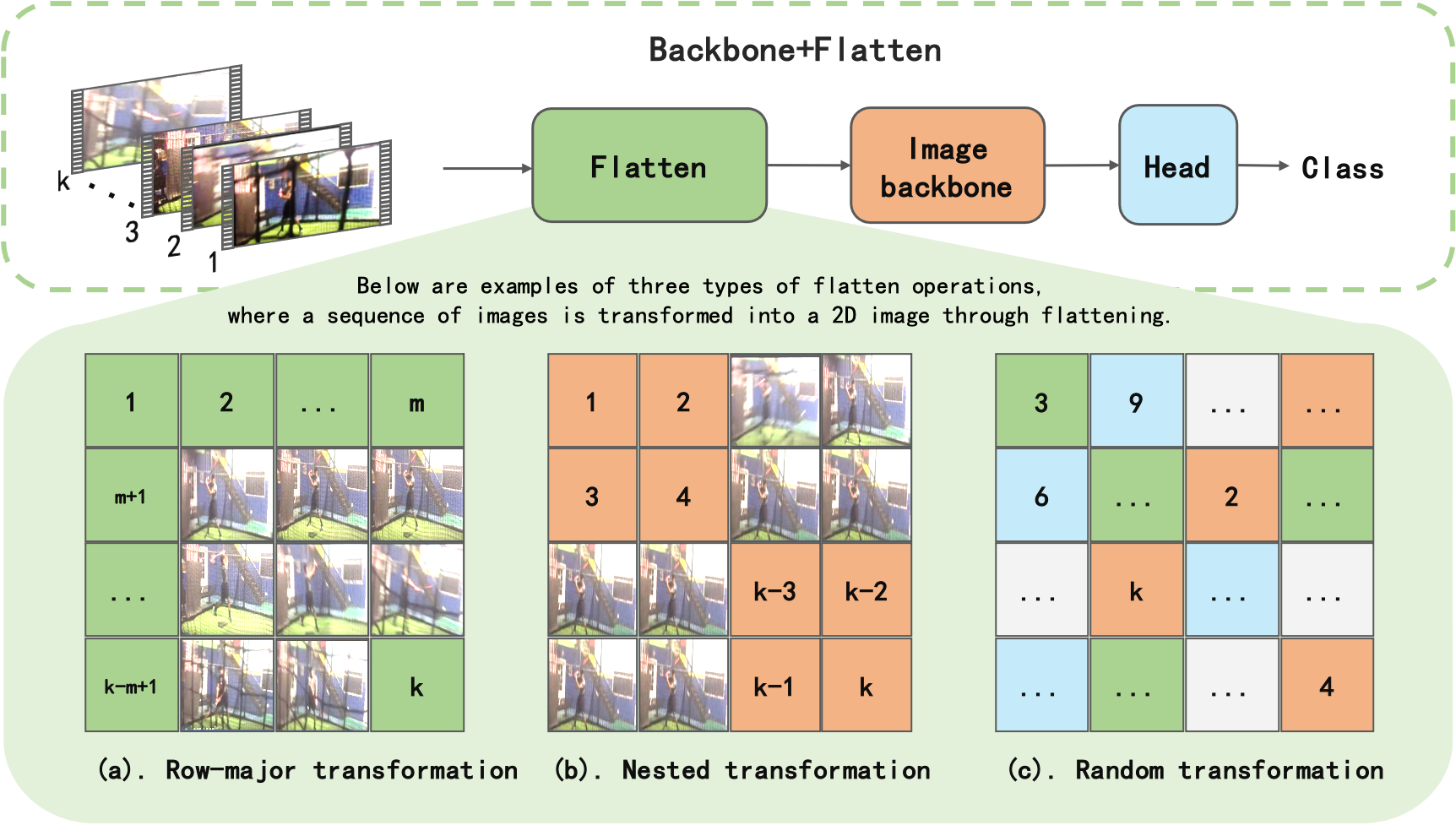
- Flatten模块对视频帧序列应用行主序展平操作,将时间序列转换为单个2D图像张量。
- 输入视频片段形状为(T, C, H, W),被重塑为(C, H*n, W*m),其中T = n*m,保留空间与时间结构。
- 该方法使用标准图像分类模型(如ResNet、SwinV2、Uniformer)且无需架构修改。
- 展平操作使模型能够通过2D布局中的空间位置编码学习时间依赖性。
- 该方法为即插即用:无需微调主干网络,仅在推理前进行一次转换步骤。
- 该方法支持多种展平类型(如行主序、列主序),并根据序列长度动态选择最优的n和m。
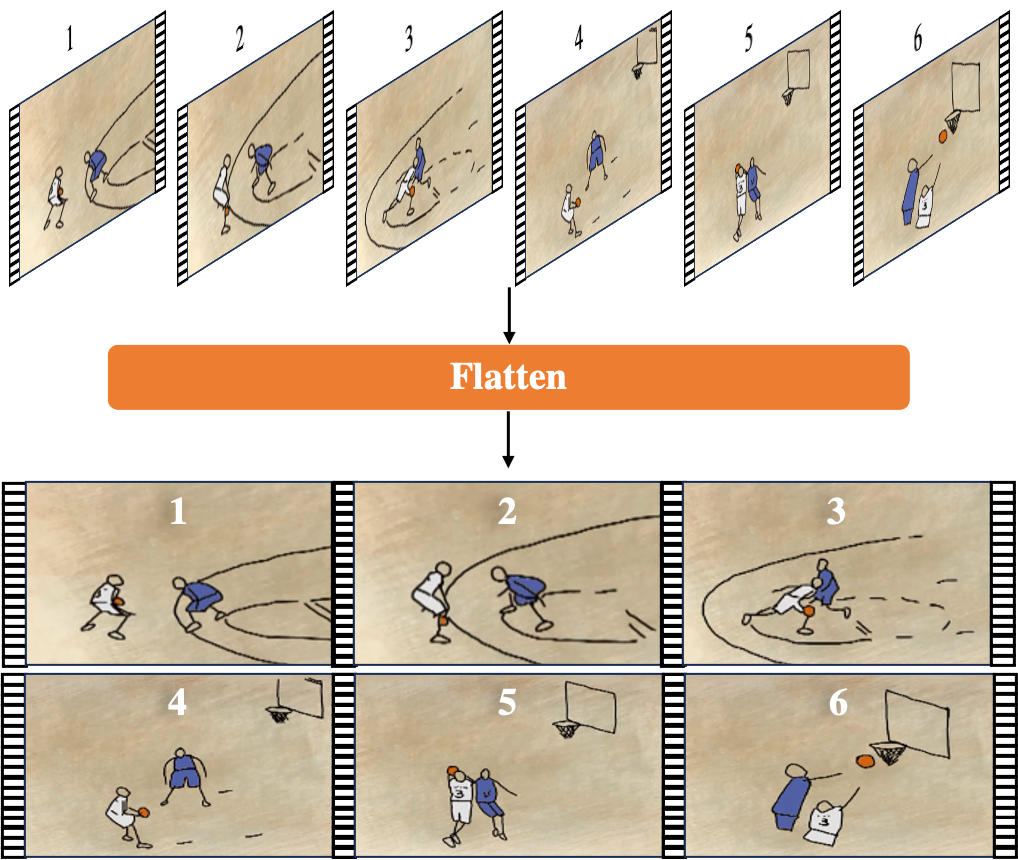
实验结果
研究问题
- RQ1在将3D视频数据转换为2D空间形式后,是否能有效使用标准2D图像分类模型进行视频动作识别?
- RQ2将时间序列展平为空间布局是否足以保留时间动态以实现准确的动作识别?
- RQ3展平后的视频表征性能与传统3D卷积或基于Transformer的视频模型相比如何?
- RQ4像Flatten这样简单轻量的模块是否可普遍应用于不同图像分类主干网络以提升视频识别准确率?
- RQ5展平帧的2D空间布局在多大程度上使注意力机制能够聚焦于运动模式?
主要发现
- Flatten在所有评估数据集上显著提升了动作识别准确率:Kinetics-400、Something-Something v2和HMDB-51。
- 在Kinetics-400上,Uniformer-S+Flatten达到85.1%的top-1准确率,优于原始3D Uniformer-S模型。
- SwinV2-T+Flatten在Kinetics-400上达到84.3%的top-1准确率,超过原始SwinV2-T模型。
- ResNet101+Flatten在Kinetics-400上达到83.7%的top-1准确率,表明在更深架构上也保持一致的性能提升。
- 可视化结果显示,Uniformer-S+Flatten相比3D变体能更聚焦地学习运动模式的注意力。
- 特征图分析证实,Flatten增强模型的深层网络逐渐捕捉到更具全局性的时间表征,表明具备有效的长程建模能力。
阅读本论文
在 Nubint 阅读器中打开原文,边读边就任意段落提问。
在 Nubint 中阅读本论文本解读由 AI 根据论文原文生成,引用前请核对原文。