
[论文解读] Flexible Clustered Federated Learning for Client-Level Data Distribution Shift
该论文提出 FlexCFL,一种灵活的聚类联邦学习框架,通过一种新颖的分解余弦相似度的欧氏距离(EDC)度量方法,基于优化方向相似性对客户端进行分组,以减少在客户端数据分布偏移下的训练分歧。该方法引入了一种冷启动机制以支持新客户端的加入,并采用基于 Wasserstein 距离的动态客户端迁移策略,在 FEMNIST 上相比 FedSEM 实现了最高达 +40.9% 的测试准确率提升,同时保持了通信效率。
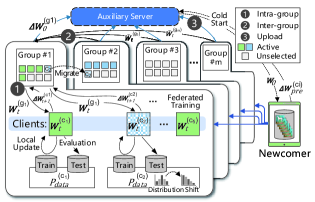
Federated Learning (FL) enables the multiple participating devices to collaboratively contribute to a global neural network model while keeping the training data locally. Unlike the centralized training setting, the non-IID, imbalanced (statistical heterogeneity) and distribution shifted training data of FL is distributed in the federated network, which will increase the divergences between the local models and the global model, further degrading performance. In this paper, we propose a flexible clustered federated learning (CFL) framework named FlexCFL, in which we 1) group the training of clients based on the similarities between the clients' optimization directions for lower training divergence; 2) implement an efficient newcomer device cold start mechanism for framework scalability and practicality; 3) flexibly migrate clients to meet the challenge of client-level data distribution shift. FlexCFL can achieve improvements by dividing joint optimization into groups of sub-optimization and can strike a balance between accuracy and communication efficiency in the distribution shift environment. The convergence and complexity are analyzed to demonstrate the efficiency of FlexCFL. We also evaluate FlexCFL on several open datasets and made comparisons with related CFL frameworks. The results show that FlexCFL can significantly improve absolute test accuracy by +10.6% on FEMNIST compared to FedAvg, +3.5% on FashionMNIST compared to FedProx, +8.4% on MNIST compared to FeSEM. The experiment results show that FlexCFL is also communication efficient in the distribution shift environment.
研究动机与目标
- 解决联邦学习中客户端级数据分布偏移带来的挑战,该问题会降低模型准确率和收敛性。
- 减少由客户端间统计异质性和非独立同分布(non-IID)数据引起的训练分歧。
- 在大规模联邦学习系统中实现高通信效率和可扩展性,支持动态客户端参与。
- 通过稳健的冷启动机制,实现对新设备的实用化部署。
- 通过自适应客户端迁移和组间聚合,维持在数据分布变化下的高模型准确率。
提出的方法
- 使用一种新颖的数据驱动度量方法——分解余弦相似度的欧氏距离(EDC),对客户端进行聚类,以避免高维集中问题。
- 部署辅助服务器以管理客户端冷启动,实现新设备的高效接入,而无需重新训练。
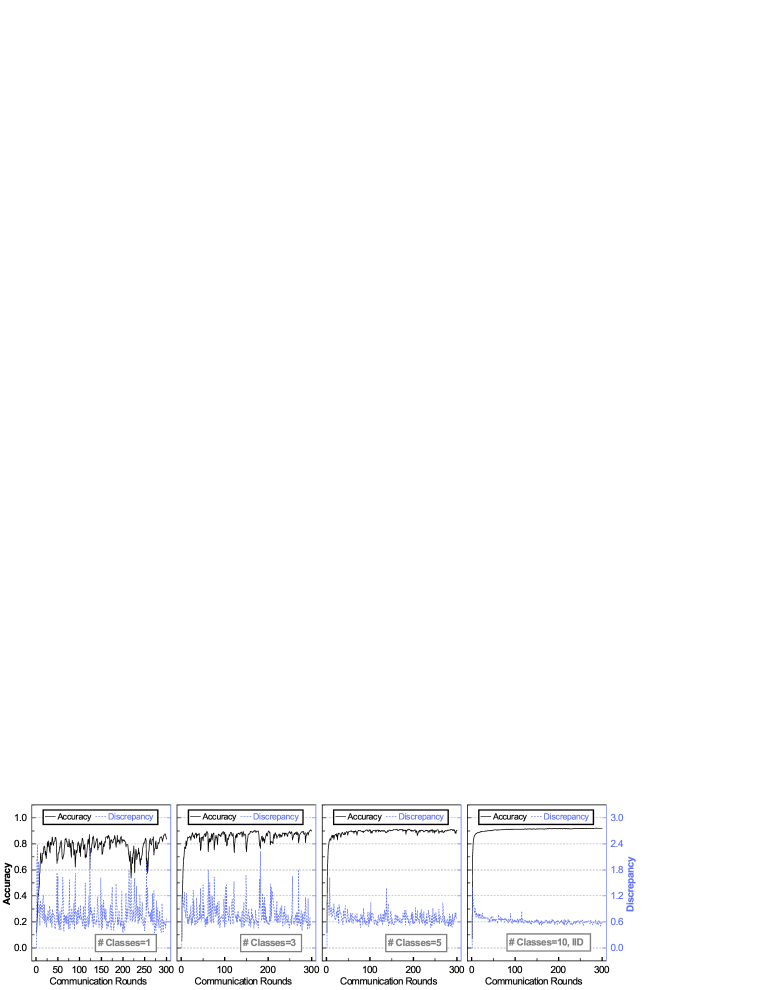
- 利用本地模型分布与组内模型分布之间的 Wasserstein 距离检测客户端级数据分布偏移。
- 基于分布偏移检测结果,动态地在不同聚类间迁移客户端,以维持聚类的一致性。
- 采用带有可学习组间学习率(ηg)的组间聚合机制,以增强跨聚类的模型泛化能力。
- 集成灵活的聚类与迁移流水线,能够根据训练过程中客户端数据分布的变化自适应调整。
实验结果
研究问题
- RQ1如何使联邦学习中的客户端聚类对客户端级数据分布偏移具有鲁棒性?
- RQ2在动态联邦学习系统中,如何实现高效且可扩展的新客户端处理方法?
- RQ3动态客户端迁移是否能在保持通信效率的同时提升分布偏移下的模型准确率?
- RQ4带有自适应学习率的组间聚合机制如何影响聚类联邦学习中的收敛性和性能?
- RQ5FlexCFL 在数据分布偏移下,相较于 FedAvg、FedProx 和 FedSEM 等现有联邦学习框架,其性能提升程度如何?
主要发现
- 与 FedSEM 相比,FlexCFL 在 FEMNIST 上实现了 +40.9% 的绝对测试准确率提升,证明了其在数据分布偏移下的优越性能。
- 在 FEMNIST 上,FlexCFL 相较于 FedAvg 提升了 +10.6% 的准确率,相较于 FedProx 提升了 +3.5%,即使在极端数据偏斜条件下也表现优异。
- 在交换部分(swap part)设置下,采用 ηg = 5.0 的组间聚合策略相比无组间学习的 FlexCFL,准确率提升了 +10.5%。
- FlexCFL 仅需 1.26× 的通信成本,便在准确率上比 FedAvg 提升 5.2%,显著优于 IFCA-MIG(通信成本为 5.48×,仅提升 1.9%)。
- 在全部交换(swap all)设置下,与 FedAvg 相比,FlexCFL 在 MNIST 上提升 +2.2%,在 FEMNIST 上提升 +3.9%,在 FashionMNIST 上提升 +1.4%,展现出对分布偏移的强鲁棒性。
- 消融实验表明,EDC 聚类和客户端迁移策略对性能提升均至关重要,其中后者显著增强了在分布偏移下的鲁棒性。
阅读本论文
在 Nubint 阅读器中打开原文,边读边就任意段落提问。
在 Nubint 中阅读本论文本解读由 AI 根据论文原文生成,引用前请核对原文。