
[论文解读] FOCAL: Contrastive Learning for Multimodal Time-Series Sensing Signals in Factorized Orthogonal Latent Space
FOCAL 引入一个自监督对比框架,在因子化的正交潜在空间中学习共享与私有模态特征,结合时间局部性约束以改善表示和下游任务。
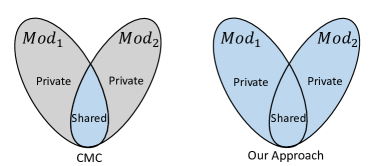
This paper proposes a novel contrastive learning framework, called FOCAL, for extracting comprehensive features from multimodal time-series sensing signals through self-supervised training. Existing multimodal contrastive frameworks mostly rely on the shared information between sensory modalities, but do not explicitly consider the exclusive modality information that could be critical to understanding the underlying sensing physics. Besides, contrastive frameworks for time series have not handled the temporal information locality appropriately. FOCAL solves these challenges by making the following contributions: First, given multimodal time series, it encodes each modality into a factorized latent space consisting of shared features and private features that are orthogonal to each other. The shared space emphasizes feature patterns consistent across sensory modalities through a modal-matching objective. In contrast, the private space extracts modality-exclusive information through a transformation-invariant objective. Second, we propose a temporal structural constraint for modality features, such that the average distance between temporally neighboring samples is no larger than that of temporally distant samples. Extensive evaluations are performed on four multimodal sensing datasets with two backbone encoders and two classifiers to demonstrate the superiority of FOCAL. It consistently outperforms the state-of-the-art baselines in downstream tasks with a clear margin, under different ratios of available labels. The code and self-collected dataset are available at https://github.com/tomoyoshki/focal.
研究动机与目标
- 通过同时利用共享信息与模态专属信息,推动多模态时间序列表示学习。
- 开发一个因子化的正交潜在空间,以区分共享特征与私有模态特征。
- 在预训练过程中引入时间局部性约束,以 Respect 时间序列结构。
- 提出用于共享、私有、正交性和时间约束的具体损失项。
- 在多数据集和多种骨干网络上证明下游分类与聚类性能的提升。
提出的方法
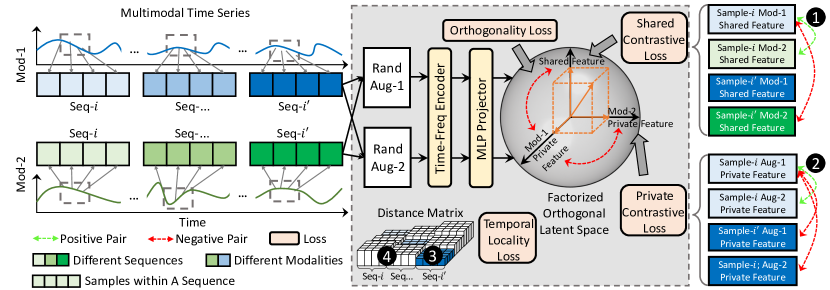
- 将每个模态编码到含有共享与私有成分的因子化潜在空间。
- 在共享空间中应用模态间和跨模态对比损失(共享空间采用 InfoNCE;私有空间采用 NT-Xent)。
- 在共享与私有分量之间以及不同模态的私有空间之间强制正交性。
- 引入时间局部性约束:预训练期间序列内平均距离 <= 序列间平均距离。
- 对每种模态进行随机增强,使用同批对比并进行不使用记忆库的对比学习。
实验结果
研究问题
- RQ1如何通过显式建模模态共享与模态私有信息来丰富多模态时间序列表示?
- RQ2在共享空间与私有空间之间强制正交性是否能提升下游的辨识能力?
- RQ3时间局部性约束是否能够更好地尊重自监督预训练中的时间序列结构?
- RQ4FOCAL 的各组件对不同数据集的下游分类和聚类任务的影响如何?
- RQ5FOCAL 对标签稀缺是否鲁棒,能否在不同骨干编码器之间实现迁移?
主要发现
- FOCAL 在四个多模态数据集和两个骨干网络上,线性探针与 KNN 微调的基线中常年领先11个基线方法。
- 私有空间与正交性约束相较仅使用共享信息,带来显著提升。
- 时间局部性约束加速收敛并在预训练阶段提升语义结构。
- 时间约束作为插件,在若干基线方法上优于 FOCAL 自身框架的表现。
- 消融实验显示移除私有空间或正交性会降低性能;时间约束带来额外提升。
阅读本论文
在 Nubint 阅读器中打开原文,边读边就任意段落提问。
在 Nubint 中阅读本论文本解读由 AI 根据论文原文生成,引用前请核对原文。