
[论文解读] Forecasting Workload in Cloud Computing: Towards Uncertainty-Aware Predictions and Transfer Learning
本文提出了一种单变量和双变量贝叶斯深度学习模型——HBNN 和 LSTMD,用于在云计算环境中实现不确定性感知的工作负载预测。通过建模随机性不确定性和认知性不确定性,这些模型通过基于置信度的资源分配提升了服务级别指标,而迁移学习仅在源领域较大且与目标领域相似时才表现出成功。
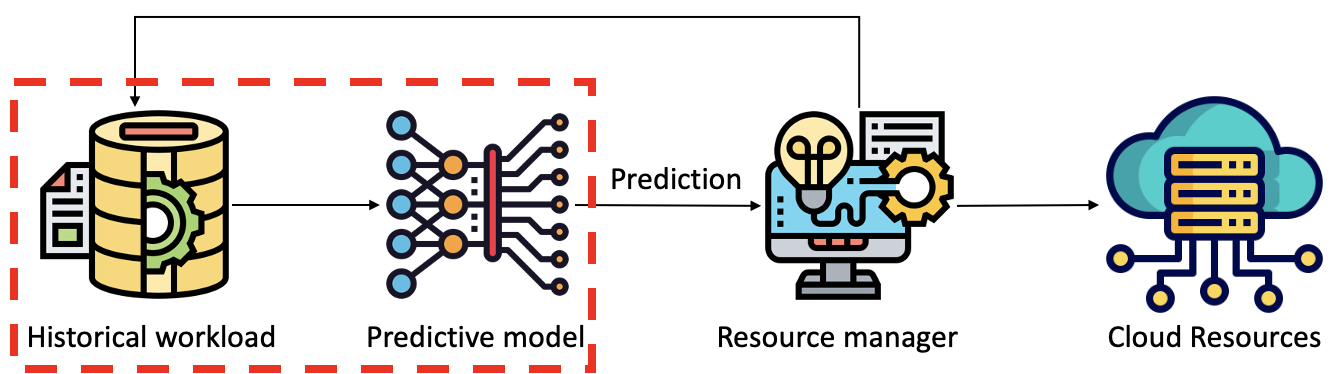
Predicting future resource demand in Cloud Computing is essential for optimizing the trade-off between serving customers' requests efficiently and minimizing the provisioning cost. Modelling prediction uncertainty is also desirable to better inform the resource decision-making process, but research in this field is under-investigated. In this paper, we propose univariate and bivariate Bayesian deep learning models that provide predictions of future workload demand and its uncertainty. We run extensive experiments on Google and Alibaba clusters, where we first train our models with datasets from different cloud providers and compare them with LSTM-based baselines. Results show that modelling the uncertainty of predictions has a positive impact on performance, especially on service level metrics, because uncertainty quantification can be tailored to desired target service levels that are critical in cloud applications. Moreover, we investigate whether our models benefit transfer learning capabilities across different domains, i.e. dataset distributions. Experiments on the same workload datasets reveal that acceptable transfer learning performance can be achieved within the same provider (because distributions are more similar). Also, domain knowledge does not transfer when the source and target domains are very different (e.g. from different providers), but this performance degradation can be mitigated by increasing the training set size of the source domain.
研究动机与目标
- 开发能够捕捉云资源需求预测中随机性不确定性和认知性不确定性的不确定性感知工作负载预测模型。
- 在来自 Google 和 Alibaba 的真实云数据集上,评估单变量和双变量贝叶斯神经网络(HBNN)以及概率性 LSTM(LSTMD)的性能。
- 研究不确定性感知模型在不同云服务提供商数据集之间迁移学习的能力,特别是在低数据量或分布外场景下。
- 评估不确定性量化是否通过支持基于置信度的资源分配策略,从而改善云服务级别指标。
- 确定迁移学习在工作负载预测中成功或失败的条件,特别是关于领域相似性和源数据集大小。
提出的方法
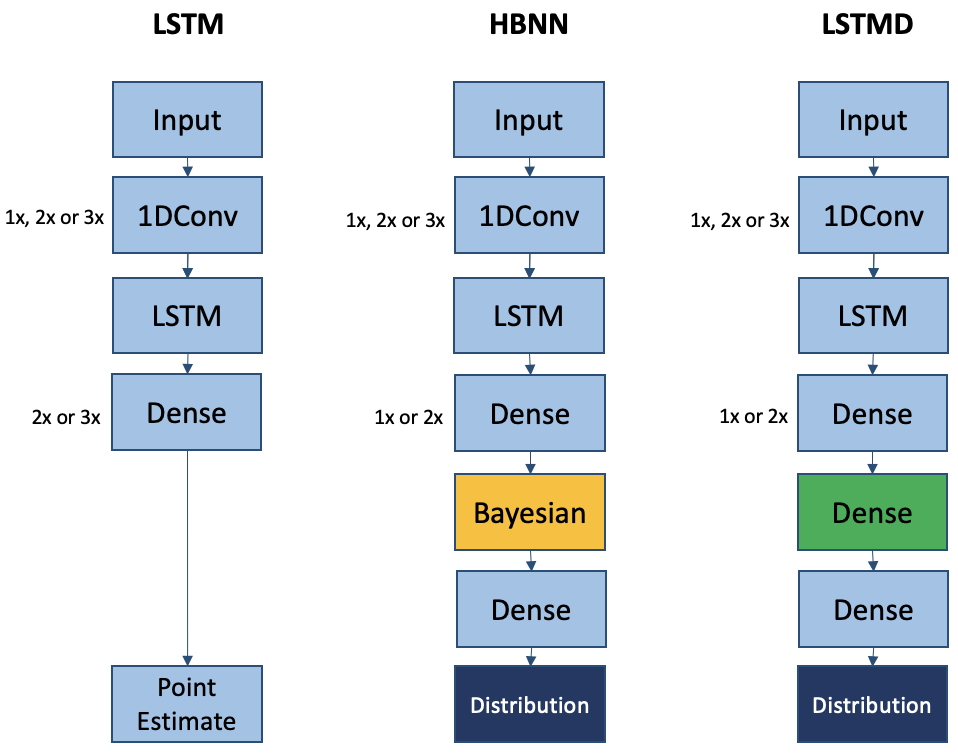
- 将贝叶斯神经网络(HBNN)和概率性 LSTM(LSTMD)架构进行适配,以预测 CPU/GPU 和内存使用量的联合分布,从而实现不确定性估计。
- 通过增加网络层数提升模型容量,以在更大规模和双变量训练数据上改善表征学习,增强泛化能力。
- 在多云提供商数据集(Google 和 Alibaba)上训练模型,以评估零样本迁移和微调场景下的迁移学习性能。
- 采用基于置信度的预测区间,并根据期望的服务水平进行定制,通过服务级别指标而非点预测精度来评估性能。
- 通过在源领域(如 Google)上训练并在目标领域(如 Alibaba)上测试来评估迁移学习,测量随着领域差异增大而产生的性能下降。
- 采用非对称损失函数和后验近似技术,以提高不确定性估计的鲁棒性。
实验结果
研究问题
- RQ1不确定性感知的深度学习模型是否能超越点估计,在工作负载预测性能上实现提升,特别是在服务级别指标方面?
- RQ2同时建模随机性不确定性和认知性不确定性如何影响云环境中的预测可靠性与资源分配决策?
- RQ3在不同云提供商或数据分布之间迁移工作负载预测知识时,迁移学习在何种条件下能够成功?
- RQ4当将知识从源域迁移到一个差异很大的目标域时,增大源域规模是否能缓解性能下降?
- RQ5不确定性感知模型是否能在实际云系统中有效部署,且具备可接受的推理延迟和可扩展性?
主要发现
- 建模不确定性显著改善了服务级别指标,通过基于置信度的资源分配实现,即使在点预测精度指标上未表现出明显优势。
- 在多个数据集上训练的双变量 HBNN(M-B-HBNN)在性能与部署复杂度之间实现了最佳平衡。
- 当源域和目标域来自不同云提供商时,迁移学习性能显著下降,尤其是在源数据集较小时。
- 微调并不总是能提升迁移性能,当源域和目标域过于不相似时,知识迁移会失败。
- 只有当源域足够大且能充分代表目标域的多样性时,才能实现可接受的迁移学习性能。
- 所有模型的运行时效率足够高,可支持在生产云环境中实时部署。
阅读本论文
在 Nubint 阅读器中打开原文,边读边就任意段落提问。
在 Nubint 中阅读本论文本解读由 AI 根据论文原文生成,引用前请核对原文。