
[论文解读] Foundation Models for Decision Making: Problems, Methods, and Opportunities
本论文综述了基础模型如何被调整用于决策制定,概述生成模型、表示学习和交互代理范式,以及在基础模型与序列决策交叉点上的开放挑战与机会。
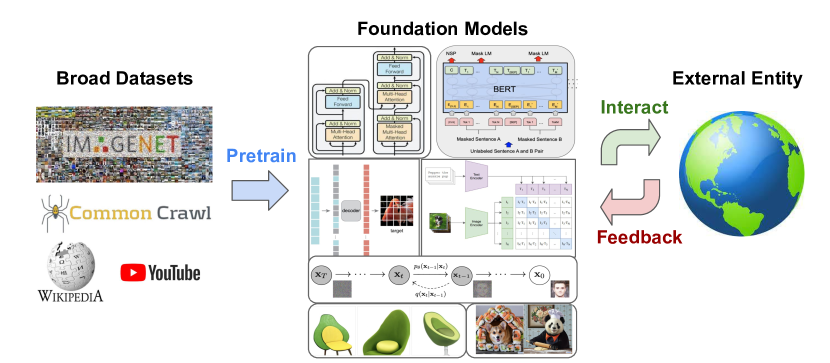
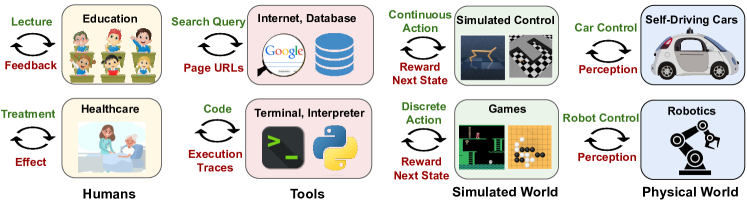
Foundation models pretrained on diverse data at scale have demonstrated extraordinary capabilities in a wide range of vision and language tasks. When such models are deployed in real world environments, they inevitably interface with other entities and agents. For example, language models are often used to interact with human beings through dialogue, and visual perception models are used to autonomously navigate neighborhood streets. In response to these developments, new paradigms are emerging for training foundation models to interact with other agents and perform long-term reasoning. These paradigms leverage the existence of ever-larger datasets curated for multimodal, multitask, and generalist interaction. Research at the intersection of foundation models and decision making holds tremendous promise for creating powerful new systems that can interact effectively across a diverse range of applications such as dialogue, autonomous driving, healthcare, education, and robotics. In this manuscript, we examine the scope of foundation models for decision making, and provide conceptual tools and technical background for understanding the problem space and exploring new research directions. We review recent approaches that ground foundation models in practical decision making applications through a variety of methods such as prompting, conditional generative modeling, planning, optimal control, and reinforcement learning, and discuss common challenges and open problems in the field.
研究动机与目标
- 解释将基础模型与序列决策结合的范围与动机。
- 提供一个技术框架与工具,帮助理解基础模型如何作为行为和世界的生成模型。
- 探索基础模型如何作为决策组成部分的表征学习者。
- 讨论语言模型如何作为交互任务中的代理与环境运行。
- 确定该交叉领域的未解决问题与未来研究的机会。
提出的方法
- 回顾顺序决策的初步概念,包括 MDPs、RL、模仿学习、规划和最优控制。
- 描述生成模型家族(潜变量、自回归、扩散、能量基)及其与决策的相关性。
- 解释基础模型如何用作行为先验和环境模型。
- 讨论即插即用表示与语言增强的任务规范用于顺序决策。
- 概述大型语言模型在互动环境中充当代理、环境或工具的方法。
实验结果
研究问题
- RQ1基础模型如何在决策任务中与外部实体建立联系并适应交互?
- RQ2哪些核心生成建模方法使基础模型能够表示行为与世界动态以用于顺序决策?
- RQ3基础模型如何作为状态、动作、奖励和转移在 MDPs 中的表征学习者?
- RQ4在将语言模型用作交互任务中的代理、环境和工具用户时,面临哪些挑战与机会?
主要发现
- 基础模型通过建模多样化的行动与目标序列,提供行为先验和通用策略。
- 对世界动态的生成建模使基于模型的规划和长期推理在决策任务中成为可能。
- 大规模行为数据与在线交互能够把通用代理扩展到超越任务特定策略。
- 以基础模型进行表示学习支持即插即用的适应与跨模态任务规范。
- 语言模型能够与人类和工具交互,在顺序决策问题中充当代理与环境。
阅读本论文
在 Nubint 阅读器中打开原文,边读边就任意段落提问。
在 Nubint 中阅读本论文本解读由 AI 根据论文原文生成,引用前请核对原文。