
[论文解读] Fourier-Net+: Leveraging Band-Limited Representation for Efficient 3D Medical Image Registration
Fourier-Net+ 通过引入带限傅里叶表示,显著降低了 3D 医疗图像配准的计算和内存成本,同时保持了最先进水平的准确性。通过在傅里叶域中学习低维位移场,并使用模型驱动解码器,它在 3D-CMR 数据上实现了 9.05 倍的推理速度提升,以及相比先前模型仅 0.35% 的乘加操作量。
U-Net style networks are commonly utilized in unsupervised image registration to predict dense displacement fields, which for high-resolution volumetric image data is a resource-intensive and time-consuming task. To tackle this challenge, we first propose Fourier-Net, which replaces the costly U-Net style expansive path with a parameter-free model-driven decoder. Instead of directly predicting a full-resolution displacement field, our Fourier-Net learns a low-dimensional representation of the displacement field in the band-limited Fourier domain which our model-driven decoder converts to a full-resolution displacement field in the spatial domain. Expanding upon Fourier-Net, we then introduce Fourier-Net+, which additionally takes the band-limited spatial representation of the images as input and further reduces the number of convolutional layers in the U-Net style network's contracting path. Finally, to enhance the registration performance, we propose a cascaded version of Fourier-Net+. We evaluate our proposed methods on three datasets, on which our proposed Fourier-Net and its variants achieve comparable results with current state-of-the art methods, while exhibiting faster inference speeds, lower memory footprint, and fewer multiply-add operations. With such small computational cost, our Fourier-Net+ enables the efficient training of large-scale 3D registration on low-VRAM GPUs. Our code is publicly available at \url{https://github.com/xi-jia/Fourier-Net}.
研究动机与目标
- 解决基于 U-Net 的 3D 医疗图像配准在高分辨率体素数据上的高计算和内存需求。
- 通过利用频谱域表示,减少基于深度学习的配准中的网络参数、内存使用和 FLOPs。
- 在不牺牲配准准确性的情况下,提升在低显存 GPU 上训练的推理速度和可扩展性。
- 通过级联架构和使用带限空间表示作为 U-Net 编码器的输入,提升性能。
提出的方法
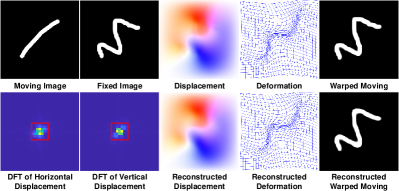
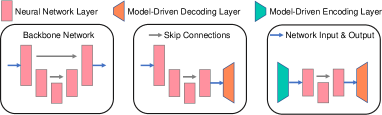
- 用参数无关的、模型驱动的解码器替代 U-Net 的扩展路径,从带限傅里叶系数中重建全分辨率位移场。
- 在傅里叶域中学习位移场的低维表示,从而减少参数数量和操作量。
- 提出 Fourier-Net+,其将带限空间表示作为输入送入 U-Net 的收缩路径,进一步减少卷积层和计算成本。
- 通过堆叠多个 Fourier-Net+ 阶段并逐步优化,采用级联架构以提升配准精度。
- 使用离散傅里叶变换(DFT)将位移场投影到频域,并在解码后通过逆 DFT 重建。
- 通过将傅里叶系数限制在低频区域,施加带限约束,保留关键形变信息,同时丢弃高频噪声。
实验结果
研究问题
- RQ1位移场的带限傅里叶表示能否降低 3D 医疗图像配准的计算和内存开销?
- RQ2用模型驱动的、无参数的替代方案替换 U-Net 的解码器,是否能在提升效率的同时保持配准准确性?
- RQ3将带限空间表示作为 U-Net 编码器的输入,能否进一步降低 FLOPs 和内存使用?
- RQ4与单阶段基线相比,级联的 Fourier-Net+ 架构在配准性能上如何提升?
- RQ5Fourier-Net+ 在不牺牲准确性或速度的前提下,能在低显存 GPU 上实现多大程度的训练支持?
主要发现
- 在 3D-CMR 数据集上,Fourier-Net+ 的 Dice 分数分别比 TransMorph 和 LKU-Net 高 7.1% 和 7.5%。
- 在 3D-CMR 数据集上,Fourier-Net+ 的推理速度比 TransMorph 快 9.05 倍,比 LKU-Net 快 4.42 倍。
- 在 3D-CMR 数据集上,Fourier-Net+ 的乘加操作量仅占 TransMorph 的 0.35%,内存使用量为 2.07%。
- 在两个脑部 MRI 和一个心脏 MRI 数据集上,该模型实现了与最先进方法相当或更优的配准准确性。
- 与单阶段版本相比,级联的 Fourier-Net+ 变体在平均 Dice 分数上进一步提升了 0.5–1.0%。
- Fourier-Net+ 实现了在低显存 GPU(如 16GB)上的训练,仅带来极小的内存开销,使在标准硬件上实现大规模 3D 配准成为可能。
阅读本论文
在 Nubint 阅读器中打开原文,边读边就任意段落提问。
在 Nubint 中阅读本论文本解读由 AI 根据论文原文生成,引用前请核对原文。