
[论文解读] Fourier Neural Operator for Plasma Modelling
本文展示 Fourier Neural Operator (FNO) 作为快速代理模型和数字双胞胎,用于 MHD 模拟和 MAST 相机观测中的等离子体演化,在速度和参数效率方面超越 Conv-LSTM 与 U-Net,同时保持精度。
Predicting plasma evolution within a Tokamak is crucial to building a sustainable fusion reactor. Whether in the simulation space or within the experimental domain, the capability to forecast the spatio-temporal evolution of plasma field variables rapidly and accurately could improve active control methods on current tokamak devices and future fusion reactors. In this work, we demonstrate the utility of using Fourier Neural Operator (FNO) to model the plasma evolution in simulations and experiments. Our work shows that the FNO is capable of predicting magnetohydrodynamic models governing the plasma dynamics, 6 orders of magnitude faster than the traditional numerical solver, while maintaining considerable accuracy (NMSE $\sim 10^{-5})$. Our work also benchmarks the performance of the FNO against other standard surrogate models such as Conv-LSTM and U-Net and demonstrate that the FNO takes significantly less time to train, requires less parameters and outperforms other models. We extend the FNO approach to model the plasma evolution observed by the cameras positioned within the MAST spherical tokamak. We illustrate its capability in forecasting the formation of filaments within the plasma as well as the heat deposits. The FNO deployed to model the camera is capable of forecasting the full length of the plasma shot within half the time of the shot duration.
研究动机与目标
- 推动快速的等离子体演化预测,以实现托卡马克的实时控制,并减少对计算密集型代码的依赖。
- 证明傅里叶神经算子能够以网格不变的方式学习 MHD 解映射。
- 在仿真数据和实验相机数据上,将 FNO 与标准代理模型(Conv-LSTM、U-Net)进行基准对比。
- 探索将 FNO 作为基于相机的等离子体状态预测的数字双胞胎,用于 MAST 托卡马克。
提出的方法
- 在自回归框架中采用 2D Fourier Neural Operator (FNO-2d),将 20 个输入时间步映射到接下来的 5 个时间步,迭代预测直到 T_out=70。
- 为密度、势和涡度场分别训练独立的 FNO,输入为 100x100 网格、32 维特征,每层最多 16 个傅里叶模。
- 在相同训练条件下(Adam 优化器、500 轮、批量大小 5)将 FNO 与 ConvLSTM 和 U-Net 架构进行比较。
- 将 FNO 方法扩展到来自 MAST 的实验快速相机数据,以预测中心电磁线圈相机和偏分器相机观测到的等离子体演化,使用经过标定的统一网格。
实验结果
研究问题
- RQ1FNO 是否能在环形几何下高效且准确地学习简化 MHD 方程的解算子?
- RQ2在训练时间、参数数量和 NMSE 方面,FNO 与 Conv-LSTM 和 U-Net 的比较如何?
- RQ3FNO 是否能够对实验相机数据建模,作为托卡马克等离子体的实时数字双胞胎,包括丝状结构形成和热沉积模式?
- RQ4基于相机诊断的 FNO 预测能力在预测 ELM 或 L-H 转变等事件方面表现如何?
主要发现
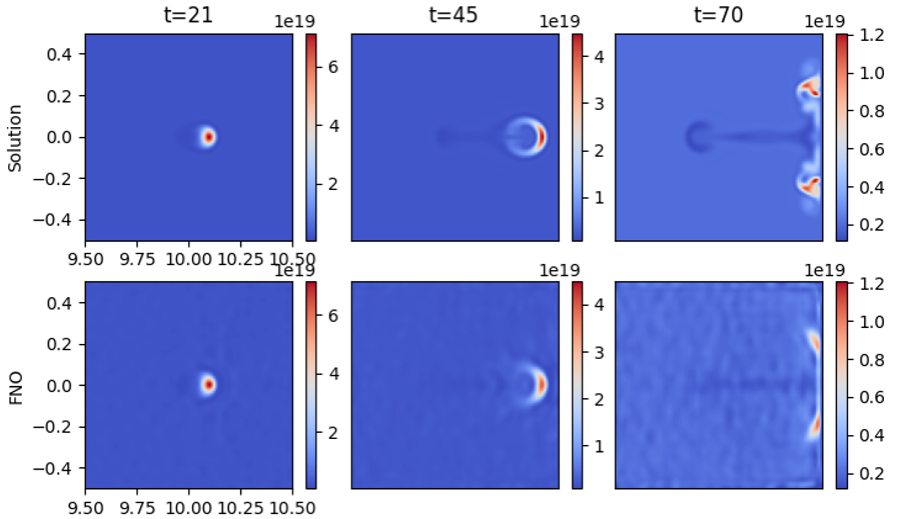
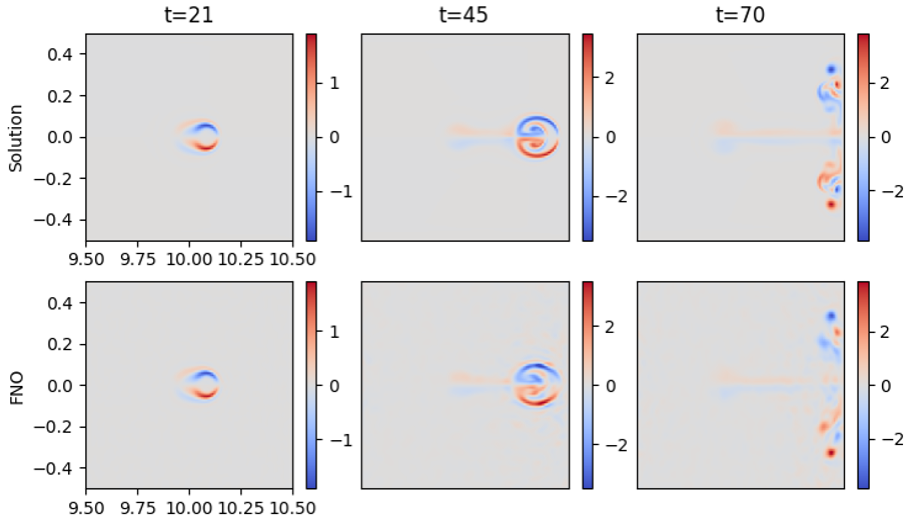
- FNO 能以 NMSE 约为 4–5×10^-5,预测包括电势、密度和涡度在内的简化 MHD 演化。
- FNO 推理时间为每次 0.025 s,远快于传统求解器和对比代理。
- FNO 的参数量和训练时间远少于 ConvLSTM 和 U-Net,同时提供更优或可比的精度。
- 在 MAST 相机数据上,FNO 在中心电磁线圈相机的 NMSE 约为 0.04,在偏分器相机为约 0.014,能预测直到剩余拍摄持续时间的全段。
- FNO 能有效捕捉全局等离子体特征和热通量区域,尽管局部像素级精度可能受限。
- 该框架显示出在聚变装置中的实时规划与控制以及诊断数字双胞胎方面的潜力。
阅读本论文
在 Nubint 阅读器中打开原文,边读边就任意段落提问。
在 Nubint 中阅读本论文本解读由 AI 根据论文原文生成,引用前请核对原文。