
[论文解读] FourierGNN: Rethinking Multivariate Time Series Forecasting from a Pure Graph Perspective
tldr: FourierGNN 将多变量时间序列预测重新定义为对超变量图的预测,并使用 Fourier Graph Operator 在傅立叶空间执行卷积,在更低的复杂度下达到行业领先的准确性。
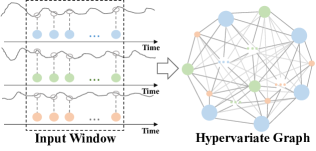
Multivariate time series (MTS) forecasting has shown great importance in numerous industries. Current state-of-the-art graph neural network (GNN)-based forecasting methods usually require both graph networks (e.g., GCN) and temporal networks (e.g., LSTM) to capture inter-series (spatial) dynamics and intra-series (temporal) dependencies, respectively. However, the uncertain compatibility of the two networks puts an extra burden on handcrafted model designs. Moreover, the separate spatial and temporal modeling naturally violates the unified spatiotemporal inter-dependencies in real world, which largely hinders the forecasting performance. To overcome these problems, we explore an interesting direction of directly applying graph networks and rethink MTS forecasting from a pure graph perspective. We first define a novel data structure, hypervariate graph, which regards each series value (regardless of variates or timestamps) as a graph node, and represents sliding windows as space-time fully-connected graphs. This perspective considers spatiotemporal dynamics unitedly and reformulates classic MTS forecasting into the predictions on hypervariate graphs. Then, we propose a novel architecture Fourier Graph Neural Network (FourierGNN) by stacking our proposed Fourier Graph Operator (FGO) to perform matrix multiplications in Fourier space. FourierGNN accommodates adequate expressiveness and achieves much lower complexity, which can effectively and efficiently accomplish the forecasting. Besides, our theoretical analysis reveals FGO's equivalence to graph convolutions in the time domain, which further verifies the validity of FourierGNN. Extensive experiments on seven datasets have demonstrated our superior performance with higher efficiency and fewer parameters compared with state-of-the-art methods.
研究动机与目标
- 以统一的时空视角来驱动预测,避免分离的空间网络和时间网络之间的不匹配。
- 提出一种超变量图数据结构,将跨变量和时间戳的所有值表示为图节点。
- 开发含有 Fourier Graph Operator 的 FourierGNN,以在傅立叶空间中执行图计算以提高效率。
- 在理论上分析 FourierGNN,确立其与时域图卷积的等价性,并展示效率提升。
- 在七个真实世界数据集上展示强劲的经验表现,参数更少、训练更快。
提出的方法
- 定义一个超变量图,其中输入窗口 X_t 在 R^{N×T} 的每个元素都是一个图节点,形成一个全连接的 NT 节点图。
- 引入 Fourier Graph Operator (FGO),在傅立叶空间中计算基核加权卷积,使得复杂度为 O(n log n)。
- 堆叠多个 FGO 以形成 FourierGNN,其输出在傅立叶空间中计算并通过 IDFT 转换回时域。
- 证明 FourierGNN 的递归傅立叶空间乘法等价于时域多阶图卷积(命题 1)。
- 通过对节点进行嵌入、应用 DFT、执行 FGOs,并通过全连接层投影到未来步来实现 MTS 预测的 FourierGNN。
- 通过对比傅立叶域运算与时域图卷积,突出其更低的计算复杂度。
实验结果
研究问题
- RQ1Can a pure graph-based model capture both inter-series (spatial) and intra-series (temporal) dependencies without temporal networks?
- RQ2Does representing MTS data as a hypervariate graph enable more accurate and efficient forecasting than traditional two-network designs?
- RQ3Is the Fourier Graph Operator equivalent to time-domain graph convolutions, and does it offer practical complexity benefits?
- RQ4Can FourierGNN achieve state-of-the-art forecasting performance across diverse real-world datasets while using fewer parameters?
主要发现
- FourierGNN achieves state-of-the-art results across seven real-world datasets.
- On average, FourierGNN improves MAE by more than 9.4% and RMSE by more than 10.9% over best baselines.
- FourierGNN requires about 14.6% less training time and 20% fewer parameters than many lightweight GNN baselines.
- The model exhibits higher efficiency and scalability due to log-linear complexity in graph operations.
- Ablation studies show the importance of node embedding and multi-order diffusion for performance gains.
- Visualization indicates FourierGNN learns meaningful temporal and spatial dependencies reflected in learned adjacency patterns.

阅读本论文
在 Nubint 阅读器中打开原文,边读边就任意段落提问。
在 Nubint 中阅读本论文本解读由 AI 根据论文原文生成,引用前请核对原文。