
[论文解读] From Crowdsourced Data to High-Quality Benchmarks: Arena-Hard and BenchBuilder Pipeline
本文提出 BenchBuilder,一个从众包数据中提取高质量提示的数据管道,用以构建 Arena-Hard-Auto v0.1,这是一个完全自动化的基准测试,在模型可分离性方面表现出色,并在低成本下与人类偏好具有高度一致性。
The rapid evolution of Large Language Models (LLMs) has outpaced the development of model evaluation, highlighting the need for continuous curation of new, challenging benchmarks. However, manual curation of high-quality, human-aligned benchmarks is expensive and time-consuming. To address this, we introduce BenchBuilder, an automated pipeline that leverages LLMs to curate high-quality, open-ended prompts from large, crowd-sourced datasets, enabling continuous benchmark updates without human in the loop. We apply BenchBuilder to datasets such as Chatbot Arena and WildChat-1M, extracting challenging prompts and utilizing LLM-as-a-Judge for automatic model evaluation. To validate benchmark quality, we propose new metrics to measure a benchmark's alignment with human preferences and ability to separate models. We release Arena-Hard-Auto, a benchmark consisting 500 challenging prompts curated by BenchBuilder. Arena-Hard-Auto provides 3x higher separation of model performances compared to MT-Bench and achieves 98.6% correlation with human preference rankings, all at a cost of $20. Our work sets a new framework for the scalable curation of automated benchmarks from extensive data.
研究动机与目标
- 推动需要不断进化、开放式基准以跟上迅速发展的 LLMs 的步伐。
- 提出 BenchBuilder 自动从众包数据中 curate 高质量提示。
- 展示 Arena-Hard-Auto v0.1 能够自信地区分模型并与人类偏好保持一致。
提出的方法
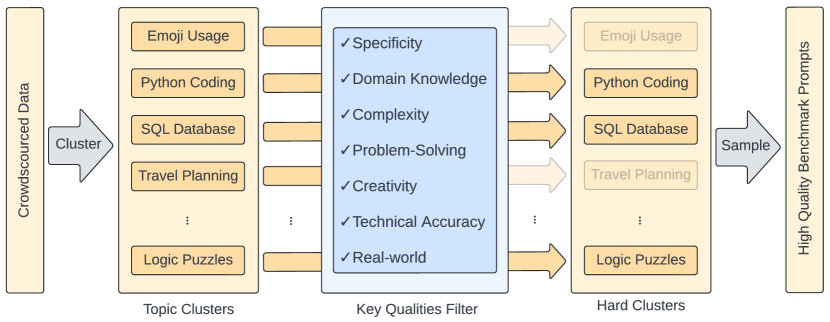
- 定义七个提示质量指标(如具体性、领域知识、复杂性、问题解决、创造力、技术准确性、现实世界应用)并使用 LLM 标注者对提示进行评分。
- 通过嵌入式主题建模对提示进行聚类(BERTopic 使用 OpenAI 嵌入、UMAP、HDBSCAN),形成主题簇。
- 按平均质量对簇进行筛选,并在簇之间均匀抽样提示以确保多样性。
- 使用 GPT-3.5-Turbo/GPT-4-Turbo 对提示进行评分,使用 GPT-4-Turbo 作为评判者,通过 LLM 判断评估的人类偏好一致性。
- 用自举置信区间和 Bradley-Terry 框架评估模型排名以生成最终分数。
- 将 Arena-Hard-Auto v0.1 与 MT-Bench 和 AlpacaEval 在可分离性和一致性方面进行比较;发布开源基准和 BenchBuilder 流水线。
实验结果
研究问题
- RQ1一个由众包数据构建的活生生的基准在多大程度上能够自信地区分最先进的模型?
- RQ2七个定义的提示质量指标是否能引导自动化筛选,生成高质量、多样化的基准?
- RQ3基于 LLM 的评判者是否能为模型评估提供可靠的自动化与人类偏好的一致性?
- RQ4Arena-Hard-Auto v0.1 与现有基准在可分离性和与人类排名的一致性方面有何比较?
主要发现
- Arena-Hard-Auto v0.1 相对于 MT-Bench 和 AlpacaEval 在置信区间更窄且分离性更强。
- Arena-Hard-Auto v0.1 在每次评估成本为 $25 时,与 Chatbot Arena 人类排名的一致性达到 89.1%。
- BenchBuilder 可以从 200,000 个 Chatbot Arena 查询中提取高质量提示,产生 500 条聚类为多样且具挑战性的任务的提示。
- GPT-4-Turbo 作为评判者对真实标签的准确率达到 85.6%,支持其作为标注器的使用。
- 对多个评判者进行集成(如 GPT-4-Turbo 加 Gemini-1.5-Pro)可提升一致性和分离性。
- Arena-Hard-Auto v0.1 展现出与人类偏好的一致性强,优于随机提示子集,并对模型对之间具有鲁棒性。

阅读本论文
在 Nubint 阅读器中打开原文,边读边就任意段落提问。
在 Nubint 中阅读本论文本解读由 AI 根据论文原文生成,引用前请核对原文。