
[论文解读] From human experts to machines: An LLM supported approach to ontology and knowledge graph construction
本文提出一种使用开源大型语言模型的半自动流水线来生成能力问题、构建本体并构建知识图谱,并有人工在环评估和一个裁判 LLM 进行评分。
The conventional process of building Ontologies and Knowledge Graphs (KGs) heavily relies on human domain experts to define entities and relationship types, establish hierarchies, maintain relevance to the domain, fill the ABox (or populate with instances), and ensure data quality (including amongst others accuracy and completeness). On the other hand, Large Language Models (LLMs) have recently gained popularity for their ability to understand and generate human-like natural language, offering promising ways to automate aspects of this process. This work explores the (semi-)automatic construction of KGs facilitated by open-source LLMs. Our pipeline involves formulating competency questions (CQs), developing an ontology (TBox) based on these CQs, constructing KGs using the developed ontology, and evaluating the resultant KG with minimal to no involvement of human experts. We showcase the feasibility of our semi-automated pipeline by creating a KG on deep learning methodologies by exploiting scholarly publications. To evaluate the answers generated via Retrieval-Augmented-Generation (RAG) as well as the KG concepts automatically extracted using LLMs, we design a judge LLM, which rates the generated content based on ground truth. Our findings suggest that employing LLMs could potentially reduce the human effort involved in the construction of KGs, although a human-in-the-loop approach is recommended to evaluate automatically generated KGs.
研究动机与目标
- 在保持质量的同时,推动减少在本体和 KG 构建中的人工工作量。
- 展示一个从能力问题开始到 KG 构建的半自动流水线。
- 重用现有本体(如 PROV-O),并将 LLM 生成的内容与真实值进行评估。
- 通过从生物多样性学术出版物构建一个 DL 方法论 KG 来展示可行性。
提出的方法
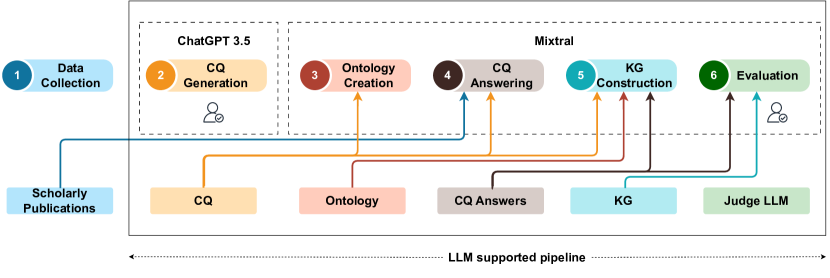
- 六组件流水线:数据收集、能力问题(CQ) 生成、本体创建、CQ 回答、KG 构建、评估。
- 在零样本设置中使用开源 LLM(经过比较后选择 Mixtral 8x7B),结合检索增强生成(RAG)来回答 CQ。
- 从 CQ 与问答构建本体,重用 PROV-O 作为基础本体,并将 CQ 答案映射到 KG 概念。
- 使用检索增强生成从五篇生物多样性出版物中回答 CQ。
- 使用裁判 LLM 对照基准评估 CQ 答案和 KG 概念;对五篇文章进行了标注。
- 通过 GitHub 提供公开代码和数据以实现可重复性。
实验结果
研究问题
- RQ1开放源代码 LLM 是否能在人工在环验证下半自动化地生成 CQ、创建本体和构建 KG?
- RQ2在与真实值对照评估时,LLM 生成的 CQ 答案及其所得到的 KG 的质量如何?
- RQ3提示设计与 RAG 配置如何影响最终的本体与 KG?
- RQ4PROV-O 是否适合作为该半自动工作流中 DL 流水线即用的基础本体?
- RQ5在生物多样性 DL 方法中实现可用 KG 的自动化与人工劳动之间的折衷是什么?
主要发现
- 生成了 40 个能力问题以覆盖 DL 流水线阶段。
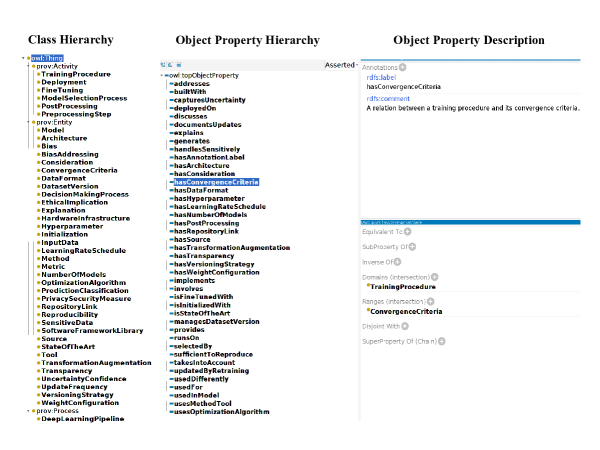
- 使用 PROV-O 重用,创建了 具有 45 个类、41 种关系和 365 条公理的 DLProv 本体。
- 在人类注释者与 LLM 裁判之间在 200 个评估的 CQ 答案中存在 42 处分歧。
- 最佳 KG 性能(与 CQ 答案对齐的 KG 个体比例)在五篇出版物中随提示/CQ 答案组合而异。
- 在五篇出版物中,一些提示/CQ 组合产生了有意义的 KG,而另一些则未产生有意义的 KG(用 x 表示)。
- 单条流水线在某一组合上达到最高 91.53% 的对齐率,其他组合在不同情况下分别达到 81.48%、82.76%、77.55%、68.06% 和 66.67%。
阅读本论文
在 Nubint 阅读器中打开原文,边读边就任意段落提问。
在 Nubint 中阅读本论文本解读由 AI 根据论文原文生成,引用前请核对原文。