
[论文解读] From LLMs to LLM-based Agents for Software Engineering: A Survey of Current, Challenges and Future
一项调查区分软件工程中的 LLMs 与基于 LLM 的代理,涵盖六个 SE 领域、基准测试和未来方向。
With the rise of large language models (LLMs), researchers are increasingly exploring their applications in var ious vertical domains, such as software engineering. LLMs have achieved remarkable success in areas including code generation and vulnerability detection. However, they also exhibit numerous limitations and shortcomings. LLM-based agents, a novel tech nology with the potential for Artificial General Intelligence (AGI), combine LLMs as the core for decision-making and action-taking, addressing some of the inherent limitations of LLMs such as lack of autonomy and self-improvement. Despite numerous studies and surveys exploring the possibility of using LLMs in software engineering, it lacks a clear distinction between LLMs and LLM based agents. It is still in its early stage for a unified standard and benchmarking to qualify an LLM solution as an LLM-based agent in its domain. In this survey, we broadly investigate the current practice and solutions for LLMs and LLM-based agents for software engineering. In particular we summarise six key topics: requirement engineering, code generation, autonomous decision-making, software design, test generation, and software maintenance. We review and differentiate the work of LLMs and LLM-based agents from these six topics, examining their differences and similarities in tasks, benchmarks, and evaluation metrics. Finally, we discuss the models and benchmarks used, providing a comprehensive analysis of their applications and effectiveness in software engineering. We anticipate this work will shed some lights on pushing the boundaries of LLM-based agents in software engineering for future research.
研究动机与目标
- 解释软件工程中 LLMs 与基于 LLM 的代理之间的区别。
- 对六个 SE 领域进行调查,以映射任务、基准和评估指标。
- 识别前沿技术、数据集和实验方法。
- 强调上下文长度、幻觉与工具集成等挑战。
- 为未来在 SE 中使用 LLM 基于代理的研究和基准测试提供指南。
提出的方法
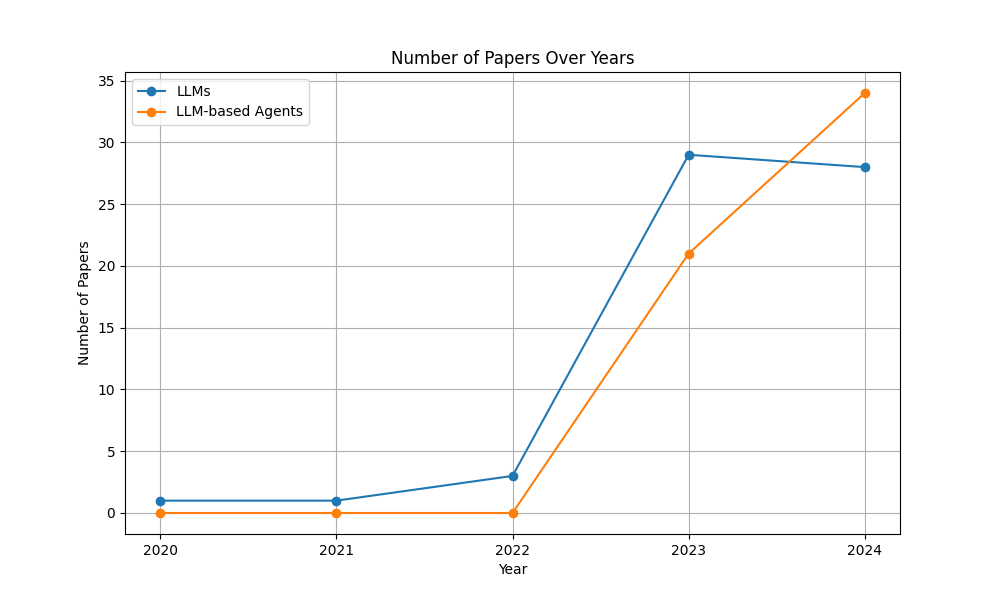
- 从 DBLP 和 arXiv 收集文献,聚焦 2023 年末至 2024 年 5 月。
- 人工筛选以排除非 LLM 论文和低质量投稿。
- 雪球式检索以覆盖初始未捕获但有影响力的工作。
- 按六个 SE 领域进行分类分析,区分 LLM 与基于 LLM 的代理。
- 比较 LLM 与代理在任务、基准和评估指标方面的差异。
实验结果
研究问题
- RQ1RQ1: 在 SE 领域中,LLMs 和基于 LLM 的代理的前沿技术与实践是什么?
- RQ2RQ2: 在 SE 应用中,LLMs 与基于 LLM 的代理在任务性能方面的关键差异是什么?
- RQ3RQ3: 用于评估 SE 任务中 LLMs 和基于 LLM 的代理性能的基准数据集和评估指标中,最常用的是哪些?
- RQ4RQ4: 在在 SE 中使用 LLM 的实验模型和方法论有哪些主导趋势?
主要发现
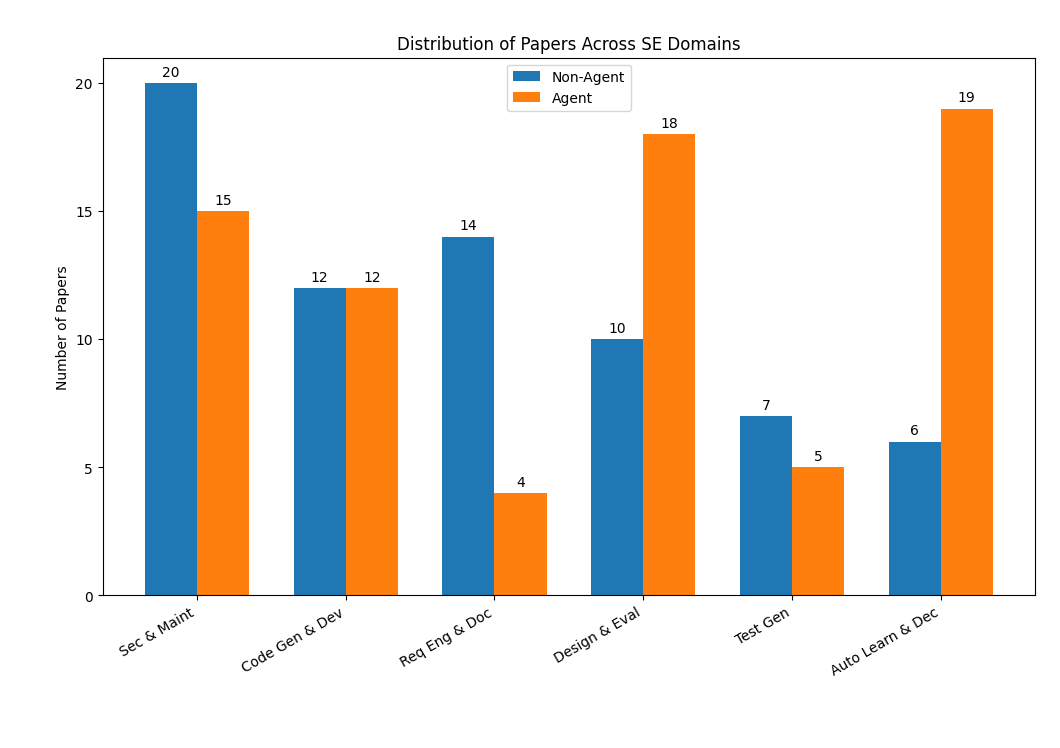
- 该调查区分了 LLMs 与基于 LLM 的代理,并将其映射到六个 SE 领域。
- 分析用于评估 LLMs 与代理在 SE 中的基准和度量。
- 指出在 SE 中缺乏统一的标准和基准用于基于 LLM 的代理。
- 总结了架构、RAG(检索增强生成)和工具使用等关键使能技术。
- 讨论单一代理与多代理系统及其对上下文管理和鲁棒性的影响。
- 汇总了当前应用的全面视角及未来研究方向。
阅读本论文
在 Nubint 阅读器中打开原文,边读边就任意段落提问。
在 Nubint 中阅读本论文本解读由 AI 根据论文原文生成,引用前请核对原文。