
[论文解读] From Persona to Personalization: A Survey on Role-Playing Language Agents
由大型语言模型驱动的角色扮演语言代理(RPLA)的综合综述,将人设分为人口统计型、角色型和个性化类型,并概述构建、评估、风险和应用。
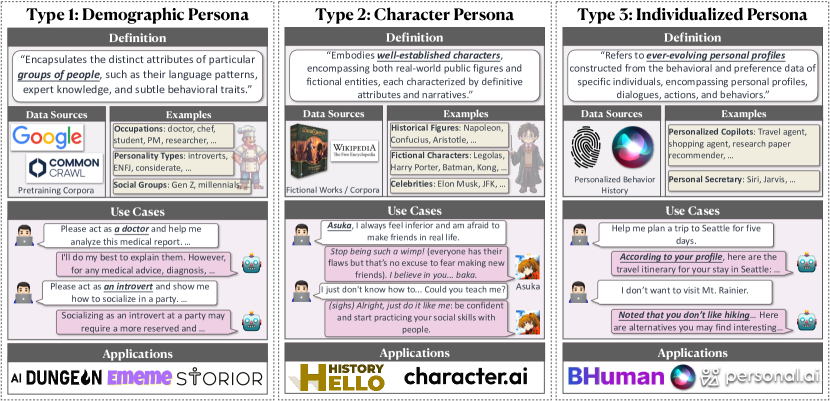
Recent advancements in large language models (LLMs) have significantly boosted the rise of Role-Playing Language Agents (RPLAs), i.e., specialized AI systems designed to simulate assigned personas. By harnessing multiple advanced abilities of LLMs, including in-context learning, instruction following, and social intelligence, RPLAs achieve a remarkable sense of human likeness and vivid role-playing performance. RPLAs can mimic a wide range of personas, ranging from historical figures and fictional characters to real-life individuals. Consequently, they have catalyzed numerous AI applications, such as emotional companions, interactive video games, personalized assistants and copilots, and digital clones. In this paper, we conduct a comprehensive survey of this field, illustrating the evolution and recent progress in RPLAs integrating with cutting-edge LLM technologies. We categorize personas into three types: 1) Demographic Persona, which leverages statistical stereotypes; 2) Character Persona, focused on well-established figures; and 3) Individualized Persona, customized through ongoing user interactions for personalized services. We begin by presenting a comprehensive overview of current methodologies for RPLAs, followed by the details for each persona type, covering corresponding data sourcing, agent construction, and evaluation. Afterward, we discuss the fundamental risks, existing limitations, and future prospects of RPLAs. Additionally, we provide a brief review of RPLAs in AI applications, which reflects practical user demands that shape and drive RPLA research. Through this work, we aim to establish a clear taxonomy of RPLA research and applications, and facilitate future research in this critical and ever-evolving field, and pave the way for a future where humans and RPLAs coexist in harmony.
研究动机与目标
- 定义 RPLA 人设的分类体系(人口统计型、角色型、个性化)并在 RPLA 中推动个性化的动机。
- 调查每种人设类型的数据源、构建方法和评估标准。
- 讨论风险、局限性和未来方向,以引导安全、有效的 RPLA 研究与应用。
提出的方法
- 调研现有的构建 RPLA 的方法学,包括参数化训练和非参数化提示。
- 描述用于实现拟人化行为的记忆、工具使用和规划模块。
- 总结每种人设类型(人口统计、角色、个性化)的数据源与构建方法。
- 概述角色扮演能力和人设忠实度的评估标准。
- 提供可用于分析 RPLA 研究与应用的分类体系和框架。
实验结果
研究问题
- RQ1RPLA 如何被归类为人口统计型、角色型和个性化人设,以及每种类型由哪些数据源支持?
- RQ2哪些常见的构建技术和模块(记忆、工具、规划)使 RPLA 能够模拟人设?
- RQ3就角色扮演能力及对分配人设的忠实度而言,如何评估 RPLA?
- RQ4与每种人设类别相关的实际应用与风险有哪些?
- RQ5在安全有效的 RPLA 研究与部署方面,存在哪些未来方向和空白?
主要发现
- RPLAs 可有效地分为三种递进的人设类型:人口统计型、角色型和个性化。
- 记忆、工具使用和规划模块是实现 RPLA 中动态、上下文感知角色扮演的核心。
- 参数化训练适用于人口统计和角色人设,而提示方法在个性化个体化中较为常见。
- 评估区分角色扮演能力与对特定个人或人口统计的人设忠实度。
- RPLAs 的应用范围广泛,从数字克隆与伴侣到互动游戏,但也带来毒性、偏见、幻觉和隐私等风险。
阅读本论文
在 Nubint 阅读器中打开原文,边读边就任意段落提问。
在 Nubint 中阅读本论文本解读由 AI 根据论文原文生成,引用前请核对原文。