
[论文解读] FSCE: Few-Shot Object Detection via Contrastive Proposal Encoding
FSCE 在 RoI 头中引入对比性提案编码分支,使用有监督对比损失来提升少样本目标检测,在 PASCAL VOC 和 COCO 的所有 shot 设置中均达到最新状态(SOTA)。
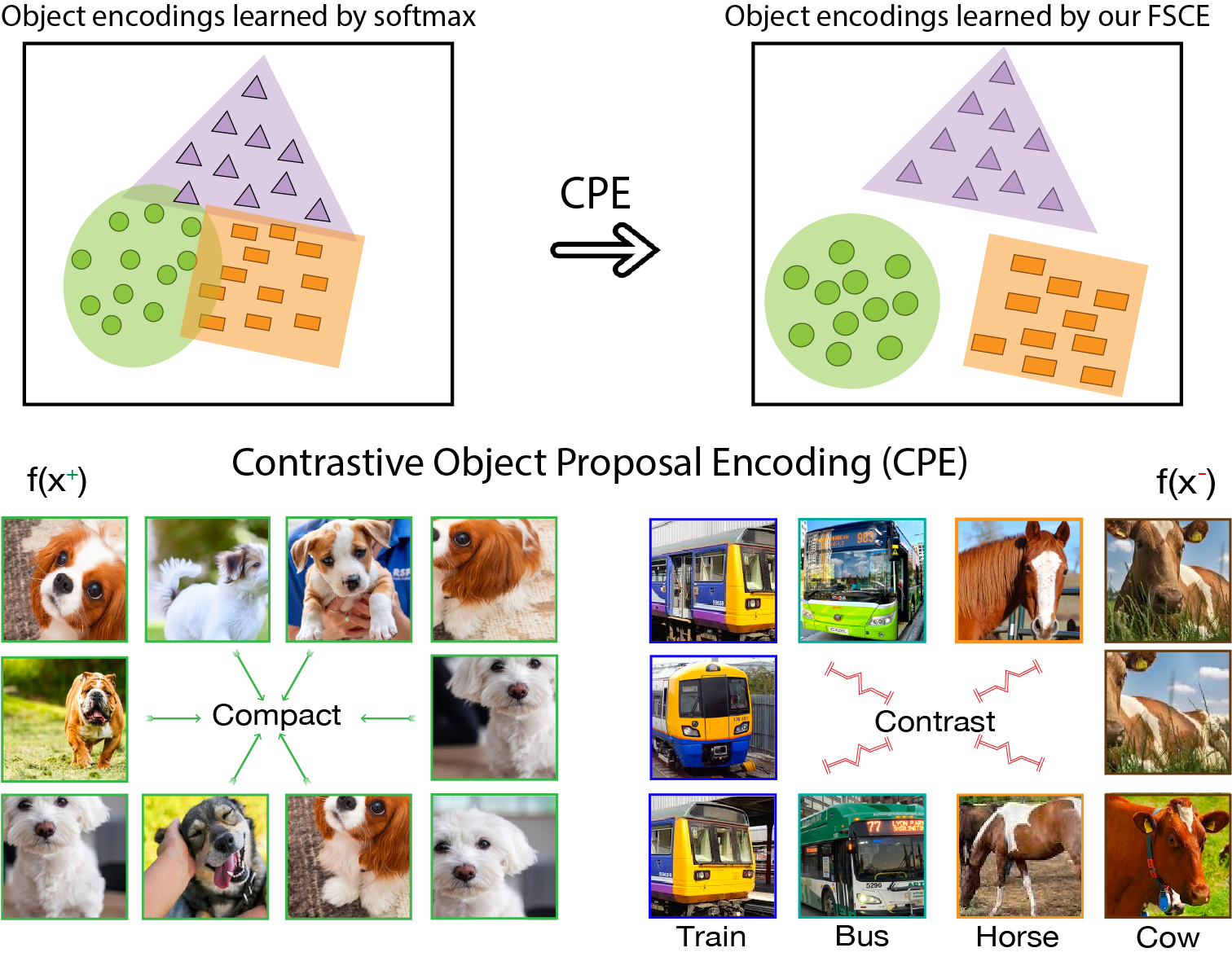
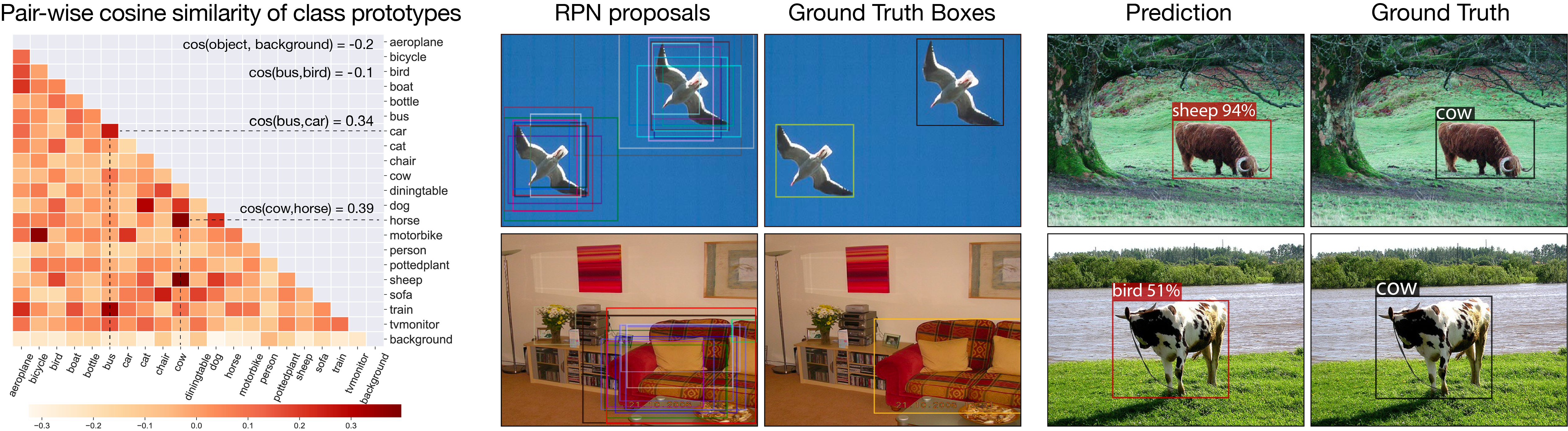
Emerging interests have been brought to recognize previously unseen objects given very few training examples, known as few-shot object detection (FSOD). Recent researches demonstrate that good feature embedding is the key to reach favorable few-shot learning performance. We observe object proposals with different Intersection-of-Union (IoU) scores are analogous to the intra-image augmentation used in contrastive approaches. And we exploit this analogy and incorporate supervised contrastive learning to achieve more robust objects representations in FSOD. We present Few-Shot object detection via Contrastive proposals Encoding (FSCE), a simple yet effective approach to learning contrastive-aware object proposal encodings that facilitate the classification of detected objects. We notice the degradation of average precision (AP) for rare objects mainly comes from misclassifying novel instances as confusable classes. And we ease the misclassification issues by promoting instance level intra-class compactness and inter-class variance via our contrastive proposal encoding loss (CPE loss). Our design outperforms current state-of-the-art works in any shot and all data splits, with up to +8.8% on standard benchmark PASCAL VOC and +2.7% on challenging COCO benchmark. Code is available at: https: //github.com/MegviiDetection/FSCE
研究动机与目标
- 在极端数据稀缺的条件下,通过学习鲁棒且具辨别性的目标提案表示来推动 FSOD 的改进。
- 通过对区域提案进行有监督对比学习,利用类内紧凑性和类间分离性。
- 将对比提案编码损失(CPE)集成到 Faster R-CNN 框架中,而不需要大幅改动训练流水线。
- 在标准基准的 1、2、3、5、10、30-shot 设置下展示超越现有方法的性能。
提出的方法
- 在 RoI 头中扩展一个并行的对比分支,通过一个小的 MLP 头将提案编码为对比特征。
- 在 RoI 特征上使用基于余弦相似度的分类器,并采用温度缩放的损失以与对比目标保持一致。
- 定义一个 CPE 损失,强制实现提案的类内紧凑和类间分离,权重由基于 IoU 的提案一致性决定。
- 采用两阶段训练协议:先在基础类别上训练,然后在冻结骨干的同时,使用新颖与基础数据的平衡混合进行微调。
- 在微调阶段通过将 L_rpn、L_cls、L_reg 与 lambda*L_CPE 结合来平衡多任务学习。
- 表明该方法可以通过一个简单、成本极低的对比头实现,且可以插入到两阶段检测器中。
实验结果
研究问题
- RQ1在 FSOD 中,区域提案上的实例级对比学习是否能减少将新对象误分类为易混淆的基础类别的情况?
- RQ2在数据稀缺的情况下,学习对比感知的提案嵌入是否能改善相似对象类别之间的分离?
- RQ3基于 IoU 的提案一致性控制对 CPE 损失效果的影响是什么?
主要发现
- FSCE 在 PASCAL VOC 和 COCO 的全 shot 设置中实现了最先进的结果。
- 在 VOC 上,FSCE 相比之前的 SOTA 在 Novel Split 3 上最高提升到 +8.8 AP,并且该方法保持了基础类别的性能。
- 在 COCO 上,FSCE 相比之前的 SOTA 提升了 +2.7 AP75。
- 消融实验显示通过联调 RPN 和 RoI 特征以获得更强的基线,能显著提升新对象的性能。
- CPE 损失通过紧缩类内提案并扩大类间边界来提升性能,这一点可从 t-SNE 可视化和定量增益中看出。
- 提出的基于 IoU 的提案一致性控制(phi 和 g)提高了鲁棒性,特别是在极低 shot 情况下。)
阅读本论文
在 Nubint 阅读器中打开原文,边读边就任意段落提问。
在 Nubint 中阅读本论文本解读由 AI 根据论文原文生成,引用前请核对原文。