
[论文解读] Full Eigenstate Thermalization via Free Cumulants in Quantum Lattice Systems
该论文通过将高阶相关分解为自由累积量来数值检验 chaotically 多体系统中的一般 ETH,表明四点相关在第四自由累积量中被编码,具有非平凡的频率结构。
The Eigenstate-Thermalization-Hypothesis (ETH) has been established as the general framework to understand quantum statistical mechanics. Only recently has the attention been paid to so-called full ETH, which accounts for higher-order correlations among matrix elements, and that can be rationalized theoretically using the language of Free Probability. In this work, we perform the first numerical investigation of the full ETH in physical many-body systems with local interactions by testing the decomposition of higher-order correlators into thermal free cumulants for local operators. We perform exact diagonalization on two classes of local non-integrable (chaotic) quantum many-body systems: spin chain Hamiltonians and Floquet brickwork unitary circuits. We show that the dynamics of four-time correlation functions are encoded in fourth-order free cumulants, as predicted by ETH. Their dependence on frequency encodes the physical properties of local many-body systems and distinguishes them from structureless, rotationally invariant ensembles of random matrices.
研究动机与目标
- 为局部、非积分的量子多体系统中的高阶相关性动机并检验一般的 Eigenstate Thermalization Hypothesis (ETH)。
- 证明四点相关函数按 Free Probability theory 的预测分解为自由累积量。
- Show that crossing partitions are exponentially suppressed and non-crossing partitions factorize, reproducing ETH structure in time and frequency domains.
- Distinguish physical many-body dynamics from structureless random matrices through frequency-resolved free cumulants.
- Explore the potential universality and higher-order correlations in non-integrable lattice models and Floquet circuits.
提出的方法
- 对两个混沌量子多体系统进行精确对角化:一个不可积的 Ising 自旋链和 Floquet brickwork 电路。
- 计算四点时间相关函数,并在 Free Probability 框架内通过自由累积量表示它们。
- 通过在时域和频域验证跨越分区的指数抑制以及非跨越分区的因子化来检验 ETH 的预测。
- 求解第四自由累积量 k4 及其傅里叶变换,以获得频率分辨的 ETH 函数 tilde{k4}(ω1, ω2, ω3)。
- 将结果与旋转不变的随机矩阵进行比较,以突出自由累积量的非平坦性和系统特定的频率依赖。
- 利用 k2 和 k4 的分解来分析 OTOCs(如 <A(t) A A(t) A>),以量化更长时间尺度的动力学。
实验结果
研究问题
- RQ1Does the general ETH, expressed via free cumulants, hold in finite-size chaotic quantum lattice systems with local interactions?
- RQ2Are crossing diagrams exponentially suppressed and non-crossing diagrams factorized in time and frequency domains as ETH predicts?
- RQ3What is the frequency dependence of the fourth free cumulant tilde{k4}(ω1, ω2, ω3) in physical systems versus random matrix ensembles?
- RQ4Can four-point correlators, including OTOCs, be accurately described by the k2 and k4 terms, and what does this imply about higher-order correlations beyond two-point functions?
- RQ5Do Floquet circuits and Hamiltonian spin chains exhibit similar ETH signatures and potential universality in k4 dynamics?
主要发现
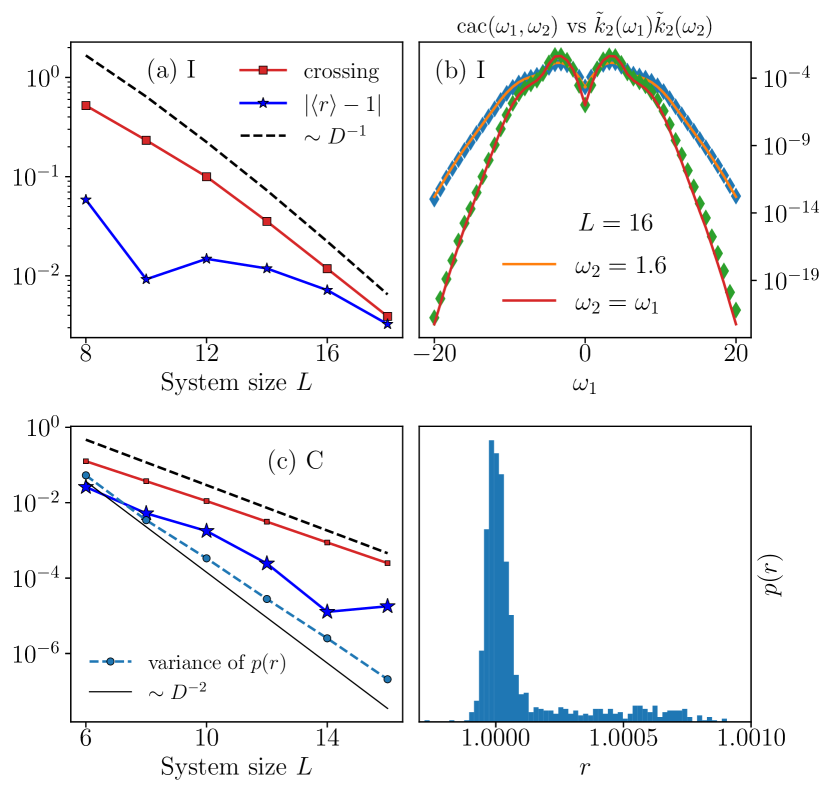
- Crossing partition contributions are exponentially suppressed with system size, supporting ETH predictions.
- Non-crossing (cactus) contributions factorize, with the ratio cac(ω1, ω2) approaching the product tilde{k2}(ω1) tilde{k2}(ω2) as L grows.
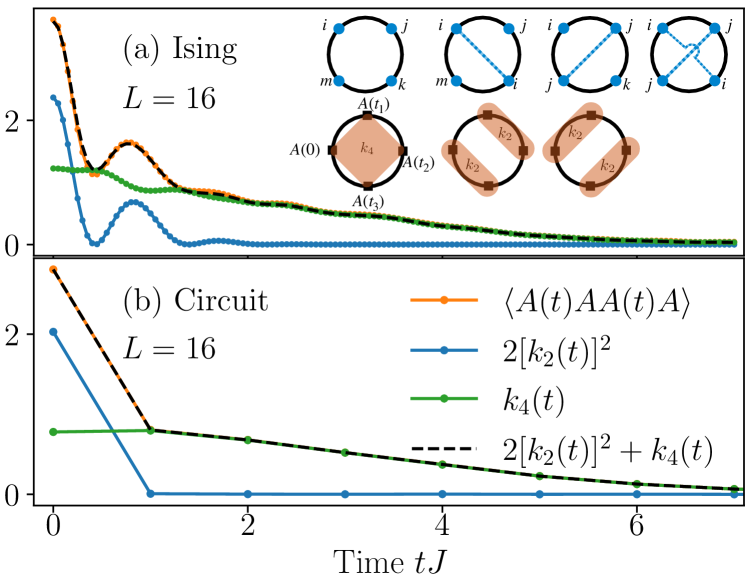
- The fourth free cumulant k4(t) captures the residual OTOC dynamics after two-point correlators decay, indicating nontrivial higher-order correlations.
- The frequency-resolved tilde{k4}(ω1, ω2, ω3) shows nontrivial structure for Ising Hamiltonians (decaying at large frequencies) and Floquet circuits (periodic with nontrivial dynamics within 2π), distinguishing ETH from flat random-matrix behavior.
- The ETH framework via free cumulants accurately reproduces the full four-point correlator as <A(t) A A(t) A> ≈ 2[k2(t)]^2 + k4(t) for both Ising and circuit models.
- Results persist across two model classes (Hamiltonian and Floquet) and differ from structureless, rotationally invariant random matrices
阅读本论文
在 Nubint 阅读器中打开原文,边读边就任意段落提问。
在 Nubint 中阅读本论文本解读由 AI 根据论文原文生成,引用前请核对原文。