
[论文解读] FunLess: Functions-as-a-Service for Private Edge Cloud Systems
FunLess 是一个面向私有边缘云系统的无服务器 FaaS 平台,利用 WebAssembly(Wasm)作为轻量级、安全且可移植的运行时,以在资源受限设备上实现高效的函数执行。它在性能上与基于容器的 FaaS 平台(如 OpenFaaS、Fission 和 Knative)相当,同时显著降低了内存占用,并实现了在边缘设备(如 Raspberry Pi 3B+)上的完整部署,无需容器运行时或编排栈。
We present FunLess, a Function-as-a-Service (FaaS) platform tailored for the private edge cloud system. FunLess responds to recent trends that advocate for extending the coverage of serverless computing to private edge cloud systems and enhancing latency, security, and privacy while improving resource usage. Unlike existing solutions that rely on containers for function invocation, FunLess leverages WebAssembly (Wasm) as its runtime environment. Wasm's lightweight, sandboxed runtime is crucial to have functions run on constrained devices at the edge. Moreover, the advantages of using Wasm in FunLess include a consistent development and deployment environment for users and function portability (write once, run everywhere) We validate FunLess under different deployment scenarios, characterised by the presence/absence of constrained-resource devices (Raspberry Pi 3B+) and the (in)accessibility of container orchestration technologies - Kubernetes. We compare FunLess with three production-ready, widely adopted open-source FaaS platforms - OpenFaaS, Fission, and Knative. Our benchmarks confirm that FunLess is a proper solution for FaaS private edge cloud systems since it achieves performance comparable to the considered FaaS alternatives while it is the only fully-deployable alternative on constrained-resource devices, thanks to its small memory footprint.
研究动机与目标
- 应对私有和边缘云环境中对无服务器计算日益增长的需求,以降低延迟、增强安全性并提高资源效率。
- 克服在资源受限的边缘设备(如 Raspberry Pi)上使用基于容器的 FaaS 平台所面临的高内存和 CPU 开销等限制。
- 通过将 WebAssembly 作为执行运行时,实现真正的“编写一次,随处运行”可移植性,并在异构边缘设备上实现一致的部署。
- 提供一种轻量级、裸金属的 FaaS 解决方案,消除对 Kubernetes 等重量级编排工具的依赖。
- 通过 Wasm 的快速启动时间和低内存占用,缓解冷启动性能问题,使边缘设备上的函数缓存成为可能。
提出的方法
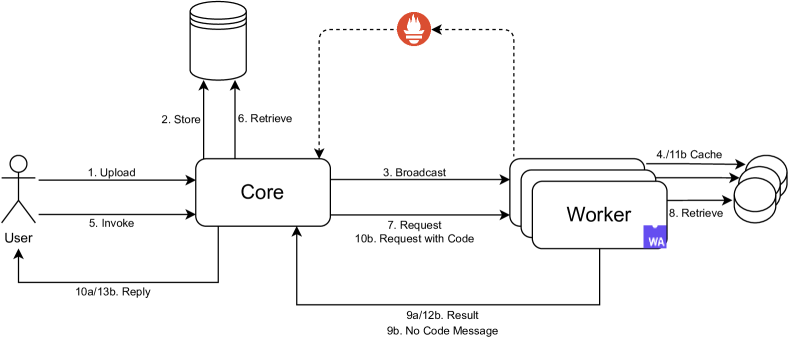
- 设计并实现 FunLess 作为基于 Wasm 的函数执行引擎的 FaaS 平台,替代传统的容器运行时。
- 利用 WebAssembly 的轻量级、沙箱执行环境,确保函数的强隔离性、安全性以及快速初始化。
- 直接在裸金属边缘设备(如 Raspberry Pi 3B+)上部署 FunLess,无需 Docker 或 Kubernetes,最大限度减少资源消耗。
- 通过利用 Wasm 的“编写一次,随处运行”模型和标准化的运行时接口,实现跨异构设备的函数可移植性。
- 与现有 Wasm 运行时(如 Wasmtime)集成,并计划未来扩展支持 WASI、HTTP、垃圾回收和多线程功能。
- 在多种部署场景下评估性能,包括仅边缘、仅云以及混合配置,并对比是否使用容器编排。
实验结果
研究问题
- RQ1基于 Wasm 的 FaaS 平台是否能在私有边缘云环境中实现与成熟容器化 FaaS 平台(如 OpenFaaS、Fission、Knative)相当的性能?
- RQ2与基于容器的 FaaS 相比,使用 WebAssembly 在资源受限的边缘设备上是否能显著降低内存和 CPU 开销?
- RQ3FunLess 是否能够在无需容器运行时或 Kubernetes 等编排工具的前提下,实现在低资源边缘设备(如 Raspberry Pi 3B+)上的完整部署?
- RQ4FunLess 通过 Wasm 的快速启动时间和低内存占用,在多大程度上有效缓解了冷启动延迟问题?
- RQ5Wasm 的可移植性和一致的运行时对简化部署、实现异构边缘系统中跨设备函数执行有何影响?
主要发现
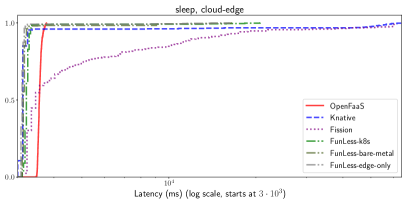
- FunLess 在代表性的云和边缘基准测试中,性能与 OpenFaaS、Fission 和 Knative 相当,证实了其作为私有边缘系统 FaaS 解决方案的可行性。
- FunLess 相较于基于容器的平台展现出显著更小的内存占用,使在资源受限设备(如 Raspberry Pi 3B+)上的完整部署成为可能。
- 由于其基于裸金属的 Wasm 架构,FunLess 是唯一一个在无需容器运行时或编排栈的情况下,可在 Raspberry Pi 3B+ 上实现完全部署的评估 FaaS 平台。
- 使用 WebAssembly 实现了快速的函数启动时间和高效的缓存机制,有效缓解了边缘设备上的冷启动问题。
- FunLess 通过 Wasm 的“编写一次,随处运行”模型,支持在异构设备间实现可移植且一致的函数执行,简化了部署流程并减少了平台相关的配置需求。
- 在资源使用最小化的场景下,FunLess 表现优于基于容器的平台,尤其在内存和 CPU 受限的边缘部署中表现更优。
阅读本论文
在 Nubint 阅读器中打开原文,边读边就任意段落提问。
在 Nubint 中阅读本论文本解读由 AI 根据论文原文生成,引用前请核对原文。