
[论文解读] Game-theoretic LLM: Agent Workflow for Negotiation Games
本文提出基于博弈论的智能体工作流,以提升大型语言模型(LLMs)在策略性谈判场景中的理性水平。通过将经典博弈论原则(如占优策略搜索和逆向归纳)整合到LLM推理中,该工作流显著提升了完整信息与不完整信息博弈中的决策能力,实现了近乎最优的结果,并减少了谈判中的被剥削风险,尤其在像‘要还是不要’(Deal-or-No-Deal)这类复杂场景中表现突出。
This paper investigates the rationality of large language models (LLMs) in strategic decision-making contexts, specifically within the framework of game theory. We evaluate several state-of-the-art LLMs across a spectrum of complete-information and incomplete-information games. Our findings reveal that LLMs frequently deviate from rational strategies, particularly as the complexity of the game increases with larger payoff matrices or deeper sequential trees. To address these limitations, we design multiple game-theoretic workflows that guide the reasoning and decision-making processes of LLMs. These workflows aim to enhance the models' ability to compute Nash Equilibria and make rational choices, even under conditions of uncertainty and incomplete information. Experimental results demonstrate that the adoption of these workflows significantly improves the rationality and robustness of LLMs in game-theoretic tasks. Specifically, with the workflow, LLMs exhibit marked improvements in identifying optimal strategies, achieving near-optimal allocations in negotiation scenarios, and reducing susceptibility to exploitation during negotiations. Furthermore, we explore the meta-strategic considerations of whether it is rational for agents to adopt such workflows, recognizing that the decision to use or forgo the workflow constitutes a game-theoretic issue in itself. Our research contributes to a deeper understanding of LLMs' decision-making capabilities in strategic contexts and provides insights into enhancing their rationality through structured workflows. The findings have implications for the development of more robust and strategically sound AI agents capable of navigating complex interactive environments. Code and data supporting this study are available at \url{https://github.com/Wenyueh/game_theory}.
研究动机与目标
- 评估最先进LLM在策略性博弈论情境下的理性水平,特别是在博弈复杂度增加时的表现。
- 解决LLM在谈判和博弈任务中,特别是在不完整信息和序列博弈场景下,表现出的与理性行为偏离的问题。
- 设计并验证基于博弈论的工作流,引导LLM推理以计算纳什均衡并做出最优决策。
- 探究采用此类工作流是否本身是智能体在谈判博弈中的一项理性元策略选择。
- 探索提示设计、谈判顺序以及智能体个性等因素如何影响LLM的理性水平与结果效率。
提出的方法
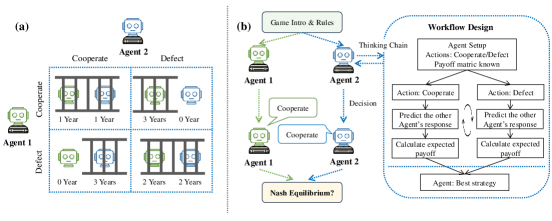
- 基于占优策略搜索设计博弈论工作流,以识别在对手行动不确定时仍能最大化收益的策略。
- 通过从终端节点反向分析决策树,实现序列博弈中的逆向归纳,以确定最优路径。
- 为不完整信息博弈(如‘要还是不要’)设计基于贝叶斯更新的工作流,以实现帕累托最优且无嫉妒的分配。
- 集成结构化推理提示,引导LLM逐步进行博弈论分析,减少对启发式或直觉性反应的依赖。
- 利用自洽的推理链评估并优化LLM决策,确保其与博弈论均衡保持一致。
- 通过在多种博弈类型中开展受控实验,对比LLM在使用与不使用工作流情况下的表现,评估工作流的有效性。
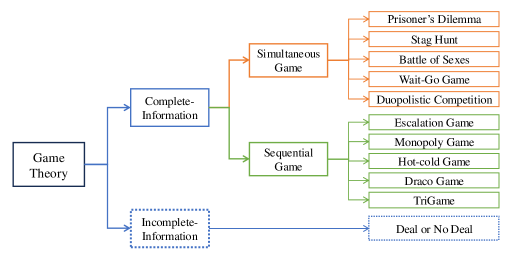
实验结果
研究问题
- RQ1随着收益矩阵规模和博弈深度的增加,LLM在完整信息博弈中偏离理性策略的程度如何?
- RQ2基于博弈论的工作流能否显著提升LLM识别纳什均衡及在策略博弈中实现最优结果的能力?
- RQ3在‘要还是不要’这类不完整信息谈判博弈中,工作流如何影响LLM的表现,特别是在实现帕累托效率和无嫉妒分配方面?
- RQ4LLM智能体采用谈判工作流是否是理性的元策略选择?这一元策略决策如何影响整体效用与结果公平性?
- RQ5提示措辞、谈判顺序以及智能体个性等因素如何影响LLM在谈判任务中决策的理性水平与一致性?
主要发现
- LLM在复杂博弈中频繁偏离理性策略,尤其在收益矩阵较大或序列树更深时,其在不确定性下的鲁棒性显著下降。
- 采用基于博弈论的工作流显著提升了LLM识别最优策略的能力,在如‘猎鹿博弈’和‘性别战’等博弈中,协调性与结果效率均有显著提升。
- 在‘要还是不要’谈判博弈中,基于贝叶斯的工作流实现了近乎帕累托最优且无嫉妒的分配,优于无工作流的策略。
- 当双方均采用工作流时,集体收益相比非合作或无结构谈判有显著提升,表明协作性与互惠收益得到增强。
- 精心设计的提示可缓解谈判对LLM理性水平的影响,但该效应随谈判轮次增加而减弱,表明需要持续的推理结构支持。
- LLM表现出的非理性模式与人类不同,提示其存在独特的认知偏差而非简单的性能差距,凸显了需要针对性的理性增强技术。
阅读本论文
在 Nubint 阅读器中打开原文,边读边就任意段落提问。
在 Nubint 中阅读本论文本解读由 AI 根据论文原文生成,引用前请核对原文。