
[论文解读] Gate Tunable Josephson Diode in Proximitized InAs Supercurrent Interferometers
演示门控可调的约瑟夫森二极管在近似化的InAs SQUID中,具有非正弦CPR,在有限磁通偏置下实现高达约30%的二极管效率。
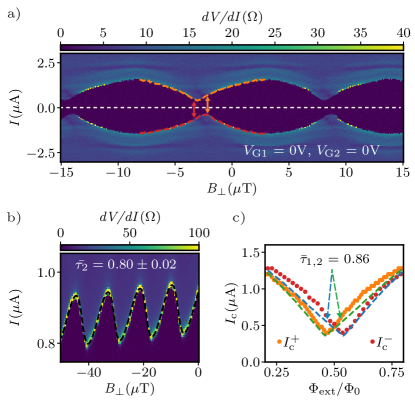
The Josephson diode (JD) is a non-reciprocal circuit element that supports a larger critical current in one direction compared to the other. This effect has gained a growing interest because of promising applications in superconducting electronic circuits with low power consumption. Some implementations of a JD rely on breaking the inversion symmetry in the material used to realize Josephson junctions (JJs), but two recent theoretical proposals have suggested that the effect can also be engineered by combining two JJs hosting highly transmitting Andreev bound states in a Superconducting Quantum Interference Device (SQUID) at a small, but finite flux bias [1, 2]. We have realized a SQUID with two JJs fabricated in a proximitized InAs two-dimensional electron gas (2DEG). We demonstrate gate control of the diode efficiency from zero up to around 30% at specific flux bias values which comes close to the maximum of approxiomately 40% predicated in Ref. [1]. The key ingredients to the JD effect in the SQUID arrangement is the presence of highly transmitting channels in the JJs, a flux bias and an asymmetry between the two SQUID arms.
研究动机与目标
- 激发将超导二极管作为量子科技中低耗散电路元件的研究。
- 研究是否可以在一个用两个非正弦型JJs的SQUID中设计出约瑟夫森二极管(SDE)。
- 表明二极管行为来自高传输通道的 CPRs 中高次諧波的干涉。
- 量化门控对二极管效率的控制,并与理论预测进行比较。
- 从环路电感和其他潜在伪影中分辨SDE的起源。
提出的方法
- 用近似非正弦 CPR 对每个结点建模,I(phi)= (I_c/A_N) * sin(phi) / sqrt(1 - tau* sin^2(phi/2)) 跨通道。
- 使用有效透射率 tau* 来描述多通道 InAs/Al JJs 中的高度透射通道。
- 通过对 SQUID 施加磁通来关联支臂相位,公式 varphi_ext = 2πΦ_ext/Φ0,并求和电流 I(phi1)+I(phi2)。
- 引入不对称参数 alpha 和 beta,以量化两臂之间的临界电流和传输通道差异。
- 将实验 I_c^+ 与 I_c^- 相对于 Φ_ext 的关系与模型预测进行比较,以识别 SDE 的起源。
- 通过仿真和对开关/重新捕获电流的交叉检查,评估来自环路电感和滞后效应的潜在伪影。

实验结果
研究问题
- RQ1是否可以在门控可调、近端化 InAs 的 SQUID 中实现约瑟夫森二极管效应?
- RQ2观察此类器件中的 SDE 需要哪些条件(非正弦 CPR、不对称性和有限磁通偏置)?
- RQ3具有高度透射通道的两结点SQUID在多大程度上能再现预测的SDE量级?
- RQ4在该平台上门控对二极管效率的控制程度如何?
- RQ5环路电感或滞后效应是否足以解释观察到的 SDE?
主要发现
- 在近端化的 InAs 的直流 SQUID 中,两接点非正弦型 JJs 的情况下观测到 SDE,显示 I_c^+ ≠ I_c^- 在有限磁通偏置时。
- 在合适的门控配置和磁通值下,二极管效率约达到 30%。
- 用 tau* ≈ 0.86(对两个结都适用)的模型拟合数据并结合测得的 I_c1, I_c2,能够很好再现 I_c^+ 与 I_c^- 的磁通依赖。
- 较大的 tau* 表明由于多通道 JJs 中高度透射通道,导致强烈的非正弦 CPR。
- 数值比较表明单独的环路电感无法解释观测到的 SDE,强化了 CPR 干涉起源。
- 门控对二极管效率的控制呈现典型的蝴蝶型图案,在不对称门设置与 Φ_ext 约为 0.25–0.75 Φ0 附近达到最大;观察到的最大值约为 0.3。
阅读本论文
在 Nubint 阅读器中打开原文,边读边就任意段落提问。
在 Nubint 中阅读本论文本解读由 AI 根据论文原文生成,引用前请核对原文。