
[论文解读] General Purpose Verification for Chain of Thought Prompting
本文提出了一种通用的思维链(CoT)提示验证框架,通过在步骤级别应用基于大语言模型(LLM)的验证器,基于三个核心原则——相关性、数学准确性与逻辑一致性——来提升大语言模型的推理能力。该方法在9个数据集中的6个上优于原始生成和最佳N选一采样方法,表明自我验证可使推理质量超越困惑度本身带来的提升。
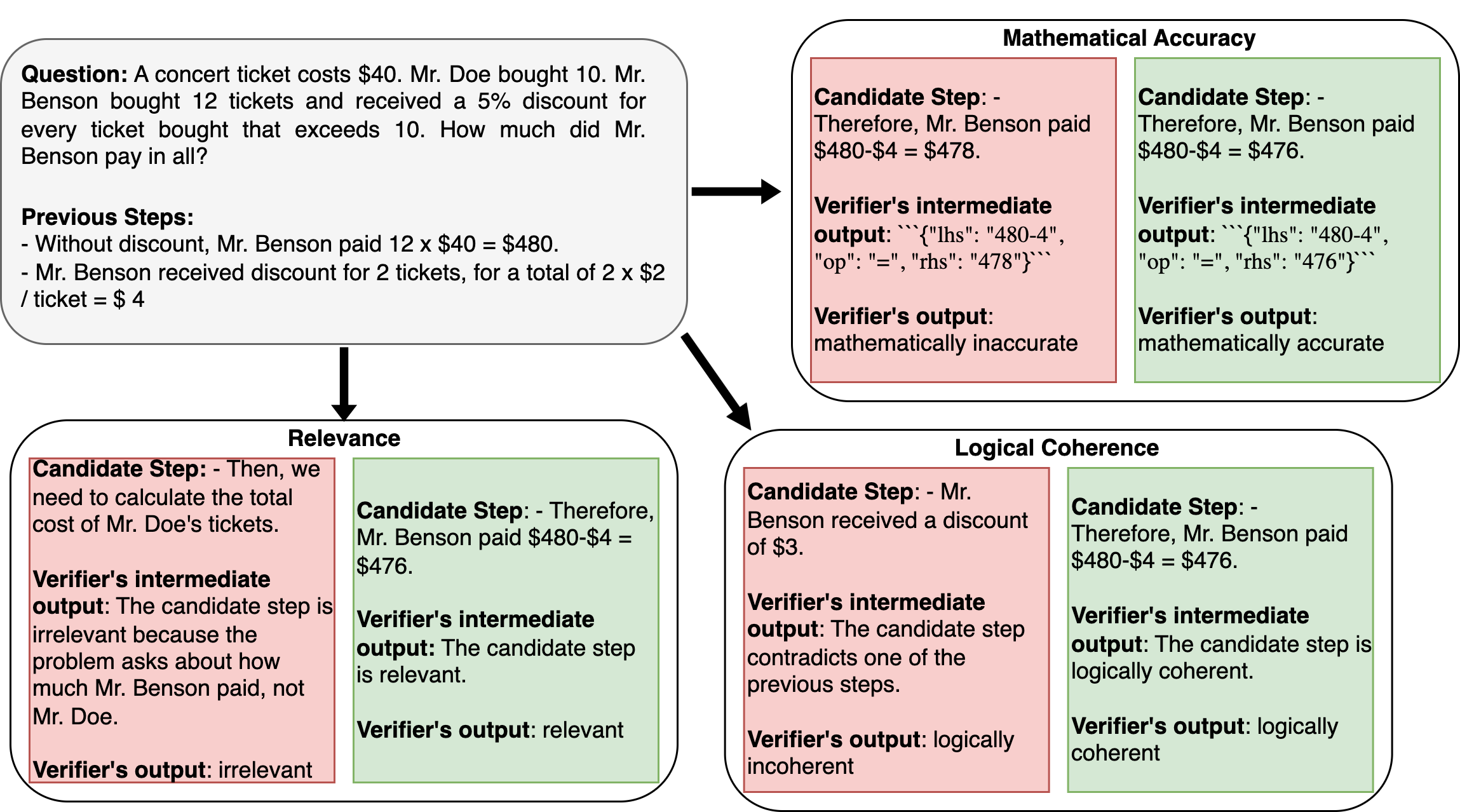
Many of the recent capabilities demonstrated by Large Language Models (LLMs) arise primarily from their ability to exploit contextual information. In this paper, we explore ways to improve reasoning capabilities of LLMs through (1) exploration of different chains of thought and (2) validation of the individual steps of the reasoning process. We propose three general principles that a model should adhere to while reasoning: (i) Relevance, (ii) Mathematical Accuracy, and (iii) Logical Consistency. We apply these constraints to the reasoning steps generated by the LLM to improve the accuracy of the final generation. The constraints are applied in the form of verifiers: the model itself is asked to verify if the generated steps satisfy each constraint. To further steer the generations towards high-quality solutions, we use the perplexity of the reasoning steps as an additional verifier. We evaluate our method on 4 distinct types of reasoning tasks, spanning a total of 9 different datasets. Experiments show that our method is always better than vanilla generation, and, in 6 out of the 9 datasets, it is better than best-of N sampling which samples N reasoning chains and picks the lowest perplexity generation.
研究动机与目标
- 通过检测并纠正中间推理步骤中的错误,提升大语言模型(LLMs)的推理能力。
- 开发一种与问题无关的验证框架,使其在无需任务特定微调的情况下,泛化于多种推理任务。
- 探究大语言模型是否能利用困惑度等内在信号与逻辑约束,自我验证其自身的推理步骤。
- 评估验证是否优于现有的集成技术(如自一致性)。
- 评估自动化验证器得分与人类对推理质量判断之间的一致性。
提出的方法
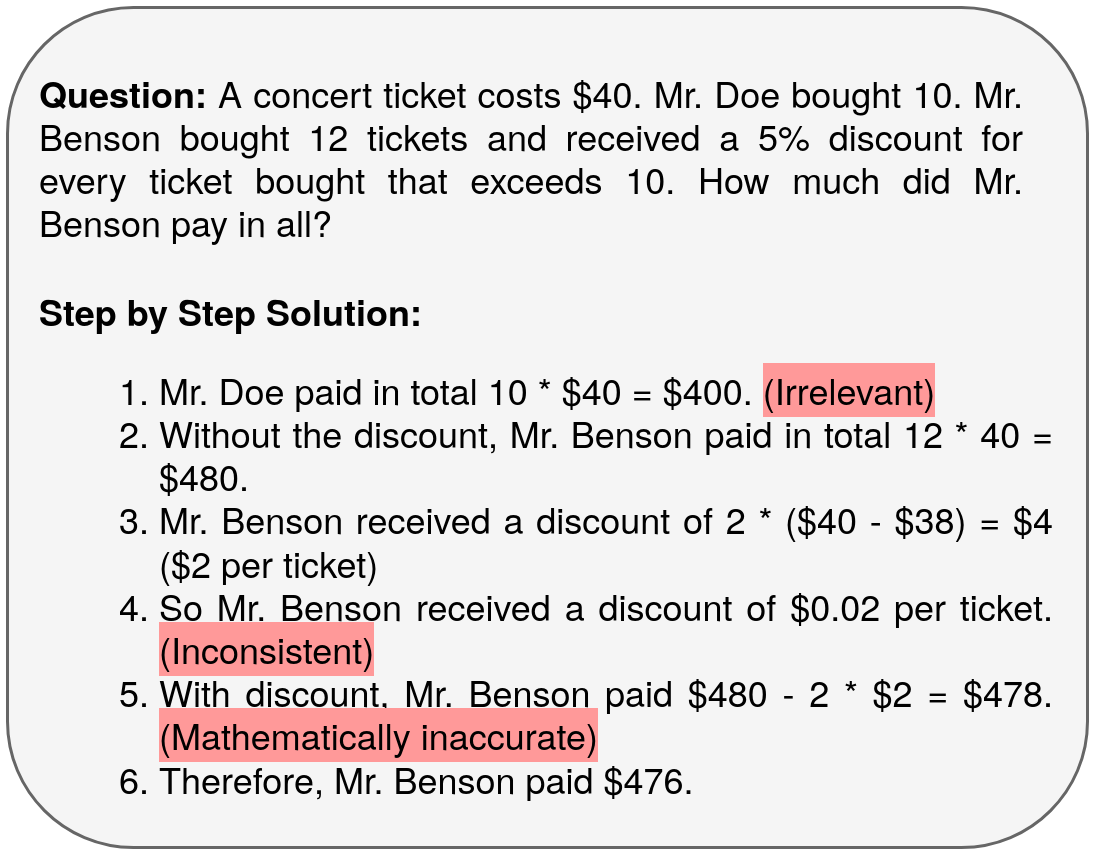
- 该框架对每个推理步骤应用三个基于大语言模型的验证器,分别评估其相关性、数学准确性和逻辑一致性。
- 每个验证器通过基于提示的LLM推理,为单个推理步骤分配得分。
- 使用每个推理步骤的困惑度作为额外的引导信号,以引导生成过程趋向高质量的推理链。
- 通过自一致性等技术聚合验证器得分,以选择最终答案。
- 采用零样本、基于提示的方法,在四种推理任务类型和九个数据集上评估该方法。
- 开展人工评估,以衡量验证器得分与人类对推理质量判断之间的一致性。
实验结果
研究问题
- RQ1大语言模型能否可靠地利用相关性、数学准确性与逻辑一致性等通用原则,验证其自身的推理步骤?
- RQ2步骤级别的验证是否能提升最终答案的准确率,超越标准CoT提示和最佳N选一采样方法?
- RQ3自动化验证器得分与人类对推理质量的判断之间的相关性如何?
- RQ4当与原则性验证器结合时,推理步骤的困惑度能否作为质量的有用代理指标?
- RQ5所提出的验证框架是否能在无需任务特定适配的情况下,泛化于多种多样的推理任务?
主要发现
- 所提出的验证框架在所有九个测试数据集上均一致地提升了推理性能,优于原始CoT生成方法。
- 在九个数据集中的六个中,该方法优于最佳N选一采样方法(即选择困惑度最低的推理链),表明验证器提供了超越困惑度本身的信息。
- 验证器得分与人类判断之间存在统计显著相关性(p < 0.0001),尽管效应量为低至中等,验证了其与推理质量的相关性。
- 少于2%的人工标注错误未被三个核心原则捕捉,表明对常见推理错误具有极高的覆盖度。
- 该框架表明大语言模型能够检测自身的错误,尽管存在噪声,暗示其在推理中具备内在的自我修正潜力。
- 该方法具有良好的泛化能力,无需微调或任务特定适配,因此可广泛应用于各类推理任务。
阅读本论文
在 Nubint 阅读器中打开原文,边读边就任意段落提问。
在 Nubint 中阅读本论文本解读由 AI 根据论文原文生成,引用前请核对原文。