
[论文解读] Generalized contact matrices for epidemic modeling
本文提出了广义接触矩阵,从多个维度(如年龄、社会经济地位(SES)和情境)对人际互动进行分层,扩展了传统的年龄分层模型。该文推导出此类模型中基本再生数 $R_0$ 的闭式表达式,证明多维分层始终使 $R_0$ 值等于或高于单维模型,从而揭示了在标准流行病建模中忽略 SES 时可能存在的低估风险。
Contact matrices have become a key ingredient of modern epidemic models. They account for the stratification of contacts for the age of individuals and, in some cases, the context of their interactions. However, age and context are not the only factors shaping contact structures and affecting the spreading of infectious diseases. Socio-economic status (SES) variables such as wealth, ethnicity, and education play a major role as well. Here, we introduce generalized contact matrices capable of stratifying contacts across any number of dimensions including any SES variable. We derive an analytical expression for the basic reproductive number of an infectious disease unfolding on a population characterized by such generalized contact matrices. Our results, on both synthetic and real data, show that disregarding higher levels of stratification might lead to the under-estimation of the reproductive number and to a mis-estimation of the global epidemic dynamics. Furthermore, including generalized contact matrices allows for more expressive epidemic models able to capture heterogeneities in behaviours such as different levels of adoption of non-pharmaceutical interventions across different groups. Overall, our work contributes to the literature attempting to bring socio-economic, as well as other dimensions, to the forefront of epidemic modeling. Tackling this issue is crucial for developing more precise descriptions of epidemics, and thus to design better strategies to contain them.
研究动机与目标
- 解决现有流行病模型中忽略社会经济地位(SES)作为接触模式结构性因素的局限性。
- 开发一种数学框架,能够将任意数量的人口统计和经济社会维度整合到接触矩阵中。
- 推导使用广义接触矩阵的模型中基本再生数 $R_0$ 的闭式解析表达式。
- 量化多维分层对 $R_0$ 和流行病动力学的影响,与单属性模型(如仅年龄)进行比较。
- 展示该模型能够捕捉不同 SES 群体在非药物干预(NPI)采纳上的异质性,并提高流行病预测的准确性。
提出的方法
- 提出广义接触矩阵 $G_{\mathbf{a},\mathbf{b}}$,将多个分层维度(如年龄和 SES)整合为单一多维接触结构。
- 构建一个易感-暴露-感染-康复(SEIR)的分层模型,其中传播率由广义接触矩阵定义。
- 基于广义接触矩阵的谱半径,推导出基本再生数 $R_0$ 的闭式解析表达式。
- 利用谱理论证明,由广义矩阵计算出的 $R_0$ 值始终大于或等于由单维矩阵计算出的值。
- 使用具有受控混合模式(偏好混合与随机混合)和各维度活动水平变化的合成数据验证模型。
- 将该框架应用于匈牙利 MASZK 调查的现实世界接触数据(2021年4月和11月),比较标准模型与广义模型在攻击率和流行病动力学上的差异。

实验结果
研究问题
- RQ1在接触矩阵中将社会经济地位(SES)作为分层维度,如何影响 $R_0$ 的估计值?
- RQ2与仅基于年龄的模型相比,多维分层(如年龄+SES)在多大程度上改变了流行病动力学,如攻击率和峰值流行率?
- RQ3广义接触矩阵能否更好地捕捉不同人口亚群之间非药物干预(NPI)采纳的异质性?
- RQ4广义接触矩阵的谱半径与由此产生的 $R_0$ 之间存在何种数学关系?
- RQ5在多维模型中,接触模式的相关性(如偏好混合和活动水平异质性)如何影响 $R_0$?
主要发现
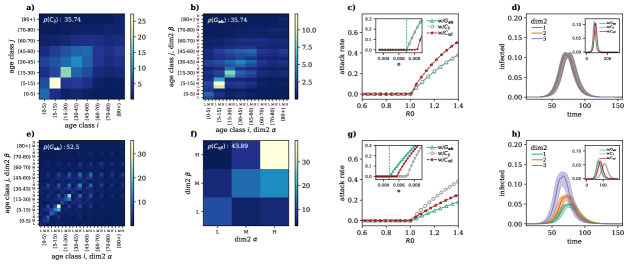
- 包含 SES 维度的广义接触矩阵所得到的 $R_0$ 值始终大于或等于仅使用单维(如仅年龄)模型的结果,且在偏好混合条件下差异更大。
- 在包含三个维度(年龄、SES 和活动水平)的合成情景中,广义矩阵的谱半径高于二维模型,意味着疾病控制的临界阈值更高。
- 在固定 $R_0$ 的情况下,使用广义接触矩阵的模型预测的攻击率低于标准模型,表明当忽略 SES 时,标准模型可能高估流行病规模。
- 对匈牙利接触数据(2021年4月和11月)的实际应用证实,广义模型能更好地捕捉不同 SES 群体之间的发病率差异,而这些差异在仅基于年龄的标准模型中是不可见的。
- 该模型成功再现了非均质的 NPI 采纳模式,表明不同 SES 水平的亚群即使在相同的政策干预下,也可能表现出截然不同的流行病轨迹。
- 在合成和现实世界场景中,将 SES 纳入接触矩阵均能带来更准确、更具表现力的流行病预测,尤其是在传播动力学受结构性不平等驱动时。
阅读本论文
在 Nubint 阅读器中打开原文,边读边就任意段落提问。
在 Nubint 中阅读本论文本解读由 AI 根据论文原文生成,引用前请核对原文。