
[论文解读] Generating Faithful Synthetic Data with Large Language Models: A Case Study in Computational Social Science
本研究测试提示策略—— grounding、基于分类法的生成,以及过滤——以提高大语言模型生成的合成数据在讽刺检测上的真实性,并将其与基线和真实数据进行比较。
Large Language Models (LLMs) have democratized synthetic data generation, which in turn has the potential to simplify and broaden a wide gamut of NLP tasks. Here, we tackle a pervasive problem in synthetic data generation: its generative distribution often differs from the distribution of real-world data researchers care about (in other words, it is unfaithful). In a case study on sarcasm detection, we study three strategies to increase the faithfulness of synthetic data: grounding, filtering, and taxonomy-based generation. We evaluate these strategies using the performance of classifiers trained with generated synthetic data on real-world data. While all three strategies improve the performance of classifiers, we find that grounding works best for the task at hand. As synthetic data generation plays an ever-increasing role in NLP research, we expect this work to be a stepping stone in improving its utility. We conclude this paper with some recommendations on how to generate high(er)-fidelity synthetic data for specific tasks.
研究动机与目标
- 在 NLP 中引入使用 LLMs 的可信合成数据的需求以增强研究动机。
- 提出提示策略(grounding、基于分类法的生成)以提高合成数据的保真度。
- 通过用合成数据训练分类器并在真实数据上进行测试来评估策略在讽刺检测中的效果。
- 评估 grounding 相对于其他策略的有效性并提供实际建议。
提出的方法
- 使用 SemEval-2022 Task 6 sarcasm 数据进行训练和评估。
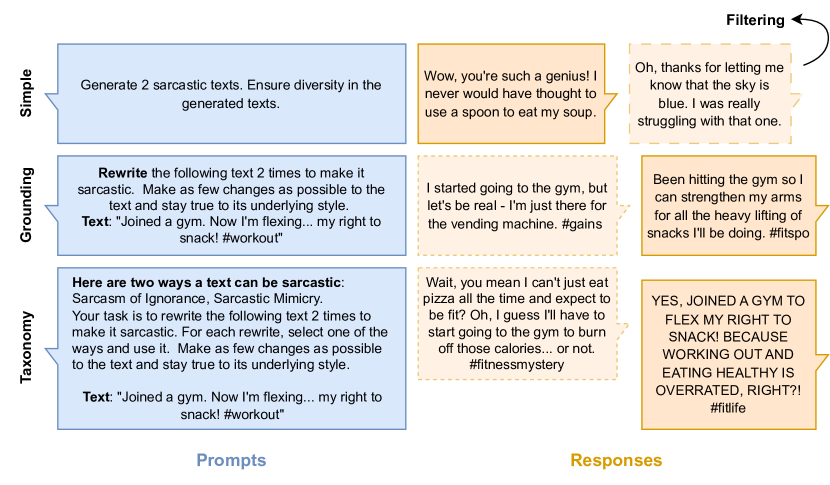
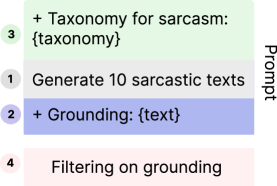
- 在多种提示策略下,使用 ChatGPT 生成合成数据。
- 在合成数据上微调一个 E5-base 模型,并在真实测试集上评估。
- 训练一个判别器以过滤合成数据,并与真实数据进行比较。
- 通过在生成数据上测试一个合成分类器与真实分类器的可置信度来评估可信度。
实验结果
研究问题
- RQ1grounding、基于分类法的生成和过滤是否能提升 LLM 生成的用于讽刺检测的合成数据的真实度?
- RQ2这些策略与简单提示和零样本 ChatGPT 在下游表现上的比较如何?
- RQ3在真实数据评估时,这些策略对分类器的宏观 F1 和可信度有哪些影响?
- RQ4grounding 是否是捕捉主题多样性和待研究构念的最有效策略?
主要发现
- 基于 grounding 的提示在以合成数据训练的分类器中取得最高的 macro-F1(0.55)。
- 简单提示表现最差(macro-F1 0.48),因主题和构造的多样性有限。
- Grounding + Taxonomy 的 macro-F1 为 0.51,介于 grounding 单独和简单提示之间。
- Grounding + Filtering 的表现较差(macro-F1 0.26),可能由于判别器的局限性。
- 零样本 ChatGPT 的 macro-F1(0.60)超过以较小提示生成的合成数据训练的模型的宏观 F1。
- 可信度因方法而异,Grounding + Filtering 的可置信度最高(0.56),而真实标注达 0.95,简单方法仍较低(0.04)。
阅读本论文
在 Nubint 阅读器中打开原文,边读边就任意段落提问。
在 Nubint 中阅读本论文本解读由 AI 根据论文原文生成,引用前请核对原文。