
[论文解读] Generation of scalable many-body Bell correlations in spin chains with short-range two-body interactions
本文展示了仅通过短程两体相互作用,即可在自旋-1/2链中动态生成可扩展的多体贝尔关联,无需全连接或长程耦合。作者识别出临界相互作用范围(r ≥ 4)和临界时间 τc,贝尔不等式破缺在此处出现,表明此类量子资源可在当前量子模拟器中实现。
Dynamical generation of strong and scalable quantum resources, like many-body entanglement and Bell correlations, in spin-$1/2$ chains, is possible with all-to-all interactions, either for constant interaction strength realizing one-axis twisting protocol or for power-law decaying potentials. We show, however, that such quantum resources can also be dynamically generated with a finite range of interactions. We identify a necessary critical range and indicate a critical time when scalable quantum correlations appear. Finally, we show that the certification of generated states is accessible in the modern quantum simulator platforms.
研究动机与目标
- 证明仅通过短程两体相互作用,即可在自旋-1/2链中生成可扩展的多体贝尔关联。
- 确定实现贝尔关联动态生成所需的最小相互作用范围 r,且该范围与系统尺寸 N 无关。
- 确定贝尔不等式破缺在系统中出现的临界时间 τc。
- 表明所生成的态可利用当前实验技术在量子模拟器中进行认证。
- 建立自旋反转动力学与通过多量子相干产生的非局域关联之间的联系。
提出的方法
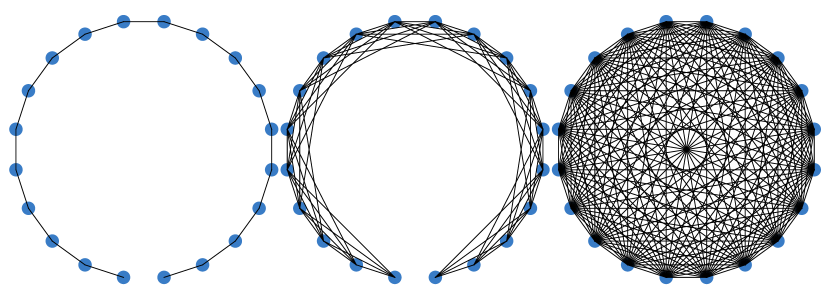
- 使用一维自旋-1/2链,其哈密顿量为 H = ∑_{k,l} J_{kl} σ_z^{(k)}σ_z^{(l)},其中有限范围耦合 J_{kl} = 1 当 0 < |k−l| ≤ r。
- 初始态制备为沿 x 轴极化的乘积态,与哈密顿量所定义的 z 轴正交。
- 时间演化由 Û(τ) = exp(−iτĤ) 描述,通过演化分析布居动力学。
- 采用微扰展开方法计算系数 |C₊(τ)|² 和 |C₋(τ)|²,分别代表初始态与完全反转的自旋态。
- 推导出贝尔关联器的近似表达式 E_N ≈ P_r² R_r² exp(−β_N τ²) τ^{N+6},其中 β_N = 2K − N/2。
- 采用多量子相干(MQC)技术,取 Â = (1/2)∑_k σ_x^{(k)} 且 m = N/2,使 E_N = I_N(ϱ) 可直接在实验中测量。
实验结果
研究问题
- RQ1仅通过短程两体相互作用,是否可在自旋链中生成可扩展的多体贝尔关联?
- RQ2实现贝尔不等式破缺所需的最小相互作用范围 r 是多少,且与系统尺寸 N 无关?
- RQ3贝尔不等式破缺在动力学中于何时出现临界时间 τc?
- RQ4当前实验平台能否对动态生成的贝尔关联态进行认证?
- RQ5自旋对反转速率与 τ^N 抑制因子之间的竞争如何影响非局域性的出现?
主要发现
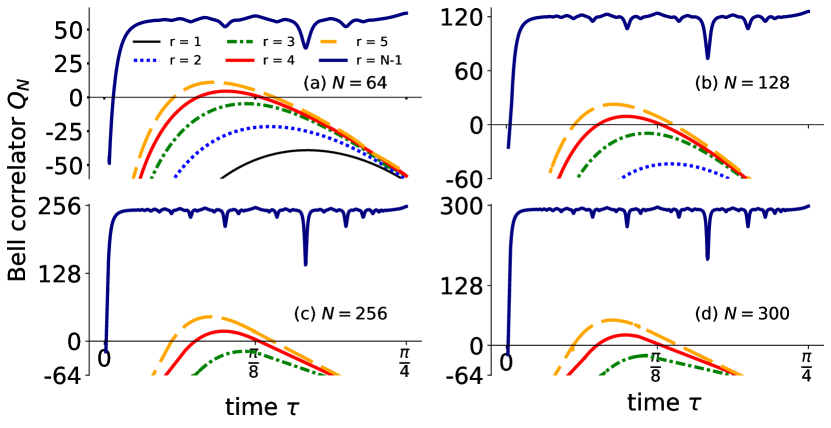
- 仅当相互作用范围 r ≥ 4 时,贝尔不等式破缺才能实现;当 r ≤ 3 时,归一化关联器的最大值的对数为负,导致 τc 无物理意义。
- 临界时间 τc 的表达式为 τc ≈ τ_max − √(Ẽ_max / (2β_N)),其中 τ_max 为完全反转态布居达到最大值的时间。
- 当 r ≥ 4 时,Ẽ_max ≥ 0,确保 τc 具有物理意义,且随着 r 增大,τc 减小,这是由于自旋对反转速率提高所致。
- 完全反转态 |C₋(τ)|² 的布居随 r 增大而增加,这是由于贡献的费曼图数量增多,从而加快贝尔极限的突破。
- 采用 m = N/2 的多量子相干(MQC)技术,可直接实验测量贝尔关联器 E_N,使当前平台中的态认证成为可能。
- 解析近似 E_N ≈ P_r² R_r² exp(−β_N τ²) τ^{N+6} 准确捕捉了系统的数值行为,尤其在 r ≥ 4 时表现优异。
阅读本论文
在 Nubint 阅读器中打开原文,边读边就任意段落提问。
在 Nubint 中阅读本论文本解读由 AI 根据论文原文生成,引用前请核对原文。