
[论文解读] Generative AI-empowered Effective Physical-Virtual Synchronization in the Vehicular Metaverse
本文提出了一种由生成式人工智能赋能的框架,用于在车载元宇宙中实现实时的物理-虚拟同步,利用数字孪生技术进行未来路径预测,并通过生成式人工智能(例如 TSDreamBooth)定制个性化 AR 推荐。多任务增强拍卖机制确保了策略无关性与逆向选择规避,同时使社会总 surplus 提高了 50%。
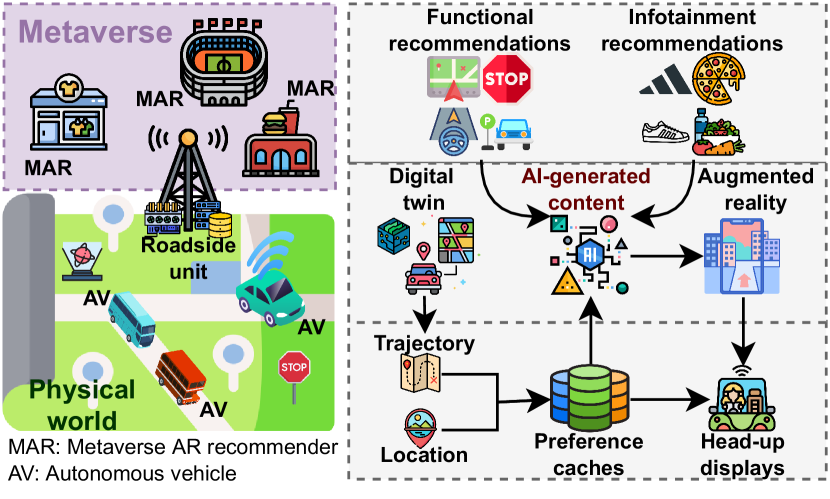
Metaverse seamlessly blends the physical world and virtual space via ubiquitous communication and computing infrastructure. In transportation systems, the vehicular Metaverse can provide a fully-immersive and hyperreal traveling experience (e.g., via augmented reality head-up displays, AR-HUDs) to drivers and users in autonomous vehicles (AVs) via roadside units (RSUs). However, provisioning real-time and immersive services necessitates effective physical-virtual synchronization between physical and virtual entities, i.e., AVs and Metaverse AR recommenders (MARs). In this paper, we propose a generative AI-empowered physical-virtual synchronization framework for the vehicular Metaverse. In physical-to-virtual synchronization, digital twin (DT) tasks generated by AVs are offloaded for execution in RSU with future route generation. In virtual-to-physical synchronization, MARs customize diverse and personal AR recommendations via generative AI models based on user preferences. Furthermore, we propose a multi-task enhanced auction-based mechanism to match and price AVs and MARs for RSUs to provision real-time and effective services. Finally, property analysis and experimental results demonstrate that the proposed mechanism is strategy-proof and adverse-selection free while increasing social surplus by 50%.
研究动机与目标
- 解决在车载元宇宙中实现沉浸式 AR 体验所需的实时、高精度物理-虚拟同步挑战。
- 通过将数字孪生任务卸载至边缘计算节点并利用生成式人工智能进行内容生成,克服自动驾驶汽车本地计算能力不足以及高质量 AR 内容稀缺的限制。
- 设计一种激励机制,协调自动驾驶汽车(AVs)、移动增强现实设备(Mars)与路边单元(RSUs)的利益,同时确保任务分配与定价的公平性与效率。
- 通过在交通标志数据集上微调生成式模型(如 TSDreamBooth),实现可扩展的个性化 AR 推荐。
- 确保同步机制具备策略无关性与逆向选择规避特性,以支持在动态车载环境中的稳健部署。
提出的方法
- 将自动驾驶汽车生成的数字孪生(DT)任务卸载至路边单元(RSUs)执行,利用历史与实时的自动驾驶汽车数据实现实时同步与未来路径预测。
- 在 BelgiumTS 数据集上应用生成式人工智能模型——特别是 TSDreamBooth(一种微调后的 DreamBooth 变体),为交通标志生成多样化、上下文感知的 AR 内容。
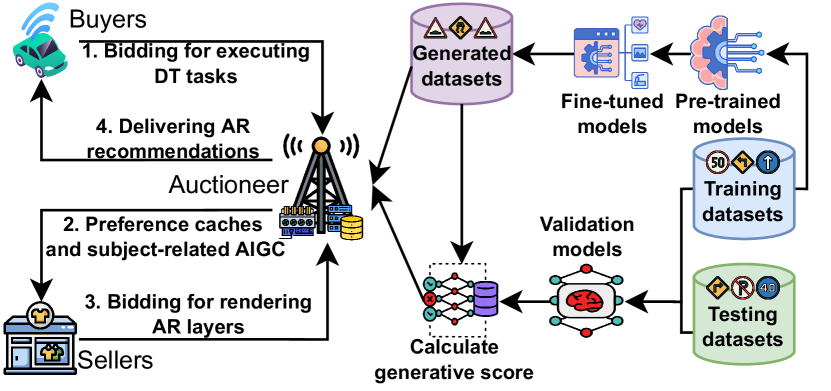
- 实施一种多任务增强拍卖机制(MTEPViSA),根据多维需求(包括截止时间与估值)匹配自动驾驶汽车与移动增强现实设备。
- 采用按时间计费的 AR 渲染模型,并结合高效的 AIGC 赋能评分规则,确保报价真实可信,防止逆向选择。
- 集成 RSU 层智能,以优化用户偏好、当前位置与预测路径,提升同步精度与服务个性化水平。
- 利用稳定扩散与微调技术,生成与用户偏好及环境上下文相匹配的高保真 AR 内容。
实验结果
研究问题
- RQ1如何有效利用生成式人工智能,为元宇宙中的车辆创建可扩展、个性化的 AR 推荐?
- RQ2在动态车载环境中,何种机制可确保物理到虚拟与虚拟到物理的实时、高精度同步?
- RQ3如何设计一种基于拍卖的机制,以公平且高效地匹配自动驾驶汽车与 MAR,同时保持策略无关性与逆向选择规避?
- RQ4与现有机制相比,所提出的框架在多大程度上提升了社会总 surplus?
- RQ5像 TSDreamBooth 这类生成式模型能否为交通相关虚拟对象生成高质量、上下文相关的 AR 内容?
主要发现
- 所提出的 MTEPViSA 机制相比基线机制(如 PViSA 与 EPViSA)使社会总 surplus 提高了约 50%。
- 生成式 AI 模型 TSDreamBooth 在 BelgiumTS 数据集生成图像上的验证准确率约为 50%,表明其在真实应用中具备中等但可用的性能。
- 该机制被证明具备策略无关性与逆向选择规避特性,确保了报价的真实性与激励相容性的稳健性。
- 性能评估显示,所提机制在总收益与 DT 专项收益方面均优于 PViSA,尤其在高负载任务场景下表现更优。
- 通过 RSU 处理的数字孪生数据实现未来路径预测,显著提升了基于位置的 AR 服务的准确性与相关性。
- 采用按时间计费的 AR 渲染模型,并结合 AIGC 赋能的评分机制,实现了同步框架中资源的高效且公平的分配。
阅读本论文
在 Nubint 阅读器中打开原文,边读边就任意段落提问。
在 Nubint 中阅读本论文本解读由 AI 根据论文原文生成,引用前请核对原文。