
[论文解读] Generative AI for Visualization: State of the Art and Future Directions
本文对生成式人工智能(GenAI)在可视化中的应用进行了全面综述,将GenAI技术(如序列、表格、空间和图生成)按四个阶段进行分类:数据增强、视觉映射生成、风格化和交互。文章识别了评估、数据集构建和流程集成中的关键挑战,并提出了未来研究方向,以弥合端到端GenAI与传统可视化工作流之间的差距。
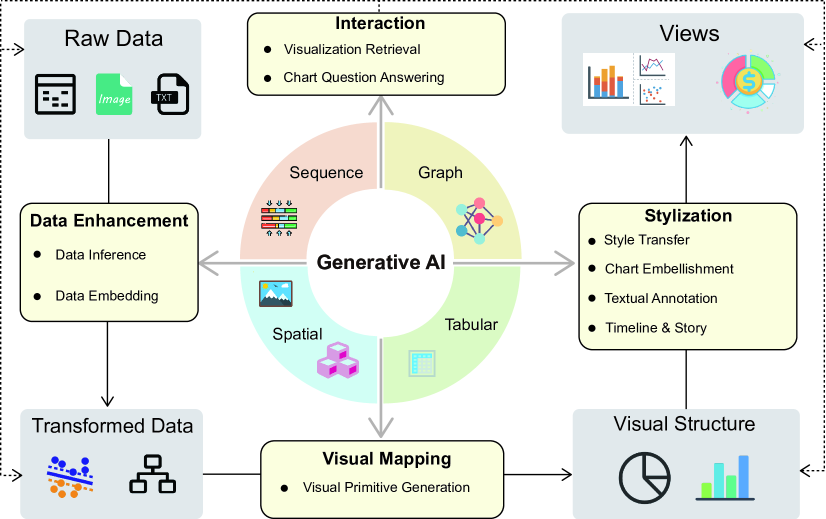
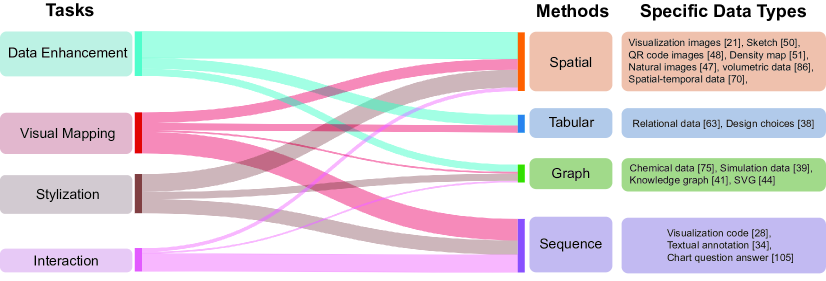
Generative AI (GenAI) has witnessed remarkable progress in recent years and demonstrated impressive performance in various generation tasks in different domains such as computer vision and computational design. Many researchers have attempted to integrate GenAI into visualization framework, leveraging the superior generative capacity for different operations. Concurrently, recent major breakthroughs in GenAI like diffusion model and large language model have also drastically increase the potential of GenAI4VIS. From a technical perspective, this paper looks back on previous visualization studies leveraging GenAI and discusses the challenges and opportunities for future research. Specifically, we cover the applications of different types of GenAI methods including sequence, tabular, spatial and graph generation techniques for different tasks of visualization which we summarize into four major stages: data enhancement, visual mapping generation, stylization and interaction. For each specific visualization sub-task, we illustrate the typical data and concrete GenAI algorithms, aiming to provide in-depth understanding of the state-of-the-art GenAI4VIS techniques and their limitations. Furthermore, based on the survey, we discuss three major aspects of challenges and research opportunities including evaluation, dataset, and the gap between end-to-end GenAI and generative algorithms. By summarizing different generation algorithms, their current applications and limitations, this paper endeavors to provide useful insights for future GenAI4VIS research.
研究动机与目标
- 系统性地回顾并分类生成式人工智能(GenAI)在不同数据类型和可视化阶段中的应用。
- 识别将GenAI应用于可视化时面临的技术与方法论挑战,包括评估复杂性、数据集稀缺性以及流程集成问题。
- 分析当前GenAI4VIS方法的局限性,特别是基于规则的可视化流程与端到端生成模型之间的脱节。
- 探索通过混合建模、知识蒸馏和交互控制机制改进GenAI4VIS的机遇。
- 通过利用多模态模型和可控生成的进展,为更有效地将GenAI整合到可视化工作流中提供研究路线图。
提出的方法
- 按数据结构对GenAI方法进行分类:序列、表格、空间和图生成,并将其映射到可视化阶段。
- 回顾81篇关于生成式人工智能用于可视化(GenAI4VIS)的研究论文,分析在数据增强、视觉映射、风格化和交互方面的技术。
- 考察特定的GenAI模型,如扩散模型(例如Stable Diffusion)、大语言模型(例如GPT、LLaMA)以及3D生成模型(例如DreamFusion)。
- 提出一种通过结合端到端学习与中间控制机制,将GenAI整合到可视化流程中的框架。
- 借鉴基于控制的GenAI方法(如ControlNet和LayoutDiffusion)以实现在生成可视化中结构的一致性。
- 建议使用带有文本标注的真实渲染可视化图像作为训练数据,以绕过显式的图表元素提取。
实验结果
研究问题
- RQ1不同类型的生成式人工智能——序列、表格、空间和图模型——如何被应用于可视化流程的不同阶段?
- RQ2在图像相似性之外,评估GenAI生成的可视化时面临哪些关键挑战,特别是关于数据完整性与效率方面?
- RQ3为何将端到端GenAI与传统的基于规则的可视化流程集成本质上具有困难性?这一差距如何弥合?
- RQ4GenAI模型如何被调整以在可视化生成过程中保持结构准确性和语义保真度,特别是在使用基于图像的扩散模型时?
- RQ5通过知识蒸馏、交互控制和多模态学习,结合GenAI与可视化的优势,存在哪些研究机遇?
主要发现
- GenAI已成功应用于可视化的所有四个阶段:数据增强、视觉映射生成、风格化和交互,使用了多样的生成技术。
- 尽管已有进展,GenAI4VIS的评估仍因超出视觉相似性的因素(如数据保真度、效率和可解释性)而复杂。
- 现有GenAI4VIS流程通常将结构生成与风格化分离(例如LIDA),导致最终输出中数据-结构对齐性的损失。
- 基于规则的可视化系统与端到端GenAI模型之间的差距限制了GenAI潜力的充分释放,凸显了构建集成化、可学习流程的必要性。
- 多模态模型(如视觉-语言模型)的最新进展使得可以直接在真实渲染可视化图像与文本提示上进行训练,从而绕过手动提取图表元素。
- 通过知识蒸馏和基于控制的生成(如ControlNet)等技术,未来可进一步增强GenAI与可视化之间的整合,实现性能与可控性的兼顾。
阅读本论文
在 Nubint 阅读器中打开原文,边读边就任意段落提问。
在 Nubint 中阅读本论文本解读由 AI 根据论文原文生成,引用前请核对原文。