
[论文解读] Generative Pre-trained Transformer: A Comprehensive Review on Enabling Technologies, Potential Applications, Emerging Challenges, and Future Directions
本文对GPT模型进行综述,详细介绍它们的演变、架构、使能技术、应用、挑战与未来方向。它总结了GPT-1到GPT-4并讨论多模态能力和伦理考量。
The Generative Pre-trained Transformer (GPT) represents a notable breakthrough in the domain of natural language processing, which is propelling us toward the development of machines that can understand and communicate using language in a manner that closely resembles that of humans. GPT is based on the transformer architecture, a deep neural network designed for natural language processing tasks. Due to their impressive performance on natural language processing tasks and ability to effectively converse, GPT have gained significant popularity among researchers and industrial communities, making them one of the most widely used and effective models in natural language processing and related fields, which motivated to conduct this review. This review provides a detailed overview of the GPT, including its architecture, working process, training procedures, enabling technologies, and its impact on various applications. In this review, we also explored the potential challenges and limitations of a GPT. Furthermore, we discuss potential solutions and future directions. Overall, this paper aims to provide a comprehensive understanding of GPT, enabling technologies, their impact on various applications, emerging challenges, and potential solutions.
研究动机与目标
- 解释 Generative Pre-trained Transformer (GPT) 模型的演变与架构。
- 确定赋能 GPT 模型的技术。
- 调查跨行业的潜在应用并强调当前挑战与局限性。
- 讨论著名的 GPT 项目、评估和未来研究方向。
提出的方法
- 对同行评审期刊和高质量会议来源的系统文献综述。
- 对GPT版本(GPT-1到GPT-4)及其架构特征、数据集和令牌进行比较。
- 描述基于Transformer的架构、预训练与微调工作流。
- 分析使能技术(大数据、AI、云、边缘计算、5G、HCI)及其在GPT发展中的作用。
- 讨论应用、项目、未解决问题与未来方向。
- 基于表格的GPT版本比较,包括参数、数据集及缺点。
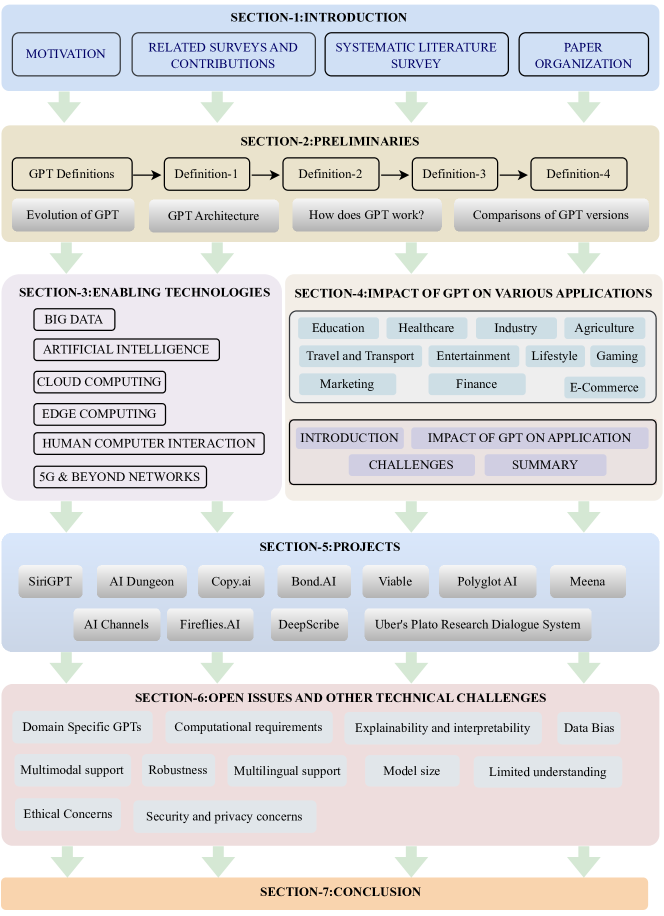
实验结果
研究问题
- RQ1从GPT-1到GPT-4,GPT模型的关键架构组件和演化里程碑是什么?
- RQ2支撑GPT模型的使能技术有哪些,它们如何影响性能与部署?
- RQ3GPT在各领域的主要应用、优势与局限性是什么?
- RQ4部署GPT时伴随的挑战、风险与伦理考量有哪些,提出了哪些未来方向?
主要发现
- GPT 模型基于使用自注意力的 Transformer 架构,在大规模文本语料上进行预训练,然后用于下游任务的微调。
- GPT-1、GPT-2、GPT-3、GPT-3.5 和 GPT-4 表现出容量的增加,GPT-4 提供多模态能力和扩展的上下文窗口(8192 和 32768 tokens)。
- GPT 模型利用大数据与深度学习,使语言建模、翻译、摘要、代码生成、问答等任务成为可能。
- 识别的使能技术包括大数据、AI、云计算、边缘计算、5G 网络和人机交互,各自提升数据获取、可扩展性和可用性。
- 论文强调机会、现实世界应用和著名的 GPT 项目,同时详述数据隐私、偏见、输出控制和高计算成本等挑战。
- 与以往调查相比,本工作提供了对 GPT 演变、架构、使能技术和未来研究方向的综合综述。
阅读本论文
在 Nubint 阅读器中打开原文,边读边就任意段落提问。
在 Nubint 中阅读本论文本解读由 AI 根据论文原文生成,引用前请核对原文。