
[论文解读] Generative Proxemics: A Prior for 3D Social Interaction from Images
本文提出 BUDDI,一种去噪扩散模型,通过 SMPL-X 身体参数学习两人近距离互动时的社会邻近关系(social proxemics)的 3D 生成先验。通过条件化于噪声 2D 到 3D 估计,BUDDI 无需接触标注即可从单张图像中优化生成合理的 3D 人体网格,在重建精度和真实感方面优于当前最先进方法。
Social interaction is a fundamental aspect of human behavior and communication. The way individuals position themselves in relation to others, also known as proxemics, conveys social cues and affects the dynamics of social interaction. Reconstructing such interaction from images presents challenges because of mutual occlusion and the limited availability of large training datasets. To address this, we present a novel approach that learns a prior over the 3D proxemics two people in close social interaction and demonstrate its use for single-view 3D reconstruction. We start by creating 3D training data of interacting people using image datasets with contact annotations. We then model the proxemics using a novel denoising diffusion model called BUDDI that learns the joint distribution over the poses of two people in close social interaction. Sampling from our generative proxemics model produces realistic 3D human interactions, which we validate through a perceptual study. We use BUDDI in reconstructing two people in close proximity from a single image without any contact annotation via an optimization approach that uses the diffusion model as a prior. Our approach recovers accurate and plausible 3D social interactions from noisy initial estimates, outperforming state-of-the-art methods. Our code, data, and model are availableat our project website at: muelea.github.io/buddi.
研究动机与目标
- 从图像数据中学习两人之间 3D 社会互动的数据驱动生成先验。
- 解决从单张图像重建合理 3D 人体姿态与形状的挑战,尤其是在相互遮挡且缺乏接触标注导致性能受限的情况下。
- 开发一种方法,利用扩散模型作为先验,对噪声初始 3D 网格估计进行优化,而无需真实接触监督。
- 通过感知研究验证生成样本的真实感,并展示该先验在下游 3D 重建任务中的有效性。
- 为从图像中合成社会上合理的多人互动提供基础,推动数字人体建模与社会行为理解的发展。
提出的方法
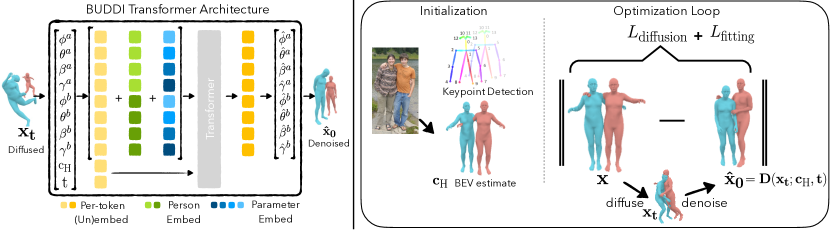
- 在包含接触标注的图像数据集与动作捕捉数据中重建的 3D 姿态基础上,训练一个去噪扩散模型(BUDDI),使用 SMPL-X 身体参数表示互动个体。
- 通过沿 token 维度拼接的方式,将多人群体网格回归器输出的估计 3D 身体参数作为条件输入,引导网格优化。
- 采用受 Score-Distillation 启发的损失函数,通过迭代优化将 3D 网格估计逐步修正为更符合社会互动逻辑的配置。
- 以 BUDDI 生成的样本作为初始条件,结合回归器输出的初始估计,优化 SMPL-X 姿态、形状与平移,使其匹配 2D 关节点检测结果。
- 将 BUDDI 的生成先验整合进整体目标函数,以在重建过程中强制实现社会合理性。
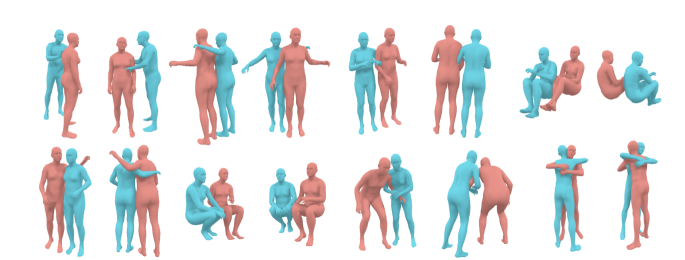
- 利用模型生成无条件真实 3D 社会互动样本的能力,用于感知有效性验证。
实验结果
研究问题
- RQ1扩散模型能否从图像数据中学习到真实、数据驱动的两人互动 3D 社会邻近关系先验?
- RQ2BUDDI 作为生成先验,在无接触标注条件下,对提升单图 3D 人体网格重建性能有多有效?
- RQ3BUDDI 生成的样本在感知真实感方面与真实互动的匹配程度如何?
- RQ4基于 BUDDI 先验的优化重建流程能否在精度与合理性方面超越当前最先进方法?
- RQ5与仅使用关节点的表示相比,使用 SMPL-X 参数是否能更好地捕捉 3D 互动中的人际接触与距离关系?
主要发现
- 在与真实样本的对比中,BUDDI 生成的 3D 人体互动在 44.4% 的比较中被感知为真实,接近人类无法区分真实与伪造样本的 50% 基准。
- 所提出的优化方法显著提升了基线多人群体网格回归器 [67] 在 FlickrCI3D、CHI3D 与 Hi4D 数据集上的性能,无论在定量还是定性指标上均表现更优。
- 该方法在单图 3D 人体网格重建任务中优于当前最先进方法,尤其在处理遮挡与确保社会合理性配置方面表现突出。
- 使用 SMPL-X 参数相比仅关节点表示,能更优地建模表面级交互与空间接近关系。
- 扩散模型通过基于得分的损失对噪声初始估计进行优化,显著提升了 3D 重建的准确度与稳定性。
- 该方法在多种社会互动类型(如站立、拥抱、运动)中均表现出良好泛化能力,证明其对多样化邻近模式的鲁棒性。
阅读本论文
在 Nubint 阅读器中打开原文,边读边就任意段落提问。
在 Nubint 中阅读本论文本解读由 AI 根据论文原文生成,引用前请核对原文。