
[论文解读] Generative Retrieval via Term Set Generation
本文提出 AutoTSG,一种新颖的自回归搜索框架,采用无序词项集合作为文档标识符,并支持集合导向生成,从而缓解严格序列生成的限制。通过允许任意词项集合排列均能检索到正确文档,AutoTSG 显著减少误剪枝现象,在 Natural Questions 和 MS MARCO 数据集上达到最先进性能,相较于现有自回归模型有显著提升。
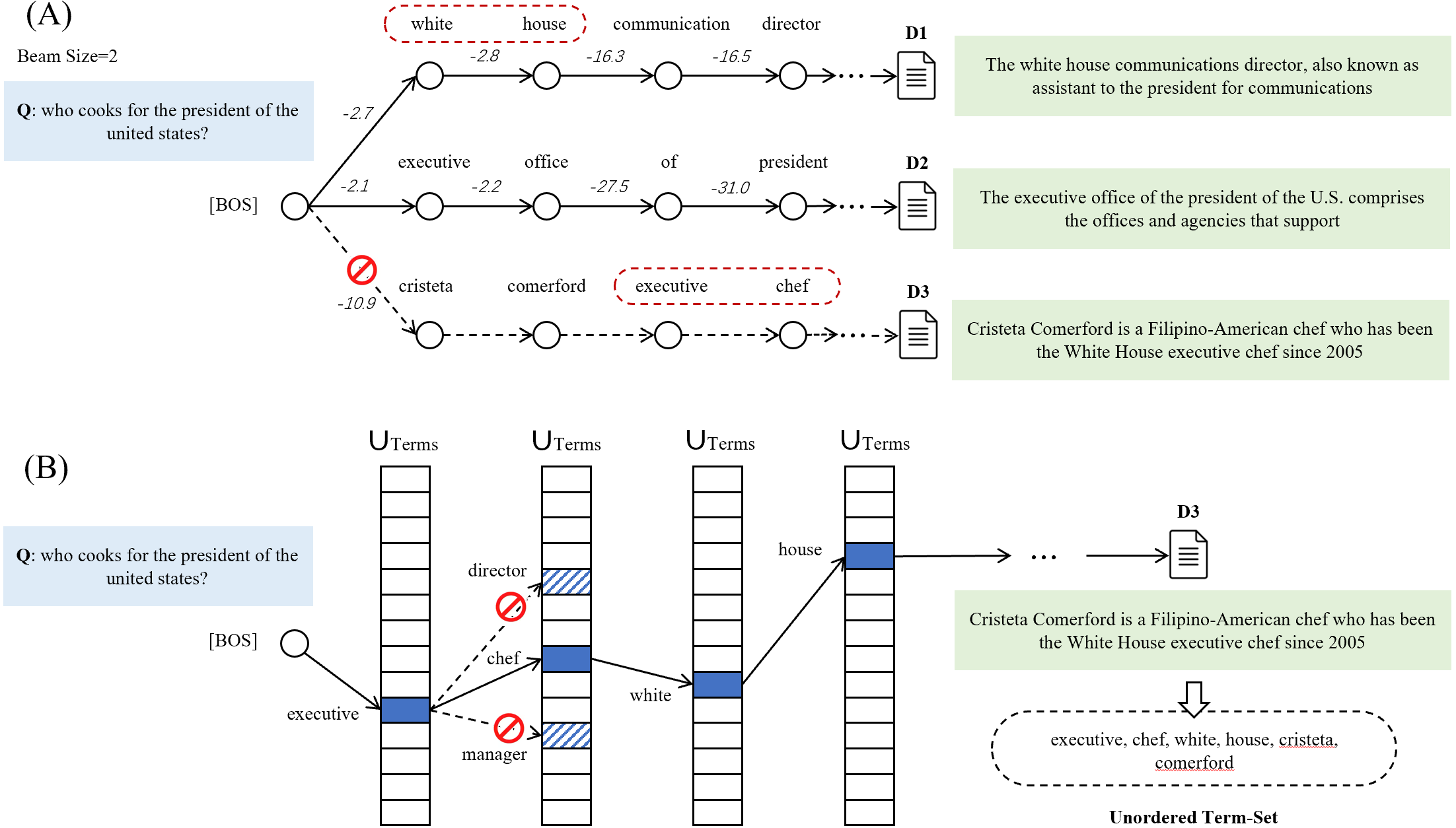
Recently, generative retrieval emerges as a promising alternative to traditional retrieval paradigms. It assigns each document a unique identifier, known as DocID, and employs a generative model to directly generate the relevant DocID for the input query. A common choice for DocID is one or several natural language sequences, e.g. the title or n-grams, so that the pre-trained knowledge of the generative model can be utilized. However, a sequence is generated token by token, where only the most likely candidates are kept and the rest are pruned at each decoding step, thus, retrieval fails if any token within the relevant DocID is falsely pruned. What's worse, during decoding, the model can only perceive preceding tokens in DocID while being blind to subsequent ones, hence is prone to make such errors. To address this problem, we present a novel framework for generative retrieval, dubbed Term-Set Generation (TSGen). Instead of sequences, we use a set of terms as DocID, which are automatically selected to concisely summarize the document's semantics and distinguish it from others. On top of the term-set DocID, we propose a permutation-invariant decoding algorithm, with which the term set can be generated in any permutation yet will always lead to the corresponding document. Remarkably, TSGen perceives all valid terms rather than only the preceding ones at each decoding step. Given the constant decoding space, it can make more reliable decisions due to the broader perspective. TSGen is also resilient to errors: the relevant DocID will not be pruned as long as the decoded term belongs to it. Lastly, we design an iterative optimization procedure to incentivize the model to generate the relevant term set in its favorable permutation. We conduct extensive experiments on popular benchmarks, which validate the effectiveness, the generalizability, the scalability, and the efficiency of TSGen.
研究动机与目标
- 解决自回归搜索引擎中因错误生成文档序列标识符而导致检索失败的误剪枝问题。
- 通过引入无序词项集合作为标识符,克服固定序列文档标识符的僵化性,使任意排列均可检索到正确文档。
- 通过允许 Seq2Seq 模型在生成过程中探索文档标识符的最优排列,提升检索质量。
- 设计一种学习框架,使生成过程适应有利排列,增强在多样化查询下的泛化能力。
- 证明基于词项集合的标识符与集合导向生成可实现更优的检索性能,且对推理效率影响极小。
提出的方法
- 使用面向匹配的词项选择策略,从文档标题和首段中提取无序词项集合,替代传统的序列文档标识符。
- 引入集合导向的生成流水线,将文档标识符视为集合,允许任意词项排列均能检索到正确文档。
- 在推理阶段采用约束性贪婪搜索,基于查询相关的似然分数生成词项集合的最优排列。
- 设计一种似然自适应的 Seq2Seq 学习目标,在训练过程中动态调整目标排列,使其与最可能的生成路径对齐。
- 采用基于重要性的词项排列初始化策略,按估计的相关性对词项进行排序,以提升训练稳定性和收敛性。
- 通过现成模型(如 DocT5)进行查询生成以实现数据增强,提升模型泛化能力,且不改变核心框架。
实验结果
研究问题
- RQ1无序词项集合能否作为自回归搜索引擎中稳健且具有区分度的文档标识符?
- RQ2允许文档标识符的灵活排列是否能减少误剪枝并提升检索准确率?
- RQ3似然自适应训练如何改善推理阶段最优词项集合排列的生成?
- RQ4初始化策略(随机、似然基、重要性基)对模型性能与收敛性有何影响?
- RQ5AutoTSG 在超越现有自回归搜索方法的同时,其效率保持程度如何?
主要发现
- AutoTSG 在 Natural Questions 和 MS MARCO 基准测试中达到最先进性能,在 NQ320k 上实现 0.766 的 recall@10 和 0.938 的 recall@100。
- 似然自适应训练方法通过在训练期间动态对齐生成目标与有利排列,显著提升检索质量。
- 基于重要性的词项集合初始化相比随机或似然基初始化表现更优,因其与查询-文档相关性对齐更佳。
- 通过 DocT5 进行查询生成可显著提升检索性能,但即使在无数据增强条件下,AutoTSG 仍保持其优势。
- 将骨干 T5 模型扩展至大尺寸可进一步提升性能,且 AutoTSG 在不同模型尺寸下均保持相对于基线的相对优势。
- 效率分析表明,AutoTSG 的开销极小,内存占用 35MB,延迟 0.06s(束宽 10),与其它方法相当,远低于内存密集型方法(如 SEAL)。
阅读本论文
在 Nubint 阅读器中打开原文,边读边就任意段落提问。
在 Nubint 中阅读本论文本解读由 AI 根据论文原文生成,引用前请核对原文。