
[论文解读] GEO-Bench: Toward Foundation Models for Earth Monitoring
GEO-Bench 提供用于地球监测的 6 个图像分类任务和 6 个语义分割任务的基准,以评估和比较基础模型,具备稳健的评估协议和对 20 个基线的结果。
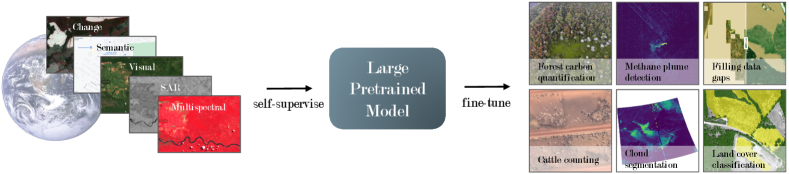
Recent progress in self-supervision has shown that pre-training large neural networks on vast amounts of unsupervised data can lead to substantial increases in generalization to downstream tasks. Such models, recently coined foundation models, have been transformational to the field of natural language processing. Variants have also been proposed for image data, but their applicability to remote sensing tasks is limited. To stimulate the development of foundation models for Earth monitoring, we propose a benchmark comprised of six classification and six segmentation tasks, which were carefully curated and adapted to be both relevant to the field and well-suited for model evaluation. We accompany this benchmark with a robust methodology for evaluating models and reporting aggregated results to enable a reliable assessment of progress. Finally, we report results for 20 baselines to gain information about the performance of existing models. We believe that this benchmark will be a driver of progress across a variety of Earth monitoring tasks.
研究动机与目标
- 通过提供多样化、易获得的基准来促进地球监测的基础模型发展。
- 提供标准化的评估协议并含不确定性估计,以实现可可靠的进展跟踪。
- 精心 curate 多模态地球观测任务,反映实际应用。
- 通过提供开源数据集、代码和基线结果,促进可重复的研究。
提出的方法
- 组装一个紧凑而多样的 12 任务套件(6 分类,6 分割),涵盖多模态和传感器。
- 将数据集转换并统一为共同加载架构,使用宽松许可。
- 对大型数据集进行子采样并平衡类别分布,以反映典型下游数据情景。
- 提供微调、超参数调优预算和评估期间的数据增强指南。
- 提出使用 IQM、自助抽样和归一化跨任务评分的稳健报告方法来比较模型。
- 开源工具和数据加载器以支持可重复的试验。
实验结果
研究问题
- RQ1GEO-Bench 中哪些架构和预训练策略最适合迁移到地球监测任务?
- RQ2训练集规模如何影响模型的判别力和在各任务上的整体性能?
- RQ3多光谱信息对分类与分割任务的影响?
- RQ4稳健的评估程序(IQM、自助抽样、归一化)如何帮助在模型间进行公平比较?
主要发现
- ConvNeXt 和 SwinV2 基线在仅 RGB 的分类任务上实现强整体性能。
- 预训练骨干网络相比从零开始训练提供明确优势,某些架构获得显著提升。
- 多光谱预训练结果不一:对某些骨干网络有适度提升,但在使用多光谱数据时对 ViT-S 可能降低性能。
- 模型数据效率各异:有些骨干网络仅需全量训练数据的几个百分比就能达到相近性能,而变换器模型往往需要更多数据才能出色。
- 子采样和数据集平衡提升判别力,防止因类别不平衡技术导致记分板膨胀。
- 基准报告既有逐任务结果,也有聚合 IQMs,且给出基于自助抽样的置信区间以量化不确定性。
阅读本论文
在 Nubint 阅读器中打开原文,边读边就任意段落提问。
在 Nubint 中阅读本论文本解读由 AI 根据论文原文生成,引用前请核对原文。