
[论文解读] GLIGEN: Open-Set Grounded Text-to-Image Generation
GLIGEN 提出一种方法,通过冻结原始模型权重并注入可训练的门控 Transformer 层来融合定位信号,使预训练的文本到图像扩散模型能够基于多样化的定位输入(如边界框、关键点、参考图像和空间图)生成图像。该方法在布局到图像生成基准测试中实现了最先进(SOTA)的零样本性能,有效泛化至开放词汇、新型空间配置及未见概念。
Large-scale text-to-image diffusion models have made amazing advances. However, the status quo is to use text input alone, which can impede controllability. In this work, we propose GLIGEN, Grounded-Language-to-Image Generation, a novel approach that builds upon and extends the functionality of existing pre-trained text-to-image diffusion models by enabling them to also be conditioned on grounding inputs. To preserve the vast concept knowledge of the pre-trained model, we freeze all of its weights and inject the grounding information into new trainable layers via a gated mechanism. Our model achieves open-world grounded text2img generation with caption and bounding box condition inputs, and the grounding ability generalizes well to novel spatial configurations and concepts. GLIGEN's zero-shot performance on COCO and LVIS outperforms that of existing supervised layout-to-image baselines by a large margin.
研究动机与目标
- 将预训练的文本到图像扩散模型扩展至支持除自然语言外的多样化定位输入,以增强可控性。
- 在保留原始模型庞大概念知识的同时,注入新的定位与视觉定位能力。
- 实现对训练期间未见过的新对象和空间配置的零样本泛化。
- 通过在推理过程中调度使用定位信息,提升图像生成质量和可控性。
- 统一检测与定位任务的训练数据格式,以增强模型泛化能力。
提出的方法
- 冻结预训练文本到图像扩散模型的所有权重,以防止知识遗忘。
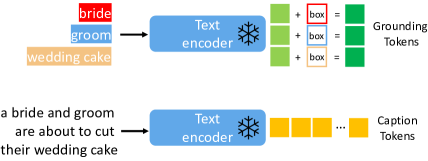
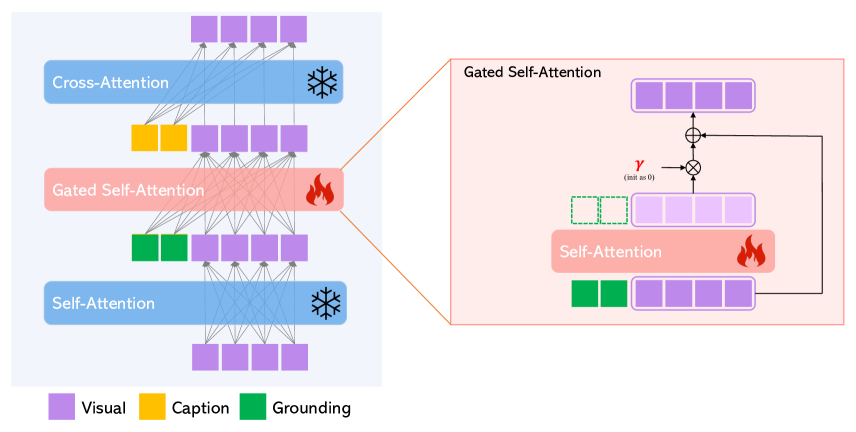
- 注入可训练的门控 Transformer 层,接收定位输入(如边界框、关键点、参考图像)并将其与文本嵌入融合。
- 使用调度融合机制,通过可学习的门控函数在训练过程中逐步整合定位信号。
- 使用共享文本编码器对每个定位实体的短语及其空间位置进行编码,实现跨概念的零样本泛化。
- 在结合目标检测与定位标注的统一数据集上训练模型,遵循 GLIP 框架以提升泛化能力。
- 通过调度采样实现灵活推理,其中定位层在去噪的早期步骤中使用,并逐渐停用,以平衡控制力与图像质量。
实验结果
研究问题
- RQ1预训练的文本到图像扩散模型能否在不发生灾难性遗忘的情况下,有效扩展以接受边界框、关键点和参考图像等多样化定位输入?
- RQ2该模型在开放词汇设置下,对训练期间未见的新对象和空间配置的泛化能力如何,尤其是对罕见或未见对象?
- RQ3训练数据规模与格式统一(检测 + 定位)对零样本泛化性能的影响如何?
- RQ4推理过程中调度采样是否能同时提升图像质量和定位保真度?
- RQ5该模型在多大程度上能利用参考图像中的视觉特征,以超越仅依赖文本条件的生成效果?
主要发现
- GLIGEN 在 COCO 和 LVIS 布局到图像生成基准测试中实现了最先进(SOTA)的零样本性能,显著优于现有监督基线方法。
- 由于共享文本空间和统一的训练数据,模型在开放词汇概念上表现出有效的泛化能力,包括罕见和未见对象。
- 扩大训练数据规模可一致提升零样本性能,尤其对罕见概念效果更显著。
- 调度采样可提升图像质量并改善泛化能力,使在人体关键点上训练的模型能够生成非人类对象(如机器人)。
- 该模型成功利用深度图、边缘图和语义图等多样化输入实现精确的空间控制,展现出强大的多功能性。
- 与原始的 Stable Diffusion 相比,GLIGEN 显著提升了定位保真度,减少了忽略特定对象或空间定位错误的倾向。
阅读本论文
在 Nubint 阅读器中打开原文,边读边就任意段落提问。
在 Nubint 中阅读本论文本解读由 AI 根据论文原文生成,引用前请核对原文。