
[论文解读] GLoRe: When, Where, and How to Improve LLM Reasoning via Global and Local Refinements
该论文提出GLoRe框架,通过使用合成数据将改进过程分解为何时、何地以及如何改进,从而提升大语言模型(LLM)的推理能力。该框架引入了分步结果奖励模型(SORMs),相比标准结果奖励模型(ORMs),能更有效地检测中间推理步骤中的错误,并结合全局与局部改进策略及基于ORM的重排序,使使用LLaMA-2 13B模型在GSM8K数据集上的准确率从53%提升至65%。
State-of-the-art language models can exhibit impressive reasoning refinement capabilities on math, science or coding tasks. However, recent work demonstrates that even the best models struggle to identify extit{when and where to refine} without access to external feedback. Outcome-based Reward Models ( extbf{ORMs}), trained to predict correctness of the final answer indicating when to refine, offer one convenient solution for deciding when to refine. Process Based Reward Models ( extbf{PRMs}), trained to predict correctness of intermediate steps, can then be used to indicate where to refine. But they are expensive to train, requiring extensive human annotations. In this paper, we propose Stepwise ORMs ( extbf{SORMs}) which are trained, only on synthetic data, to approximate the expected future reward of the optimal policy or $V^{\star}$. More specifically, SORMs are trained to predict the correctness of the final answer when sampling the current policy many times (rather than only once as in the case of ORMs). Our experiments show that SORMs can more accurately detect incorrect reasoning steps compared to ORMs, thus improving downstream accuracy when doing refinements. We then train extit{global} refinement models, which take only the question and a draft solution as input and predict a corrected solution, and extit{local} refinement models which also take as input a critique indicating the location of the first reasoning error. We generate training data for both models synthetically by reusing data used to train the SORM. We find combining global and local refinements, using the ORM as a reranker, significantly outperforms either one individually, as well as a best of three sample baseline. With this strategy we can improve the accuracy of a LLaMA-2 13B model (already fine-tuned with RL) on GSM8K from 53\% to 65\% when greedily sampled.
研究动机与目标
- 解决大语言模型在无外部反馈的情况下进行自我改进时在推理任务中表现脆弱的问题。
- 通过改进用于中间步骤的奖励模型,提升对推理错误的检测能力。
- 开发一种可扩展的、基于合成数据的方法,用于训练准确的中间步骤奖励模型。
- 利用基于奖励的重排序,结合全局与局部改进策略,以实现更优的性能。
- 证明合成数据可有效训练出在无人工标注监督下优于基线模型的模型。
提出的方法
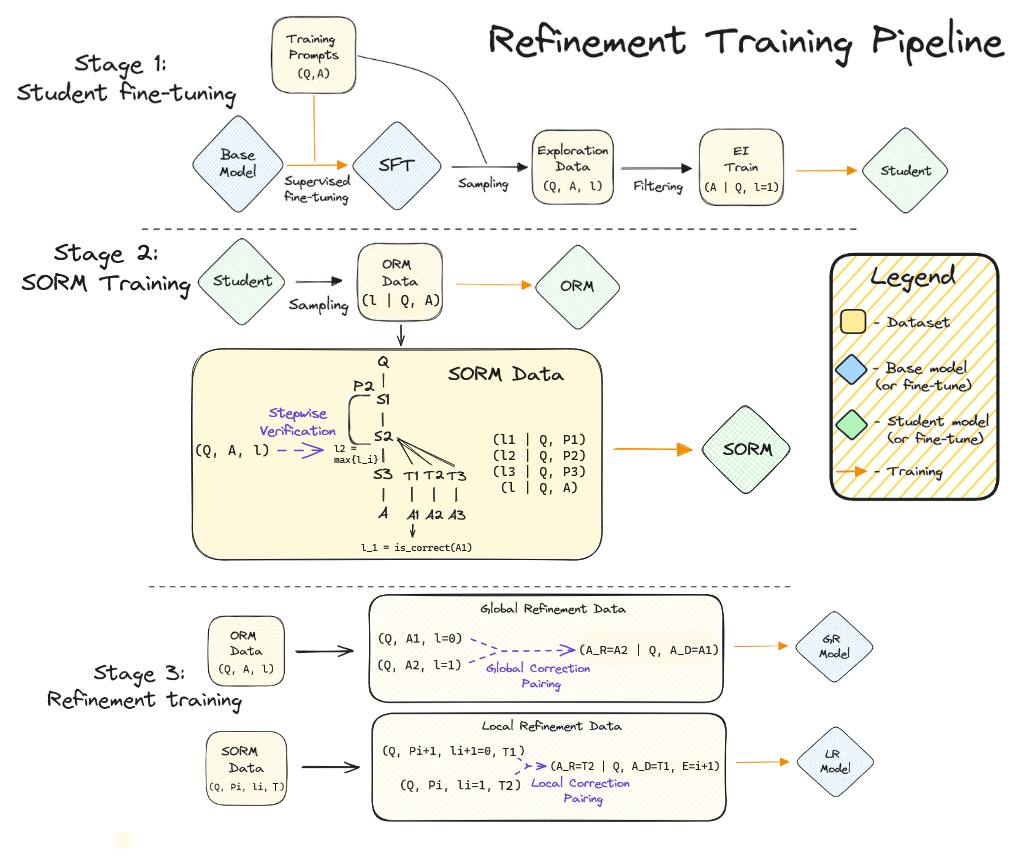
- 引入分步结果奖励模型(SORMs),通过从每个中间步骤多次采样策略来估计最终答案的正确性,利用合成数据进行训练。
- 使用拒绝采样和后处理方法近似最优策略π*,并生成SORMs的训练标签。
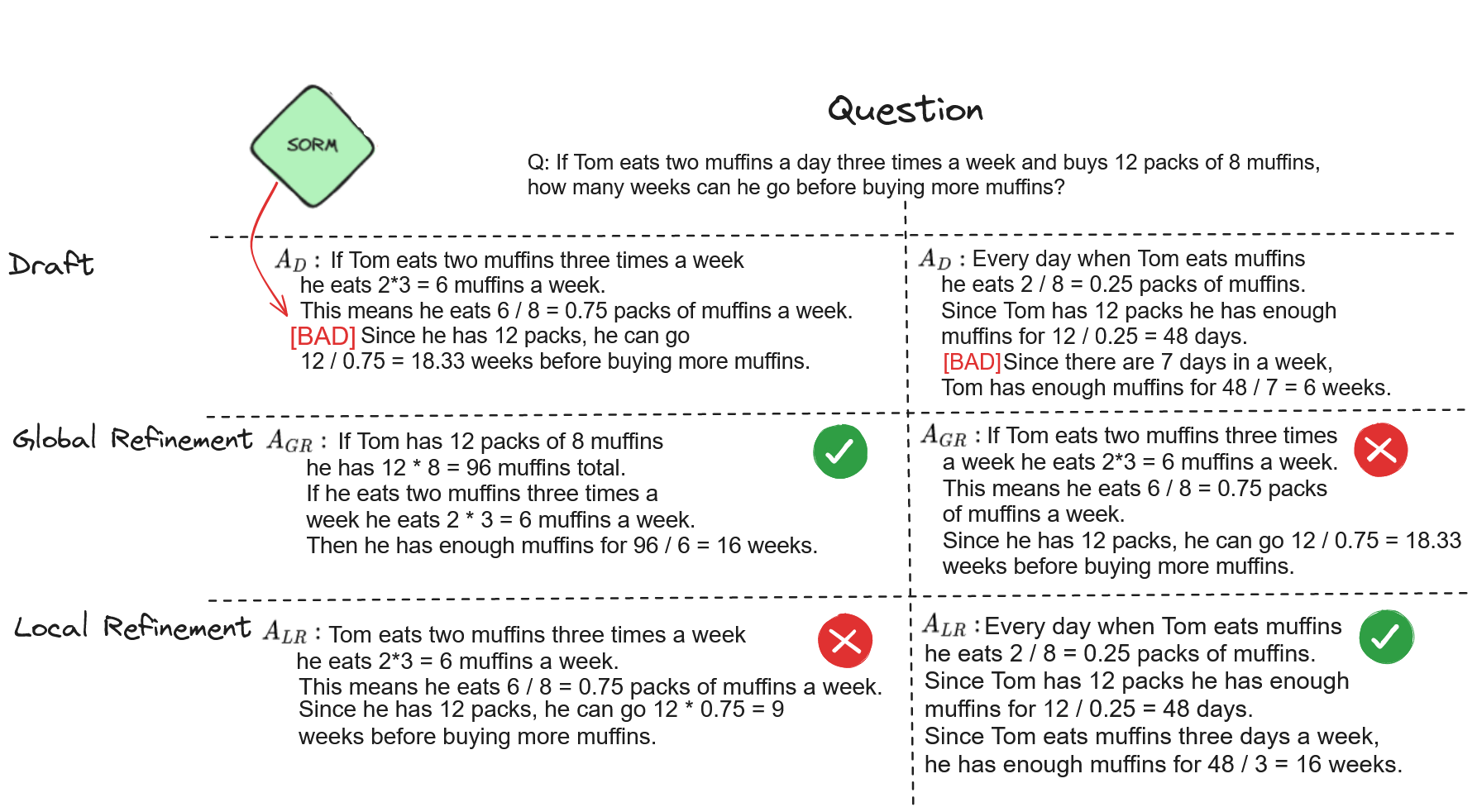
- 使用合成的错误与正确解法配对,训练全局改进模型,以修正整个推理过程。
- 训练局部改进模型,利用SORM反馈识别并修正首个错误的推理步骤。
- 结合全局与局部改进,并使用ORM作为重排序器,从草稿、全局改进和局部改进中选择最佳输出。
- 复用SORM与ORM的训练数据以支持所有组件,实现完全基于合成数据的训练,无需人工标注。
实验结果
研究问题
- RQ1基于结果的奖励模型(ORMs)能否可靠评估大语言模型中间推理步骤的正确性?
- RQ2在不依赖昂贵人工标注用于过程型奖励模型(PRMs)的情况下,如何改进对中间步骤的评估?
- RQ3能否使用合成数据训练出比标准ORMs更优地检测推理链中错误的奖励模型?
- RQ4结合全局与局部改进策略及基于奖励的重排序,是否能提升整体推理准确率?
- RQ5SORMs在策略远离最优时,是否能在更难的推理任务中表现出比ORMs更强的泛化能力?
主要发现
- SORMs在检测错误推理步骤方面优于ORMs,尤其在策略远离最优的困难任务中表现更优。
- 利用SORMs指导局部改进可提升中间步骤的准确率,相比ORMs显著降低假阴性率。
- 全局与局部改进模型解决的问题集基本不重叠,表明二者具有很强的互补性。
- 结合两种改进方式并使用基于ORM的重排序,使LLaMA-2 13B在GSM8K上的准确率从53%提升至65%,优于最佳三选一基线8-13%。
- 当全局与局部改进均由ORM重排序时达到最佳性能,可修复基线模型先前失败的多达41%的问题。
阅读本论文
在 Nubint 阅读器中打开原文,边读边就任意段落提问。
在 Nubint 中阅读本论文本解读由 AI 根据论文原文生成,引用前请核对原文。