
[论文解读] GMS-3DQA: Projection-based Grid Mini-patch Sampling for 3D Model Quality Assessment
本文提出 GMS-3DQA,一种无参考的 3D 质量评估方法,通过多投影网格小块采样策略,在保持高精度的同时降低计算成本。通过渲染六个相互垂直的投影图,从中采样小块,并将它们融合为单一的质量小块图(QMM),该方法实现了基于 Swin-Transformer 的高效特征提取,相较于先前方法,实现了更优的性能,推理速度提升 3.28 倍,参数量更少。
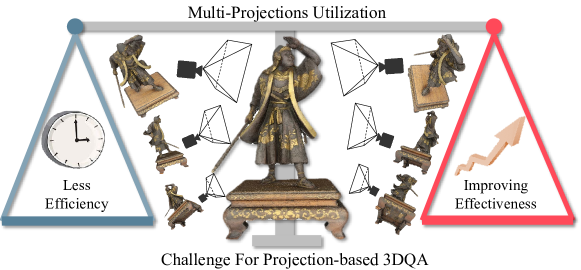
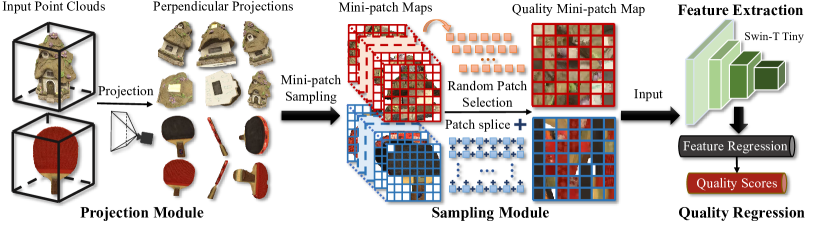
Nowadays, most 3D model quality assessment (3DQA) methods have been aimed at improving performance. However, little attention has been paid to the computational cost and inference time required for practical applications. Model-based 3DQA methods extract features directly from the 3D models, which are characterized by their high degree of complexity. As a result, many researchers are inclined towards utilizing projection-based 3DQA methods. Nevertheless, previous projection-based 3DQA methods directly extract features from multi-projections to ensure quality prediction accuracy, which calls for more resource consumption and inevitably leads to inefficiency. Thus in this paper, we address this challenge by proposing a no-reference (NR) projection-based extit{\underline{G}rid \underline{M}ini-patch \underline{S}ampling \underline{3D} Model \underline{Q}uality \underline{A}ssessment (GMS-3DQA)} method. The projection images are rendered from six perpendicular viewpoints of the 3D model to cover sufficient quality information. To reduce redundancy and inference resources, we propose a multi-projection grid mini-patch sampling strategy (MP-GMS), which samples grid mini-patches from the multi-projections and forms the sampled grid mini-patches into one quality mini-patch map (QMM). The Swin-Transformer tiny backbone is then used to extract quality-aware features from the QMMs. The experimental results show that the proposed GMS-3DQA outperforms existing state-of-the-art NR-3DQA methods on the point cloud quality assessment databases. The efficiency analysis reveals that the proposed GMS-3DQA requires far less computational resources and inference time than other 3DQA competitors. The code will be available at https://github.com/zzc-1998/GMS-3DQA.
研究动机与目标
- 解决现有基于投影的 3D 质量评估(3DQA)方法计算成本高、推理时间长的问题。
- 在保留足够质量信息以实现准确评估的前提下,减少多投影特征提取中的冗余。
- 开发一种高效、无参考的 3DQA 框架,使其在多种 3D 模型类型和失真类型下均保持高性能。
- 在目标领域标注数据极少的情况下,实现有效的跨域泛化。
提出的方法
- 从 3D 模型中渲染六个相互垂直的投影图,以确保几何与视觉质量信息的全面覆盖。
- 应用多投影网格小块采样策略(MP-GMS),从每个投影图中提取非重叠的小块。
- 将来自六个视图的所有采样小块融合为单一的质量小块图(QMM),以聚合多视角的质量模式。
- 使用 Swin-Transformer 的微型主干网络,从 QMM 中提取分层的、与质量相关的特征,用于最终的质量预测。
- 在大规模 3DQA 数据库上端到端训练模型,以学习与人类感知对齐的质量表征。
- 通过减少输入 token 数量和计算操作次数,优化模型效率,相较于处理完整投影图更具优势。
实验结果
研究问题
- RQ1基于投影的 3DQA 方法是否能在显著降低计算成本和推理时间的同时,实现高精度?
- RQ2所提出的网格小块采样策略在减少多投影输入中的冗余方面效果如何?
- RQ3与单独处理各投影图相比,质量小块图(QMM)在性能和鲁棒性方面提升程度如何?
- RQ4在目标领域标注数据有限的情况下,该方法在不同 3D 数据格式(如点云与网格)之间是否具备良好的泛化能力?
- RQ5与无参考及全参考 3DQA 基线方法相比,该方法在精度和效率方面表现如何?
主要发现
- GMS-3DQA 在点云与网格质量评估数据库上均达到最先进性能,在跨域评估中,SJTU 数据库的 SRCC 达到 0.75,WPC 数据库的 SRCC 达到 0.60。
- 该方法在 CPU 上的推理速度比最快的竞争方法快 3.28 倍,且参数量和 FLOPs 显著更少。
- 在 SJTU-PCQA 和 WPC 数据库上,GMS-3DQA 分别显著优于 14 种和 15 种无参考度量方法,统计检验结果显著。
- 在 TMQ 数据库上训练的 GMS-3DQA 在 SJTU 和 WPC 数据库上均达到具有竞争力的性能(SRCC:0.75 和 0.60),表明其具备强大的域泛化能力。
- 在 PCQA 数据库上,该方法与全参考方法在统计上无显著差异,证实其具备高度的感知准确性。
- 基于 QMM 的方法通过聚合多视角的质量模式,有效减少了冗余并提升了鲁棒性。
阅读本论文
在 Nubint 阅读器中打开原文,边读边就任意段落提问。
在 Nubint 中阅读本论文本解读由 AI 根据论文原文生成,引用前请核对原文。