
[论文解读] Graph Learning under Distribution Shifts: A Comprehensive Survey on Domain Adaptation, Out-of-distribution, and Continual Learning
本综述全面梳理了在分布偏移下图学习的分类体系与分析,根据分布可观测性与监督可用性,将方法划分为域自适应、分布外(OOD)学习与持续学习三类。综述整合了最先进技术,识别关键挑战,并为动态现实场景中鲁棒、可泛化的图神经网络指明未来研究方向。
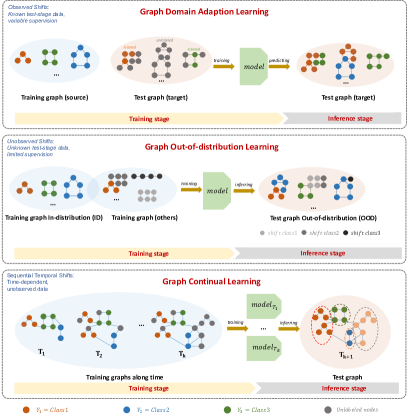
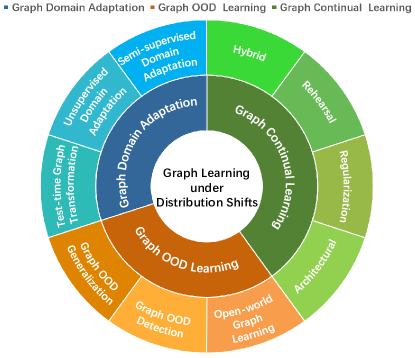
Graph learning plays a pivotal role and has gained significant attention in various application scenarios, from social network analysis to recommendation systems, for its effectiveness in modeling complex data relations represented by graph structural data. In reality, the real-world graph data typically show dynamics over time, with changing node attributes and edge structure, leading to the severe graph data distribution shift issue. This issue is compounded by the diverse and complex nature of distribution shifts, which can significantly impact the performance of graph learning methods in degraded generalization and adaptation capabilities, posing a substantial challenge to their effectiveness. In this survey, we provide a comprehensive review and summary of the latest approaches, strategies, and insights that address distribution shifts within the context of graph learning. Concretely, according to the observability of distributions in the inference stage and the availability of sufficient supervision information in the training stage, we categorize existing graph learning methods into several essential scenarios, including graph domain adaptation learning, graph out-of-distribution learning, and graph continual learning. For each scenario, a detailed taxonomy is proposed, with specific descriptions and discussions of existing progress made in distribution-shifted graph learning. Additionally, we discuss the potential applications and future directions for graph learning under distribution shifts with a systematic analysis of the current state in this field. The survey is positioned to provide general guidance for the development of effective graph learning algorithms in handling graph distribution shifts, and to stimulate future research and advancements in this area.
研究动机与目标
- 为应对真实世界图数据中分布偏移带来的关键挑战,此类偏移会降低模型在动态环境中的泛化与适应能力。
- 基于测试分布的可观测性与监督的可用性,系统性地对图学习方法进行分类,以更清晰地理解各类方法的差异。
- 对图域自适应、分布外学习与持续学习中的现有方法提供详尽的分类体系,突出关键技术进展与开放问题。
- 识别并分析在分布偏移下可信性方面的主要挑战,包括对抗鲁棒性、可解释性与公平性。
- 通过提出评估协议、跨模态融合与可扩展框架,为未来研究提供指导,以实现复杂、动态分布下的鲁棒图学习。
提出的方法
- 提出一种三类分类体系,用于分布偏移下的图学习:图域自适应(可观测分布偏移,监督可变)、分布外学习(不可观测分布偏移,监督有限)、持续学习(顺序分布偏移,增量数据)。
- 为每类方法引入详细分类体系,分析核心技术如域不变表示学习、分布差异最小化与不确定性感知消息传递。
- 强调使用灵活的消息传递机制,以适应跨域的结构与特征分布偏移。
- 突出在图构建中整合跨模态依赖关系(如来自图像或文本)的重要性,以支持在复杂、多源分布偏移下的学习。
- 提出评估协议,用于衡量模型在多样化图分布上的性能,包括在不同领域数据集上的近域与远域OOD泛化。
- 倡导统一指标以量化节点级与图级的分布差异,实现不同偏移程度下模型的公平比较。
实验结果
研究问题
- RQ1当测试时分布可观测但与训练数据不同时,如何有效适应图学习模型以处理未见的图数据分布?
- RQ2在测试分布未知且监督有限的情况下,哪些技术可实现对分布外图数据的鲁棒泛化?
- RQ3当图学习模型随时间暴露于顺序性、概念性变化的图分布时,如何保持性能与适应能力?
- RQ4需要何种评估协议,才能在多样化分布偏移场景(包括跨域OOD泛化)下公平比较模型?
- RQ5在图学习中,如何在复杂分布偏移下保持可信性维度(如对抗鲁棒性、可解释性、隐私与公平性)?
主要发现
- 图域自适应方法通过分布差异最小化与对抗对齐学习域不变表示,实现泛化性能的提升。
- 分布外泛化技术得益于不确定性估计与分布鲁棒优化,增强了模型在未见图结构上的可靠性。
- 整合经验回放与参数正则化的持续图学习方法,在保留先验知识的同时,能更好地适应新分布。
- 当前评估协议缺乏标准化,模型从引文网络迁移到社交网络时性能差距显著,凸显跨域基准的迫切需求。
- 在分布偏移下,对抗脆弱性与公平性偏差等可信性挑战被加剧,未来模型需采用鲁棒性感知与可解释性设计。
- 未来在分布偏移下的图学习必须整合跨模态图构建(如来自图像或文本)与自适应消息传递,以应对复杂、演化的数据分布。
阅读本论文
在 Nubint 阅读器中打开原文,边读边就任意段落提问。
在 Nubint 中阅读本论文本解读由 AI 根据论文原文生成,引用前请核对原文。