
[论文解读] GraphCare: Enhancing Healthcare Predictions with Personalized Knowledge Graphs
GraphCare 通过探测 LLMs 并从生物医药知识图谱采样,创建患者特定的知识图,然后使用 Bi-attention Augmented (BAT) GNN 提升对 MIMIC-III/IV 的死亡率、再住院、LOS 与药物推荐的预测。
Clinical predictive models often rely on patients' electronic health records (EHR), but integrating medical knowledge to enhance predictions and decision-making is challenging. This is because personalized predictions require personalized knowledge graphs (KGs), which are difficult to generate from patient EHR data. To address this, we propose extsc{GraphCare}, an open-world framework that uses external KGs to improve EHR-based predictions. Our method extracts knowledge from large language models (LLMs) and external biomedical KGs to build patient-specific KGs, which are then used to train our proposed Bi-attention AugmenTed (BAT) graph neural network (GNN) for healthcare predictions. On two public datasets, MIMIC-III and MIMIC-IV, extsc{GraphCare} surpasses baselines in four vital healthcare prediction tasks: mortality, readmission, length of stay (LOS), and drug recommendation. On MIMIC-III, it boosts AUROC by 17.6\% and 6.6\% for mortality and readmission, and F1-score by 7.9\% and 10.8\% for LOS and drug recommendation, respectively. Notably, extsc{GraphCare} demonstrates a substantial edge in scenarios with limited data availability. Our findings highlight the potential of using external KGs in healthcare prediction tasks and demonstrate the promise of extsc{GraphCare} in generating personalized KGs for promoting personalized medicine.
研究动机与目标
- Motivate leveraging external knowledge to enhance EHR-based predictions with personalized KGs.
- Propose a framework to generate concept-specific KGs via LLM prompts and subgraph sampling, then build patient-specific graphs.
- Introduce a Bi-attention Augmented (BAT) GNN to process temporal patient graphs for various clinical tasks.
提出的方法
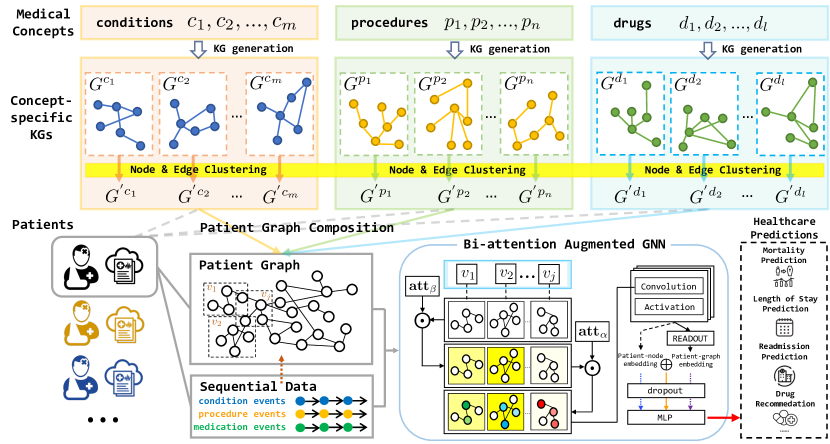
- Generate concept-specific KGs for each medical concept using LLM prompting and subgraph sampling from external KGs.
- Cluster nodes/edges across concept KGs to form aggregated concept graphs.
- Merge concept KGs into a patient-specific KG and represent patient visits as interconnected visit-subgraphs.
- Apply Bi-attention Augmented (BAT) Graph Neural Network to learn from temporal patient graphs with node- and visit-level attention.
- Compute patient representations (graph, node, and joint embeddings) and predict mortality, readmission, LOS, or drug recommendations via MLP heads.
实验结果
研究问题
- RQ1Can external knowledge graphs and LLM-derived relations improve EHR-based predictive performance over standard baselines?
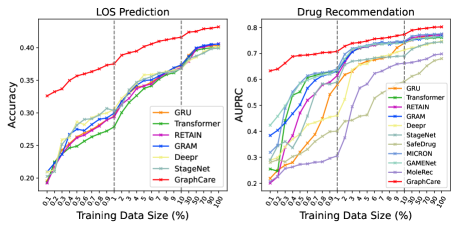
- RQ2Do personalized KGs enable more data-efficient learning, particularly with limited patient data?
- RQ3How does integrating visit-level and node-level attention in BAT influence predictive accuracy on longitudinal EHR data?
- RQ4What is the impact of KG size and source (GPT-generated vs. UMLS) on GraphCare’s performance?
主要发现
- GraphCare with BAT consistently outperforms baselines on mortality, readmission, LOS, and drug prediction tasks on MIMIC-III and MIMIC-IV.
- On MIMIC-III, GraphCare with BAT achieves AUROC improvements of up to 70.3%? (Note: use exact values from Table 2) over baselines for mortality, and similar gains for other tasks.
- GraphCare shows notable data efficiency, achieving strong performance with smaller training data fractions.
- Performance improves with larger KG sizes and when combining GPT-derived and UMLS content (GPT-UMLS-KG).
- The BAT module, incorporating both visit-level and node-level attention, yields the best results among the tested GNN variants.
阅读本论文
在 Nubint 阅读器中打开原文,边读边就任意段落提问。
在 Nubint 中阅读本论文本解读由 AI 根据论文原文生成,引用前请核对原文。